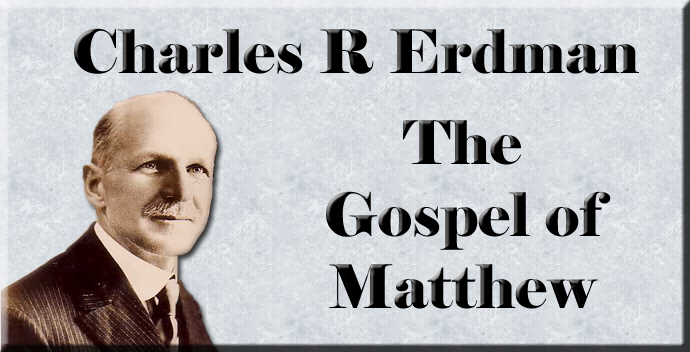
The Gospel of Matthew
By Charles R Erdman
Introduction
|
Only by the power of Christ could a publican be transformed into an apostle. Such a change was experienced by Matthew, also called Levi, to whom tradition has assigned the authorship of the first Gospel. Even modern critics, who favor the theory that another writer compiled the book from various sources, believe that the great discourses which form a main feature of the Gospel came from the pen of the taxgatherer of Capernaum. These taxgatherers, or publicans, as collectors of revenue, were everywhere dreaded or despised. Throughout the whole Roman Empire they were accused of being extortionate, dishonest, and cruel. In the province of Judea they were looked upon with loathing, as traitors and renegades who were serving a hated and heathen oppressor. Even .in Galilee, where one like Matthew may have been serving Herod Antipas and may have been collecting lawful customs from the caravans which moved along the great commercial highway, he would be regarded with suspicion and classed with social and religious outcasts. It is never quite fair, however, to condemn men by groups; at least we are certain that in this despised publican Jesus Christ saw great possibilities of future usefulness. He found him at “the receipt of custom” and called him into the inner circle of his chosen companions. Matthew probably had seen Jesus before and had heard his impressive teachings, but in any case he rose up instantly and left all and followed him. He had much to leave, for he seems to have been a man of wealth and popular among men of his own class, as might be concluded from the fact that he gave a great feast, to celebrate his decision to serve Christ, and to introduce his old friends to his new Master. Wealth in a collector of customs, and friendship with publicans do not indicate an irreproachable character; but Matthew seems to have had at least one virtue; he must have been, or have become, a modest man; for in reciting events of supreme importance in which he himself had played a part he makes no personal allusion. Whatever his character, his duties as a government official had disciplined him in system and accuracy and had developed a capacity for orderly thought and for methodical writing which fitted him for his immortal task as a biographer of Jesus Christ. Strictly speaking, Matthew did not attempt to produce a life of his Master. No one of the Gospel writers had this in view. If so, they would not have passed with intentional silence the events of long years; they would not have omitted thrilling incidents which were known to all, but were recorded only by one or the other of the four evangelists; they would not so have centered the interest upon a few days at the close of the earthly ministry of our Lord. The purpose of this writer, like that of the other three, was to tell the “good news” of salvation wrought out by the life and death and resurrection of Christ. There is in reality only one Gospel; it is found in four forms or versions, but the essential message is the same; the points in which all agree are of vastly more significance than those in which they differ. These differences, however, are of interest and importance and combine to form a more complete story. They are due to the varying experiences of each author and to some more or less definite but subordinate design in relating the “glad tidings” which are common to all. Thus it has been said that Matthew wrote for Jews; Mark for Romans; Luke for Greeks; and John for the Church. It might be more accurate to say that all four were intended primarily for Christian believers. Undoubtedly the Gospel of Matthew has a prevailing character which is properly termed Jewish. If, however, Matthew wrote to convince unbelieving Jews of the truth of Christianity, it is strange he should have so emphasized the offense Jesus gave to the Jews by his disregard of their traditions, his denunciation of their rulers, his declaration of the rejection of Israel and of the salvation of Gentiles. Contrast for example the opening chapters of Matthew and those of Luke. In the former the Jews are disturbed by the coming of their king; their ruler seeks the life of the infant Jesus; Gentile Wise Men offer him princely gifts; and his parents are compelled to flee with him for safety into the land of Egypt. The latter story opens in the Temple at Jerusalem, where a godly priest is listening to the message of an angel. In the pious homes of Elisabeth and Mary, Hebrew saints are chanting their inspired canticles of praise to Jehovah and of gratitude for his goodness toward Israel, his chosen and beloved people. Such an approach to the Gospel story would be much more fitting for one who was seeking to conciliate and convince the Jews. Of course, Matthew was written by a Jew, and he must have had in mind his believing fellow countrymen; but the distinguishing marks of this Gospel may be explained from the fact that the aim of the writer was so to rehearse the story of salvation as to demonstrate the fact that Jesus of Nazareth was the Christ, the predicted Messiah, the King of the Jews, who had been rejected by his own nation, who was being accepted by Gentiles, and who some day was to return in power and great glory. As a result of this aim Matthew does possess traits which distinguish it from the other Gospels. In each the portrait of our Saviour is identical, yet by each certain features are so emphasized that the picture is distinct. Thus Matthew is characteristically the Gospel of the King. The figure of Jesus is painted in colors of royalty. His ancestry is traced from a royal line; his birth is dreaded by a rival king, and Wise Men offer their royal gifts; his herald declares that his Kingdom is at hand. His temptation reaches its climax as he is offered the kingdom of the world; his great message to his followers, “the Sermon on the: Mount,” is like the manifesto of a king, setting forth the fundamental laws of his Kingdom. His miracles are his royal credentials; his parables are termed “mysteries of the Kingdom.” Even outside his own land he is hailed as the “Son of David”; he claims freedom from paying tribute to “the kings of the earth,” for he is the child of a King; he makes his royal entry into Jerusalem and claims sovereign power, and tells concerning himself the story of the marriage of the king's son; while facing the cross he predicts his return in glory and his universal reign. He claims power to command legions of angels. In the hour of his death the rocks are rent, the earth is shaken, the dead are raised; his resurrection is a scene of majestic power, emphasized by an earthquake, by the appearance of an angel, and by the terror of the guards; his last words are a kingly claim and a royal command, “All authority hath been given unto me; . . . Go ye therefore.” The characteristic and significant phrase of the Gospel is in the legend “the kingdom of heaven.” Here is a portrait in which even the minor touches are resplendent with purple and gold. This King, however, is the “King of the Jews.” Matthew is the Gospel of the Messiah. The appearance of this princely figure has been predicted by the Hebrew prophets. In fact, every important event in his career has been explicitly foretold; his birth of a virgin in the town of Bethlehem; his residence in Egypt, in Nazareth, and in Capernaum; his healing of the sick; his speaking in parables; his royal entry into Jerusalem; his desertion by his followers; his “triumphant spirit in death. Allusions are made to sixty-five Old Testament passages, forty-three are verbally quoted, a number equal to that of all the other Gospels combined. Thus Matthew is the Gospel of fulfillment. It faces the Old Testament; it properly begins the New. The scenes are colored by Jewish customs; Jewish symbols and types abound. The Law, the Prophets, and the Psalms, all are shown to have pointed forward to Jesus of Nazareth. In him are found their significance, their meaning, and their goal; he is the expected Son of David, the son of Abraham; he is the predicted Messiah; he is the Christ of God. With all propriety Matthew is placed as the first Gospel, showing how the ancient Scriptures are linked with the good news of salvation in Jesus Christ. Matthew is further the Gospel of rejection. Of course the fact is essential to all the Gospels; but here it is presented continually. It colors all the teaching, it forms the background of every scene; its shadow is never lifted. Before Jesus is born, his mother is in danger of being repudiated” by Joseph; at his birth Jerusalem is troubled and Herod seeks to take his life; on the plains of Bethlehem no angel choir sings, but mothers are weeping in anguish over their slaughtered babes; Jesus is hurried away to Egypt and hidden for thirty years in Nazareth; his forerunner is imprisoned, and beheaded in a dungeon. As Jesus points men to “the narrow way” he declares that few will find it. To the many he is to say as he sits in judgment “I never knew you: depart from me”; men marvel at his miracles and offer to follow him, but he declares that the “Son of man hath not where to lay his head”; he warns his messengers that they, too, are to be rejected. His parables indicate that his Kingdom will not be realized.on earth until the present age ends; as soon as his disciples understand that he is the Messiah, he begins to express and iterate the truth of his cruel sufferings and death; he relates to the people his “parables of rejection”; he pronounces his most solemn woes on the rulers of the people; he predicts the destruction of the city and the anguish of the nation; in the hour of his death is heard that desolate cry, “My God, my God, why hast thou forsaken me?” No penitent thief is praying, no word of human sympathy is spoken; those who pass by revile, the chief priests and elders mock him; even after his death they set a seal and a watch; even after his resurrection they hire soldiers to hide his glory with their lie. In no Gospel is the attack of his enemies so bitter; in no other is the King more definitely offered to the nation, and in none is his rejection so cruel and so complete. However, Matthew is likewise the Gospel of the returning King. No other evangelist lays such stress on the Second Coming of Christ. As he relates the great discourse concerning the return of our Lord which Mark and Luke likewise record, Matthew alone adds the memorable parable of the Wise and Foolish Virgins, and of the Talents, and then draws the picture of the triumphant King seated on his throne of judgment while all nations are gathered before him and he determines who are to be received and who are to be excluded from his Kingdom. He agrees with Mark in recording for us the words spoken by our Master to the high priest as he stands under the very shadow of the cross. “Henceforth ye shall see the Son of man sitting at the right hand of power, and coming on the clouds of heaven”; but he alone records the closing claim of “all power in heaven and on earth.” This is the Gospel of triumph. The good news of the coming glory and the universal sway of Christ the King. In ordering his literary material the method of Matthew is unique. As he tells the story of redemption he does not consistently follow the order of time, but he groups similar events or teachings which may be logically related, and so heightens the effects. Thus we find collected in a single chapter seven of the fourteen parables which Matthew records, and in the same way in one group ten of the twenty miracles. So too the unique feature of the Gospel consists in five great summaries of the teachings of Christ; the Sermon on the Mount, the Instruction to the Disciples, the Parables of the Kingdom, the Woes Against the Pharisees, and the Discourses Relative to the Return of the King. Luke, by way of contrast, follows the order of time. He has been compared to a botanist who likes to follow a stream and to examine each flower in its native home; but Matthew prefers to gather the blossoms and to arrange them according to kind or color in great clusters of beauty. It is this method of Matthew which suggests one helpful way of analyzing his Gospel. Of course many will prefer to use the outline commonly applied to the writings of each of the first three evangelists, namely, the division of the Gospel according to the time or place of the ministry of Christ. For example: Introduction to the Gospel. Chs. 1: 1 to4: 11; The Ministry in Galilee. Chs. 4: 12 to 18: 35; The Journey Through Perea. Chs. 19, 20: The Last Week in Jerusalem. Chs. 21 to 28. Such a division is clear and satisfactory; but the outline here-suggested is designed to fix the thought upon the great central Figure of the Gospel as he is presented in the character of a King, and to designate consecutively each group of teachings and incidents which Matthew combines under a single topic. Thus after the section dealing with the Birth, the Infancy, and the Preparation of the King, chs. 1:1 to 4:11, there follow the Proclamation of the King, or the “Sermon on the Mount,” chs. 4:12 to 7: 29; the Credentials of the King, or the First Ten Miracles of our Lord, chs. 8:1 to 9:34; the Messengers of the King, or the Instructions to his Disciples, chs. 9: 35 to 10: 42; the Claims of the King, chs. 11, 12; the Parables of the King, ch. 13; the Withdrawal of the King, chs. 14:1 to 16:12; the Person and Work of the King, chs. 16:13 to 17:27; the Servants of the King, or Directions for his Followers, chs. 18 to 20; the Rejection of the King, chs. 21 to 23; the Prophecies of the King's Return, chs. 24, 25; and the Death and Resurrection of the King, chs. 26 to 28. Such an outline may have the merit of emphasizing the apparent method of Matthew and of enabling the reader to see with increasing clearness the kingly majesty of Christ.
|
|
 |
 |
|
|
|
-
Site Navigation
 Home
Home What's New
 Bible
Bible Photos
 Hiking
 E-Books
 Genealogy
 Profile
Free Plug-ins You May Need
Profile
Free Plug-ins You May Need
 Get Java
.png) Get Flash
Get Flash Get 7-Zip
 Get Acrobat Reader
 Get TheWORD