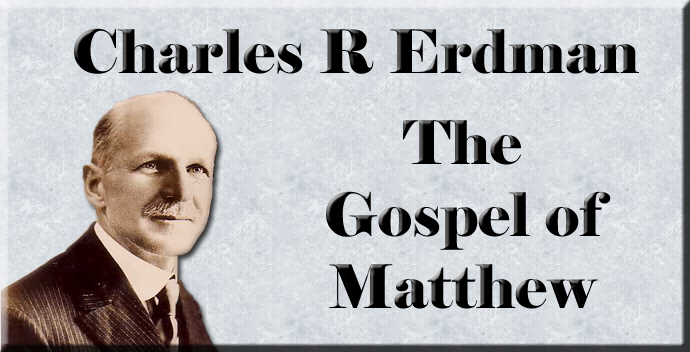
The Gospel of Matthew
By Charles R Erdman
Chapter 1
|
I. THE ANTECEDENTS OF THE KING. Matt. 1:1 to 4:11 1. THE GENEALOGY. Ch. 1:1-17
The opening chapters of Matthew may be regarded as an introduction to the Gospel. They concern the ancestry, birth, and infancy of Jesus, and the preparation for his public ministry. Each of these facts and events is so related as to reveal the distinct purpose of the writer and the distinguishing features of his narrative. Thus (1) Matthew is the “Gospel of the King,” and this “Book of the Genealogy of Jesus Christ,” this birth roll, which begins the story, is emphatically the genealogy of a King. It is designed to show that Jesus was the lawful heir to the throne of David. It differs essentially from the genealogy recorded by Luke. , The two lists of names diverge after the mention of David. Some have conjectured that Luke gives the natural as distinct from the royal line. Others have supposed that he gives the lineage of Mary. As to the true explanation of this divergence no agreement has been reached, but the important point is obvious. Luke, who paints the portrait of the ideal Man, traces the genealogy of Jesus to Adam, the father of the race; but Matthew, who draws for us the picture of the King, records the royal ancestry of Jesus. He traces the line from Abraham, but first mentions David in whom the family attained the royalty which was lost at the Captivity and regained in Christ. The genealogy omits several names in the royal line, but this does not destroy its value. It indicates, however, that the word “begat” does not mean, literally, “was the father of” but “was the legal ancestor,” so that Joseph is shown to be the heir of David and because of his marriage to Mary, her Son becomes in all reality the “Son of David” the King. (2) Matthew, however, is the “Gospel of the Messiah.” The King he described is emphatically the King of the Jews. In him the inspired prophecies are fulfilled. What more fitting opening could be suggested than this genealogy which points. backward over the whole history of the Hebrew people? It is no barren and lifeless list of names; it awakens the most sacred memories; it embodies the most glorious hopes; it forms the best conceivable link between the Old Testament and the New; it is not wanting in spiritual significance. This genealogy is divided into three sections representing fourteen generations each. The division is characteristically Jewish, as it combines the divine number “three” with twice the sacred number “seven.” These sections cover the three great periods of Jewish history before the time of Christ. The first is the period of the Patriarchs and Judges. Beginning with Abraham there appears the succession of heroes who made the name of Israel famous; mention is made of Ruth, whose romance forms the most charming idyl of the East, and of Jesse, and of David his royal son. The second period is that of the monarchy which attained its splendor in the days of David and Solomon. It is, however, a period of decline and failure. Something of revival and glory is suggested by the names of Jehoshaphat, Hezekiah, and Josiah; but the mention of Rehoboam, Ahaz, and Manasseh intimate the degeneration and apostasy which resulted in the tragedy of the Captivity. With few exceptions the persons named as belonging to the third period, covering the six hundred years between the monarchy and Christ, are shrouded in dateless and unbroken darkness. Thus the story outlined by the genealogy of Jesus is one of mingled pathos and glory, of heroism and disgrace; but its three chapters with their fascinating and diverse characters remind us that through the troubled centuries, through the changing scenes, by patriarchs, kings, and priests, by men illustrious and obscure, God was preserving a line and accomplishing a purpose, until at last appeared One who, as the “son of David,” was destined to be the source and center of universal rule, and. as the “son of Abraham,” the source and center of universal blessing. (3) Matthew is also the “Gospel of Rejection.” It is in harmony with this picture that the genealogy of Jesus contains names which /the Jews might gladly have repudiated for their suggestions of disgrace and other names which recall apostasy from God, the breaking of his covenants, and the refusal of his offers of mercy. Most of all is it noticeable that Matthew includes four names which occasion surprise. “They are the names of women and therefore unusual in such a Jewish genealogy, and they are the names of women, three of whom were guilty of gross sin and two were members of hated and heathen races. It may be that they were intended to suggest that the King whom the Jews rejected was a Saviour who identified himself with sinful humanity, who offered pardon and high privilege to all penitent offenders, and who promised to Jew and Gentile alike the blessings of his transforming power; it even may be an intimation that, as the royal line had been preserved in extraordinary and irregular ways, so the last step would be the most marvelous of all, even the miraculous birth of Jesus, the Son of the Virgin Mary, the reputed Son of Joseph. (4) It may be suggested further that, as this Gospel so emphasizes the final triumph of the King, it is not unnatural that the royal line from which he came had for a time lost its glory and had been hidden in obscurity. Thus the Monarch who was despised and rejected and was nailed to a cross by his enemies, will ultimately appear as the true Son of David, and will restore the vanished glory as the rightful Heir of Solomon, as the Prince of Peace, as the universal King. 2. THE BIRTH OF JESUS. Ch. 1:18-25
The genealogy of Jesus declared him to be the Son of David. The story of his birth reveals him as the Son of God. It includes an explanation of the name which was given and of the prophecy which was fulfilled. The story is brief, but it bears the features characteristic of Matthew, the “Gospel of the King,” of the predicted and rejected Messiah; for it shows that the mother of Jesus is about to be repudiated and that Joseph who was to be his legal father is addressed as the “son of David,” that Jesus is to save “his people” and that an Old Testament prediction is divinely fulfilled in his birth. This account of the supernatural birth of our Lord is given with inspired delicacy and reserve, yet with such definiteness and clearness as to leave no doubt as to the fact recorded. The statement of the perplexity of Joseph, the reference to Jewish law and custom, the divine guidance granted in the dream, the simple declaration of the miraculous event are all so natural and circumstantial as to indicate that the writer was composing not a poetic idyl but sober history. It is not necessary to believe that the deity or sinlessness of Christ were conditioned upon the miracle of his birth; it is conceivable that they might have been secured by some other method of incarnation; but surely, in the light of this miracle, they are more easily understood, and it is further true that doubt as to this miracle is usually accompanied by a denial of the divine person of our Lord or of the authority of Scripture. Nor should this miracle be regarded as difficult to believe. Christ is himself the embodiment of miracle. In him the human and divine are inseparably united. If he has existed eternally as God, if his earthly ministry was attended by superhuman works, if he left the world by a supernatural resurrection and ascension, it is not incredible that his coming to earth was attended by miracle and mystery. The real importance of the event lies, however, not in the method, but in the result of the supernatural birth. This is emphasized by the announcement of the name of Jesus and by the interpretation of an inspired prophecy. “Jesus” is the Greek form of the Hebrew word “Joshua” (“Jehovah is salvation”) and in the dream it is announced by the angel in the form of this memorable promise “Thou shalt call his name Jesus; for it is he that shall save his people from their sins.” Other men had borne that same name; notably, the great deliverer Joshua, who had gained the victory over the peoples of Canaan, and also the high priest who had aided in the restoration of Jerusalem; but now One was to appear who was to realize in its fullness all that the name implied; he was to save his people from all the guilt and power of sin. This birth and this inspiring name were interpreted by Matthew as the fulfillment of an ancient prophecy. In the days of Ahaz, Isaiah had predicted that God was to grant deliverance to Judah from the kings of Israel and Syria, and that as a symbol of this divine intervention a virgin should bring forth a son who should be called “Immanuel,” which means “God with us.” The ancient prophet may not have had in mind either a miracle or an event of the distant future, but the writer of the Gospel saw that the true meaning of his prediction was realized in the birth of Jesus, for he was no mere pledge of divine deliverance but himself a divine Saviour, not only was his name a token of the presence of God, but he himself was manifest deity. The real significance of the birth of Jesus, as here related, lies therefore in the fact that the Son of Mary is also the incarnate God who is able to save those who put their trust in him, for he is all that his blessed name implies, our divine Saviour, “Jesus.” 3. THE VISIT OF THE WISE MEN. Ch. 2:1-12
Fancy has been allowed to play so freely with the story of the “Wise-men from the east,” that in most minds it is difficult to dissociate the elements of fable from those of fact It is commonly imagined that these Wise Men were kings, that they were three in number, that they were named Caspar, Melchior, and Balthasar, that one came from Greece, one from India, and the third from Egypt. All these statements belong to the realm of fiction, as do the descriptions of their journey and of their retinue, and the stories of their later life, and of their baptism by Thomas. It is even said that their bones were discovered in the fourth century by Saint Helena, were brought to Constantinople and deposited in the Church of Saint Sophia, subsequently transferred to Milan, and finally brought by Frederick Barbarossa to Cologne, where the three skulls are guarded to-day in a golden shrine in the great cathedral. In reality nothing is known of these Wise Men in addition to the few brief statements here recorded by Matthew. Out of the mystery of their past they step upon the stage for only one short scene and then they disappear forever. However, the part they play is not unimportant and the lessons they bring are full of meaning. Their designation as “Wise-men” is a translation of the Greek word “Magi,” a name by which they are familiarly known, and from which have come such terms as “magic” and “magician.” They were probably members of an Oriental princely caste, who were familiar with astronomy or astrology, and who had been taught by Jews of the Dispersion to expect the coming of a Saviour, a universal King. Some sign in the heaven convinced them that such a Prince had appeared and they journeyed to Jerusalem, the capital city of the Jews, to render to the King who had been born the homage which was his due. The important point is that these men were heathen and that they re-represent the first fruits of the Gentile nations. They symbolize the truth that in the great world to-day there are countless hungry hearts yearning for a divine Saviour and ready to follow even faint and imperfect signs which may lead to his feet. The background of the story is peculiarly dark. “When Herod the king heard it, he was troubled, and all Jerusalem with him.” “The cruel and suspicious tyrant feared that his power might be endangered by one who was reputed to be born “King of the Jews”; and the people themselves, who should have rejoiced in the announcement that their Deliverer had come, were distressed rather than gladdened by the arrival and the strange story of the Wise Men. Herod seems to have been the only one who was stirred to action or sufficiently concerned to aid the travelers in their quest. He summoned the Jewish leaders to learn from them where their promised Messiah was to be born. They knew exactly; they were familiar with the prophecy which pointed to Bethlehem, but they showed not the slightest interest in the possibility that their Messiah had appeared. It was Herod who closely questioned the Wise Men and sent them to report concerning “the young child,” promising, hoary hypocrite that he was, to “come and worship him.” Thus it is now; many who are most familiar with the facts concerning Christ are least interested to accept him as their Lord, while some, like Herod, are hostile to him, fearing that to admit his claims may result in some personal loss. Here, too, is a lesson in divine guidance. God gave the Wise Men a sign in the east; he led them to Jerusalem; he spoke to them from the Scripture; he directed them to Bethlehem, and finally showed them how to return to their homes in safety. Where hearts are eager to find the King, there are always provided signs which lead at last into his presence chamber. The method of guidance may be mysterious, the fact is certain. In the case of the Wise Men it is impossible to affirm what is meant by “the star, which they saw in the east.” Was it a planet or a conjunction of planets, or one of those variable stars which sometimes flash forth with unwonted brilliance? An actual star might have guided them westward and southward, but how could a star move before them on that last brief journey and stand over a definite house in the little town of Bethlehem? It seems probable that the guidance was supernatural. Something like a star in appearance, but near the earth, may have been granted to lead those travelers to their sacred goal. It has been conjectured that it was the “cloud of glory” which had led the people through the wilderness, the chariot of Jehovah, the pavilion of the King. Here speculation is futile, the reality is plain; where men really are eager to learn the truth concerning Christ, providences are granted which give them occasion to rejoice “with exceeding great joy.” The third familiar lesson concerns the service of Christ. It is embodied in the picture of the Wise Men as “They fell down and worshipped him; and opening their treasures they offered unto him gifts, gold and frankincense and myrrh,” When one sees the King in his beauty, when one recognizes in Christ the divine Saviour, there is always awakened the desire to render to him priceless offerings. It is not necessary to regard the gifts of the Magi as symbols; but they were surely princely and precious. They rightly indicate that the acceptance of Christ involves the devotion to him of praise, and of love, and of treasure, , and of toil, and of life. When this story is compared with the early chapters of Luke it appears that the visit of the Wise Men must have occurred at least forty days after the birth of Jesus. There is no difficulty in harmonizing the accounts; but the contrasts emphasize the features which ever characterize the Gospel of Matthew. Here no humble shepherds are sent to find a “babe lying in a manger,” but distinguished sages from foreign lands offer their princely gifts, while Herod the Great trembles on his throne. This is the “Gospel of the King.” It is also the “Gospel of the Messiah”; and here Jesus is declared to be the King of the Jews who was definitely predicted as the shepherd of Israel to be born “in Bethlehem of Judea.” This is the Gospel of “rejection,” and here the rulers of Israel appear from the first as indifferent to his coming, and “all Jerusalem” is “troubled” by his birth. It is also the Gospel of the coming and the triumph of Christ; and here appear the representatives of the Gentile nations offering homage to him before whom all knees will bow, whom some day all will acknowledge as universal King. 4. THE FLIGHT INTO EGYPT. Ch. 2:13-23
In addition to the story of the Wise Men, Matthew records only two other incidents in the infancy of Jesus, the flight into Egypt occasioned by the cruel jealousy of Herod, and the return to Palestine made possible by the death of the murderous king. The hatred of Herod was stirred to a rage by the failure of the Wise Men to report to him of the Child whom they regarded as King of the Jews, whom Herod desired to kill. When, therefore, he learned that they had disappeared without returning to Jerusalem, he sent forth his heartless command to slaughter “all the male children that were in Bethlehem, and in all the borders thereof, from two years old and under”; he wished to make sure that the rival. King, a mere helpless babe, had been. destroyed. Such a deed was wholly in accord with the character of Herod who had recently murdered his own sons, Alexander and Aristobulus, for fear that they might usurp his throne. Thus jealousy often appears as the most cruel of passions. However, before the heartless edict of the king had been issued, Joseph, with Mary and Jesus, had fled to Egypt. How old the child then was, or how many years were spent in exile, is quite unknown. Two facts, however, are emphasized by the writer: the story, like that of the Magi, is one of divine guidance, and, secondly, all its incidents are declared to be in fulfillment of inspired prophecy. On the departure of the Wise Men, Joseph was warned by a dream to “Take the young child and his mother, and flee into Egypt.” On the death of Herod he was directed by a dream to “arise and take the young child and his mother and go into the land of Israel.” While he might have returned to Judea, “Being warned of God in a dream, he withdrew into the parts of Galilee.” Thus by means of his own choosing God is ever guiding those who are devoted to the interests of his Son. The divine element of the history is further revealed by the connection of the events with Old Testament prophecy. In this one brief paragraph three distinct quotations are made. Matthew is the Gospel of the Messiah, the Gospel of “rejection,” the Gospel of fulfillment, and here all these features can be distinctly traced, while the last is made peculiarly prominent. The flight into Egypt is declared to fulfill the words of Hosea, “Out of Egypt did I call my son.” Matthew does not quote the exact words, nor does he mean that the prophet intended them as a prediction, but that the history of Israel in being brought out of Egypt was a type and anticipation of this experience of the Messiah, the true Son of God. The second quotation is from Jeremiah, a highly figurative passage in which Rachel, the mother of Joseph and Benjamin, is pictured rising from her grave and lamenting the destruction of her descendants as she sees the files of captives who, by order of the king of Babylon, are being driven northward from the desolated city. Her anguish is said to find its counterpart, the picture of her agony is said to be fulfilled, in the grief of the bereaved mothers of Bethlehem. The third prophecy is less definite; it probably refers to no specific prediction but to an intimation of several writers that the Messiah was to be “despised and rejected of men.” This was actually the experience of Jesus; and one reason for his being despised was the fact of his long residence in the obscure and humble town of Nazareth. Yet his dwelling there was due to divine guidance. On his return from Egypt, Joseph would have lived in Judea; but there Archelaus was ruling in the place of his father and had begun his reign as a true son of Herod by the murder of three thousand citizens. Thus it came to pass that Joseph “Being warned of God in a dream, . withdrew into . . . Galilee, and . . . dwelt in. Nazareth”; and as a result Jesus was “called a Nazarene.” This was a term of reproach and scorn, and the prophets had foretold that the Messiah would thus bear the contempt of men; but from despised Nazareth came forth One who finally will fulfill the prophecies of glory as he once did the predictions of shame, Jesus the Christ, the universal King. 5, THE HERALD OF THE KING. Ch. 3:1-12
John the Baptist was the forerunner of Jesus; he prepared the way for the public ministry of our Lord; he was, in reality, the herald of the “King.” This is evident from the word used to describe his work; he came “preaching,” literally “heralding,” and even the term “came” or “cometh” implies the “arrival of an official.” This is evident also from the message he delivered, “Repent ye; for the kingdom of heaven is at hand”; the other evangelists record the call to “repent”; but only Matthew adds the proclamation of the Kingdom. This is further evident from the prophecy quoted as fulfilled in his mission, “The voice of one crying in the wilderness, make ye ready the way of the Lord”; thus to John is assigned the rôle of a royal herald ordering the repair of the roads in view of the progress and near approach of the King; for, as in the Orient where roads were few and poor, it was necessary to send an officer before a monarch to command the repair of the highways; so John by his call to repentance was preparing the people for the public ministry of Christ. The time when John appeared is stated most definitely, “Tn those days,” when Jesus was residing in Nazareth; but nearly thirty years had passed, and when at last Jesus was ready to leave his obscure home and to undertake his royal task, John was sent to arouse the expectation of the people and to make them eager for the coming of the King. His mode of life was in keeping with the stern character of his office; he was clad in a rough garment of camel's hair cloth; “His food was locusts and wild honey.” He was not teaching men to be ascetics; but as he was calling them from self-indulgence and from sin, he set an example of self-denial and of self-forgetful devotion to his task. His success was immediate and surprising; the nation was aroused, and multitudes were baptized, not as a mere Jewish rite symbolizing a purification which might be repeated daily, but as a sign of a definite break with a sinful past, of a crisis never to be experienced again. Among the crowds John saw “many of the Pharisees and Sadducees coming to his baptism.” They had not repented; they did not believe in John; they had no desire to do the will of God; they were ready to reject and to destroy the Christ whose coming John proclaimed. He addressed them in bitter rebuke and in tones of ironical surprise, “Ye offspring of vipers, can it be that ye are actually aroused and seek to escape the coming judgment as serpents flee before advancing flames?” Repentance must be sincere; it involves a change of heart and a corresponding life; “Bring forth therefore fruit worthy of repentance.” Inherited privileges, and membership in a religious sect will not suffice; “Think not to say within yourselves, We have Abraham to our father”; God can prepare a people for himself out of most unpromising material, he “is able of these stones to raise up children unto Abraham.” Such in part was the rebuke addressed by John to the insincere and impenitent; Matthew continues to record the message intended for the multitudes as well. It consists of warnings and of promises. Repentance is absolutely necessary, for judgment is near. “The axe lieth at the root of the trees”; it is not to prune but to destroy; “every tree therefore that bringeth not forth good fruit is hewn down, and cast into the fire.” The King is about to appear; he will baptize the penitent “in the Holy Spirit,” not merely with the physical symbol of water but into spiritual fellowship with a divine Person, not merely to symbolize a turning from sin but to secure an actual deliverance from the guilt and power of sin. Yet he is also to baptize “in fire.” The coming judgment is described by the picture of a threshing floor; the penitent are like the wheat which will be garnered into the Kingdom, but the impenitent are like the chaff which will be burnt up “with unquenchable fire.” Such is the proclamation of the herald: The King is coming to establish his Kingdom; but judgment will precede; turn from sin, accept the King and share the glory of his reign. How perfectly this story of the ministry of John corresponds with the uniform features of the First Gospel. Here appears the herald of the Messiah, his denunciation of the rulers intimates their future rejection of his Lord, his prediction of judgment points to the ultimate triumph and perfected Kingdom of Christ. 6. THE ANOINTING OF THE KING. Ch. 3:13-17
There is something strikingly majestic in the appearance of Jesus as for the first time, in this Gospel of Matthew, he steps upon the scene; yet something equally humble. He unexpectedly presents himself before the great herald who has been proclaiming his coming and offers to submit to the baptism John is administering. His kingly superiority is shown by the surprise and hesitation of John and by his own word of command, “Suffer it now: for thus it becometh us to fulfil all righteousness.” These are the first words from the lips of Jesus which Matthew records. They denote at once royal dignity and divine humility. The “suffer it now” is significant. John had hesitated to baptize Jesus, not that he then knew him to be the Messiah, but because he saw in him One of infinite moral superiority to himself. Jesus does not disclaim this superiority, he admits it; but he bids John, just for the time, to yield to him the inferior position, which he voluntarily assumes. Yet, why should Jesus be baptized? He has answered, “to fulfil all righteousness,” that is, that the righteous will of God, which Jesus alone understands, may be done in all its fullness. By his submission to baptism he set his seal of approval upon the work of John as being “not of men but of God,” and attested the word of John that repentance and confession of sin are absolutely necessary for those who are to enter the Kingdom of heaven. Further, he thus identified himself with his people, not as himself sinful, but as sympathizing with sinners in their hatred of sin, in their sorrow for its burden, and in their hope and expectation of relief. Only those who sympathize, can save. Then, again, as baptism was for each penitent the beginning of a new life acceptable to God, so the baptism of Jesus was his entrance upon his public ministry; he had no life of sin to leave behind in the waters of Jordan, but there he did bring to an end the home life of Nazareth, the quiet peaceful years of preparation, and did accept as “the righteous will of God,” the storm and strain and sacrifice of the work which he had come to do. The essential features of the incident, however, were those which immediately followed, the vision of the descending Spirit, and the voice from heaven. The former was a symbolic indication of the divine power by which his ministry was to be accomplished, the latter was an assurance that he was the Messiah, the very Christ of God. Both were vitally related to his baptism. He had then yielded himself to his task, he is now prepared for his service; he had then dedicated himself to his work, he is now consecrated to his career. We are not to suppose that he before had lacked the presence of the Spirit, nor that he now assumed any new relationship to the Father; but at this hour of his baptism there came the new assurance of divine power and sonship. The vision was of “the Spirit of God descending as a dove,” the symbol of gentleness and meekness, for the King was to be humble and lowly in spirit and ministry; the voice of the Father was heard to say, “This is my beloved Son, in whom I am well pleased,” declaring Jesus to be the Messiah, the very Christ of God. This was the true anointing of the King. As of old the chosen rulers of Israel were anointed with oil to suggest that the divine Spirit, thus symbolized, would grant them needed grace for the fulfillment of their tasks, so our Lord went forth from the scene of his baptism, anointed with the Holy Spirit, and fully equipped for his kingly ministry. Thus for the followers of Christ, it is true that, while they all are granted the abiding presence of the Spirit, nevertheless, when they yield themselves anew to the service of their Lord, they are filled anew with his Spirit, empowered for their tasks and strengthened by a deeper assurance that they are indeed the sons of God. 7. THE TEMPTATION OF THE KING. Ch.4:1-11
The most important, the most memorable, the most mysterious battle in history, was the conflict between Jesus and the Devil. It is not to be supposed that this was the first or last assault of the false against the rightful Ruler of this world; but the experience which closed the forty days spent by Jesus in the wilderness was a type and summary of all the attacks of Satan and a pledge and prophecy of his final defeat. The time is significant. “Then,” when at his baptism Jesus had been assured of his divine sonship and had become conscious of his supernatural powers, “Then was Jesus . . . tempted,” and to this new consciousness and experience each attack of the enemy was related. The seasons of highest spiritual exaltation are often followed by those of greatest moral peril; after the opening skies the descending Spirit and the heavenly voice, come the whisper of the demon and the serpent's hiss. So, too, every enlarged power, every advancement in life, every increased privilege, is accompanied by some new danger to the soul. “Jesus was led . . . into the wilderness to be tempted,” and the place is likewise suggestive, for in the hour of bitter struggle and testing the human heart is conscious of peculiar loneliness and isolation; happy is he who is then conscious of the presence of a divine Deliverer and of angel ministers. Jesus was “led up of the Spirit . . . to be tempted,” for it was in accord with a divine purpose and its issue was an unbounded benefit; Jesus was thus prepared to meet triumphantly every temptation of his earthly ministry, and his followers are assured of his sympathy in their hours of deepest darkness and of his strength in places of most desperate need. (1) The first temptation was in the sphere of bodily appetite. After forty days of fasting there had come the reaction of ravenous hunger. “The tempter came and said unto him, If thou art the Son of God, command that these stones become bread.” Why not? The desire for food was innocent, the need was imperative, and he had the power to secure instant relief; but had Jesus resorted to miracle to gratify his human desire and to relieve his personal needs, he would have separated himself from the experiences of men, he would have surrendered the very purpose of his mission; for him there would have been no suffering and in the end no cross, for us there now would be none to sympathize and none to save. A divine impulse had driven him into the wilderness as a divine purpose had brought him into the world, he must endure as a man, whatever the divine purpose may involve; there will be times and places for miracles, but never to gratify any selfish desire. Divine sonship secured superhuman powers, but it obligated perfect submission to the will of God. It is the custom of the Tempter to entice men to gratify innocent desires in wrong ways; and many careers are ruined by devoting to selfish indulgence the powers which have been designed for higher service. The real character of this temptation is revealed by the quotation which Jesus makes from the Old Testament. By one flash the battery of the enemy is unmasked and is silenced, “Man shall not live by bread alone, but by every word that proceedeth out of the mouth of God.” Jesus recognized his need, but he was resolved to depend upon God for its supply. The Devil had been tempting him to doubt the goodness or the power of God. Jesus declared that as his Father had sustained Israel in the wilderness, so now he would sustain his Son; then it had been by bread from heaven, how it now might be he did not know: he left that in the hands of God; he knew that he was in way of his Father's will and he knew that his Father would supply his need. To say that the phrase “Man shall not live by bread alone” implies that man has higher powers and capacities which physical food cannot satisfy, is quite aside from the point. It was exactly physical food which Jesus had in mind; this was his need; and he resisted the temptation to an improper gratification of bodily appetite by his belief that God would supply every real need, and that however strong the demand of appetite might be, the way and the will of God were certain to secure satisfaction and the truest enjoyment of life. (2) The second temptation was in the sphere of intellectual curiosity. The Devil had failed to make Jesus doubt; he takes him at his word and now tries to drive him to the other extreme of presumptuous trust. He leads him to “the pinnacle of the temple” and urges him to cast himself down. Why should he? Just to see what the experience would be. As he is the Son of God, he is tempted to test the providential care of his Father. He is asked to put himself in a situation of mortal peril and to trust in God to deliver him by supernatural power. To strengthen his suggestion the Devil cites Scripture, as he always can for his purpose, “He shall give his angels charge concerning thee: and on their hands they shall bear thee up.” By this device Satan still seeks to destroy human souls. He urges men to “see for themselves,” to increase their knowledge by experiences which needlessly endanger their purity, their credit, their health, their honor, to place themselves in moral peril, to live beyond their means, to undertake tasks beyond their strength. He does this even in the holiest places, even in full sight of the Temple where faith will be strongest, even in Christian service; he bids them to trust in God, and assures them that as children of God, as men of strong principles, as followers of Christ, no harm can possibly befall them, that God will work miracles and will preserve them. Jesus met the temptation and the text by another quotation which showed that Satan had misapplied the Scripture, “Again it is written, Thou shalt not make trial of the Lord thy God.” To. compel God to rescue us, to put him to the test, to see whether or not he will act, is not faith but presumption, not belief but distrust. In the path of actual duty the child of God need not fear the most threatening perils, but one who puts himself in unnecessary danger cannot expect divine deliverance. (3) The third temptation is in the sphere of personal ambition. Jesus is offered “all the kingdoms of the world.” It is noticeable that Matthew, the “Gospel of the King,” unlike Luke, the “Gospel of the Ideal Man,” places this temptation last, and brings the story thus to its climax. It was not unnatural that Jesus should desire universal rule; this he claimed; this he expected; this he will yet attain; but not on the Devil's terms, “If thou wilt fall down and worship me.” Of course not; what could be more abhorrent to the Son of God? He has ready his inspired reply, “Thou shalt worship the Lord thy God, and him only shalt thou serve.” However, for even the followers of Christ, there is subtle power in this appeal of the Tempter. He does not ask them to give up their high purposes of ultimate helpfulness and service to others and to the world; he only asks them to compromise with evil as a means of attaining the goal. He insists that the end will justify the means. He intimates that in the world of commerce, or society, or politics, evil methods are so much in vogue that success can be attained only by complicity with evil. He tells us that this is his world and we can rule only in so far as we make terms with him. For Christ the issue was now clearly drawn, it was submission to Satan and an easy way to worldly popularity and temporary power, or it was loyalty to God with conflict and toil and tears and a cross, but then a universal and an eternal throne. That same choice is for his followers; for them unswerving loyalty is the way of the cross but that is the way of the crown. “Then the devil leaveth him; and behold, angels came and ministered unto him.” Victory is possible, and after the conflict comes glad refreshment for all who fight with the sword of the Spirit and trust in the Son of God.
|
|
 |
 |
|
|
|
-
Site Navigation
 Home
Home What's New
 Bible
Bible Photos
 Hiking
 E-Books
 Genealogy
 Profile
Free Plug-ins You May Need
Profile
Free Plug-ins You May Need
 Get Java
.png) Get Flash
Get Flash Get 7-Zip
 Get Acrobat Reader
 Get TheWORD