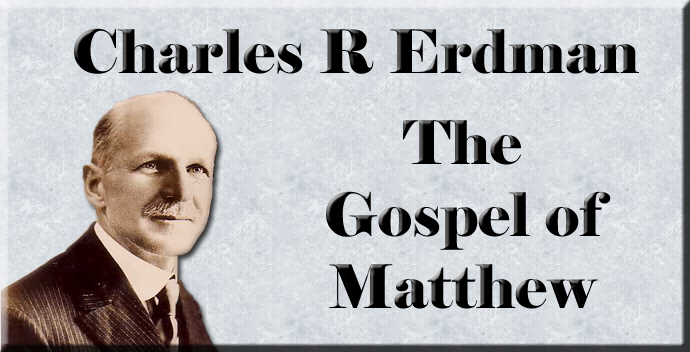
The Gospel of Matthew
By Charles R Erdman
Chapter 2
|
II. THE PROCLAMATION OF THE KING. Chs. 4:12 to 7:29 1. THE CIRCUMSTANCES. Ch. 4: 12-25
A distinguishing feature of the Gospel of Matthew is the prominence of great discourses or collected sayings of Jesus. The first and most familiar of these is popularly known as “The Sermon on the Mount.” It may be regarded as a proclamation or manifesto of the King, or as the Magna Charta of his Kingdom. The closing verses of chapter four indicate the circumstances under which these sayings were delivered; the sermon itself is recorded in chapters five, six, and seven. a. Jesus had selected for himself a new home. Vs. 12-17. After his early experiences in Judea, after baptism and temptation, he had returned to Galilee and settled for a time in Nazareth, the home of his youth and early manhood; but as he was about to begin his public ministry, “Leaving Nazareth, he came and dwelt in Capernaum.” The occasion of his withdrawal to Galilee is declared to be the arrest and imprisonment of John the Baptist. If his. herald is treated thus, what can the King expect? John had severely rebuked the religious rulers in Jerusalem and Judea; now that his career is ended their opposition is the more likely to interrupt the work of Jesus. He retires to a part of the country where their influence is less powerful. Galilee was despised, as lacking in religious privileges; it was, however, an attractive field for the proclamation of the Kingdom. The thronging multitudes were keen, alert, and intelligent; among them were many Gentiles who would carry the “good news” into all the world; here Jesus could collect a large company of followers before again offering himself to the nation, in Jerusalem, as the promised Messiah. The location of Capernaum “by the sea,” and on the border line of the two ancient tribes of Israel, “Zebulun and Naphtali,” is stated thus definitely to show how exactly an inspired prophecy was fulfilled. Isaiah had predicted that these northern tribes which had suffered most severely should be granted deliverance from their enemies; in their “darkness” of despair should spring up the “light” of relief. Matthew declares that the prophecy is most truly fulfilled by the appearance in this region of Jesus, the “Light of the world” who would bring deliverance from the tyranny of sin. His coming was, as Matthew always indicates, the coming of a King, and the passage from Isaiah thus further describes him: “The government shall be upon his shoulder: and his name shall be called Wonderful, Counsellor, Mighty God, Everlasting Father, Prince of Peace.” Thus as Jesus now begins his ministry in Galilee it is described as a proclamation of his Kingdom, “From that time began Jesus to preach, and to say, Repent ye; for the kingdom of heaven is at hand.” In the person of the King and in the proclamation of his Kingdom the light was shining which yet will banish all darkness from the world. b. The first followers of Christ had also been summoned. Vs. 18-22. These were the brothers Peter and Andrew, and James and John. They previously had known Jesus, and believed him to be the Messiah; but now they were called from their homes and their usual course of life to devote all their time and energies to his service. The King needed men whom he could train as his heralds, and who could aid in proclaiming his Kingdom. He had summoned them with an imperial command, “Come ye after me” but he had added an inspiring promise, “I will make you fishers of men.” Their work was to be somewhat similar in kind, requiring the same qualifications and abilities, but its results were to be infinitely more glorious. Promptly, they left their nets, the boat and “their father, and followed him.” Jesus is still summoning men to his service. His command involves sacrifice, but it should be promptly obeyed, for it promises fellowship with a King and the incomparable rewards and privileges of his Kingdom. c. The Opening Ministry, vs. 23-25, probably a circuit in Galilee, had also been accomplished, and it is recorded briefly, before the Sermon on the Mount, to suggest and summarize the conditions under which the Kingdom was being proclaimed. The ministry was that of “teaching” and “preaching” and “healing.” The last was unquestionably miraculous and it resulted in spreading the fame of Jesus through all the province of Syria, while from every part of Palestine actual multitudes thronged about him. It was at such a time and under such conditions that Jesus uttered those matchless precepts which are preserved for us in the Sermon on the Mount. The followers of Christ who go forth to preach and to teach and to heal in his name can expect to reach the multitudes only in case they observe the laws of his Kingdom and manifest in their lives the power of the King. 2. THE SERMON ON THE MOUNT. Chs. 5 to7 a. Introduction: The Character a Blessedness of the King's Servants.
The Sermon on the Mount is the supreme discourse in the literature of the world. It is not, however, the sum and substance of Christianity. It does set forth the fundamental laws of the Kingdom, but aside from the truth of the divine person and redeeming work of Christ, it would fill the heart of the hearer with bewilderment and despair. It reveals a divine ideal and a perfect standard of conduct by which all men are condemned as sinful and to which men can attain only by divine help. It is commonly called “The Sermon on the Mount” from the circumstance of the place where it was delivered. This fact, however, is by no means essential, and the familiar title gives no conception of the sermon. It might better be called “The Proclamation of the King,” or possibly “The Sermon of True Righteousness,” for surely its theme is the righteousness which the King requires. It sets forth the fundamental law of his Kingdom. The discourse opens with a description of the character and the blessedness of the followers of the King. This introductory section contains those familiar promises commonly known as The Beatitudes, and also contains the parables of The Salt of the Earth and The Light of the World. The Beatitudes suggest ideal relations both to God and to man. “The first of these sayings may be regarded as comprehensive, “Blessed are the poor in spirit.” It indicates the humility and conscious dependence which characterize a right attitude toward God. The promise is that “Theirs is the kingdom of heaven.” They already enjoy something of its blessedness; but the riches of their inheritance belong to the future when the Kingdom shall be manifested in its perfection. These heirs of the Kingdom “mourn” for their sins and they are certain of a divine comfort. They are meek in their relation toward their fellow men, but they are yet to “inherit the earth.” They are hungering and thirsting after righteousness, but they are certain to be satisfied. They are “merciful” toward others, and they “shall obtain mercy” from God. They are “pure in heart,” and consequently they now enjoy a divine fellowship and shall yet be blest with the vision beatific when they see the King in his beauty. They are eager to make peace among men and for such royal service they shall yet be acclaimed as the “sons of God.” It might be expected that persons of such character would enjoy peace and popularity in the world. For them no such experience is promised, in the present. On the contrary, they are to expect persecution. Ina world which rejects the King his followers must expect to share his sufferings; but “Theirs is the kingdom of heaven,” and in the blessedness of that Kingdom their earthly distresses will be forgotten. This last Beatitude is directly applied to the disciples who were listening to the Master's word. They are bidden to rejoice when reproached and persecuted and slandered. They should count themselves happy not only because of the reward which awaits them in heaven, but also because they have the honor of belonging to the great army of prophets and saints and martyrs who before them have suffered for righteousness” sake and have won the crown of glory. The blessedness of these followers of the King is not confined, however, to the future. It is their high privilege, in the present, to exert upon the world in which they five a saving and helpful influence. Yet this can be exerted only when they are true to the requirements of the King, and when they seek to make known his person and power. “Ye are the salt of the earth.” Their influence would keep the world from corruption; but if so they must be true to their own convictions; otherwise they would be like salt which has lost its savor. “Ye are the light of the world”; but if their mission was to be performed, their light must not be hid. Those who built a city upon a hill never intended it to be concealed, as those who lighted a lamp did not hide it in under a measure. So those who had been called to follow the King must manifest the righteousness which he requires if they are to fill their rightful places and . to reflect glory upon their Father in heaven. b. The King's Servants and the Moral Law. Ch. 5:17-48 (1) The General Principle. Ch. 5:17-20.
In setting forth the righteousness required by his followers, Jesus naturally explained, first of all, the relation in which this righteousness stands to the demands of the law as delivered by Moses and the prophets. The general principle is that Jesus came not to amend nor to abrogate this law, but to interpret it and himself to realize its demands both in his own experience and increasingly in the experience of his followers. “Think not that I came to destroy the law or the prophets: I came not to destroy but to fulfil.” Jesus regards this moral law as changeless and eternal. “Till heaven and earth pass away, one jot or one tittle shall in no wise pass away from the law, till all things be accomplished.” In his Kingdom eminence and power will depend upon the attitude one has shown toward this law, both in proclaiming it to others and in observing it himself; the highest place will be assigned to him who shall do and keep its commandments. More specifically still, Jesus contrasts the righteousness he requires with that which was manifested by the scribes and Pharisees. For them it was a matter of external observance, of form or of pretense. Jesus insists that it must be a matter of the heart, of motive, and of desire, as well as of external performance. Above all it must be a righteousness which regards the will of God and seeks to please him, in contrast with actions which are designed to secure merely the approval of men. One who manifests a mere formal righteousness will be excluded from the Kingdom, “Except your righteousness shall exceed the righteousness of the scribes and Pharisees, ye shall in no wise enter into the kingdom of heaven.” (2) The Five Illustrations. Ch. 5:21-48. (a.) The Sixth Commandment. Ch. 5:21-26
Jesus suggests five illustrations of his interpretation of the moral law as contrasted with the false interpretations of the scribes and Pharisees. The latter were concerned merely with external acts; Jesus traces every deed to the underlying motive and thought. The first illustration is taken from the law against murder. The Pharisee might suppose that he had not broken the Sixth Commandment if his hands were not red with the blood of his brother. Jesus declares that anger itself is a breach of this commandment, for if allowed to express itself in action it would finally result in murder. He suggests three expressions of this evil and intimates for each an increasing severity of punishment. He who is “angry with his brother” is declared to be in danger of condemnation by the local court. He whose ill-will is expressed in slander and contempt will be made to answer before the supreme council, but he whose anger expresses itself in open abuse and in charges of impiety shall bein danger of the sufferings of hell. So serious is this offense that if one remembers, even in the hour of worship, that he has given occasion to his brother for such a feeling against himself, even at the risk of apparent irreverence he should leave the place of worship and seek for a reconciliation; then he can come and worship with acceptance before God. Nor is there any time to be lost; opportunities are fleeting; if one delays, it may be too late and he will be compelled to bear the utmost penalty. Thus seriously, then, Jesus warns his followers against the perils of anger. Thus perfect is the fulfillment of the “law against murder” which he requires. (b.) The Seventh Commandment. Ch. 5:27-32
Nor can the securing of a divorce justify an act which is contrary to the moral law. No mere decree of a court can make right that which is in itself impure. To divorce an innocent wife or a husband and then to marry another, no matter what the civil law may declare, is a breach of os moral law which cannot be allowed in a follower of Christ. (c.) Oaths. Ch. 5:33-37
(d.) The Law of Retaliation. Ch. 5:38-42
The next illustration of the perfect righteousness which Jesus requires of his followers is suggested by a contrast which he draws between his law of perfect love and the traditional interpretation of an Old Testament precept which was used by the Pharisees as an excuse for retaliation and revenge. According to the Law of Moses the civil courts were to administer justice in accordance with the command, “An eye for an eye, and a tooth for a tooth.” This simply meant that the penalty was to fit the crime. It is a fundamental principle of law in all lands and ages; but the Pharisee and the formalist whom he represented, used this prescription for civil courts as a pretext for taking private revenge. It is necessary to have this distinction in mind when we read the Master's words, if we would be kept from fanaticism and folly. When he gives the command, “Resist not him that is evil,” he has in mind no thought that men are to allow the innocent to be abused and the helpless to be killed, when it is possible to protect and to deliver them. In such defense it may even be necessary to lay down life. Our Master is insisting, however, that we are never to inflict suffering in a spirit of revenge. Evildoers must be punished, but the followers of Christ cannot be moved by malice. So, in the matter of injustice inflicted by legal process, rather than seek revenge one should be willing to make even greater sacrifice; or when suffering oppression from some civil power, instead of seeking to retaliate, one should show a willingness to endure greater hardship; or, when one is asked to grant a loan, while it would be folly to grant it in every instance, the refusal must never be inspired by a desire for revenge. (e.) The Law of Love. Ch. 5:43-48
The Old Testament plainly required one to observe the law of love. No precept could be more familiar than this, “Thou shalt love thy neighbor as thyself.” However, in order to excuse himself for his narrow exclusiveness and national selfishness, the Jew had interpreted his “neighbor” as meaning only his fellow countrymen and, with other nations in mind, he had stated the following rule to guide his conduct, “Thou shalt love thy neighbor, and hate thine enemy.” Then further, he came to apply in private life a precept which, at its best, was only a poor rule for national guidance. Our Lord gives to the familiar precept a very different interpretation and statement, “Love your enemies, and pray for them that persecute you.” He suggests that such conduct is princely and royal and is becoming to those who are sons of the heavenly Father, “For he maketh his sun to rise on the evil and the good, and sendeth rain on the just and the unjust.” Jesus further insists that love for those who are kind and love for kindred, requires no special grace and is deserving of no particular reward. Even taxgatherers and pagans show such selfish or natural affection. It is for the follower of Christ to show the perfect love which can seek the highest welfare of enemies and can pray for the unkind; for this is like the perfect love of the Father. c. The King's Servants and Religious Observances. Ch. 6:1-18 (1) Almsgiving. Ch. 6:1-4.
The ideal life which Jesus demands of those who are to enter his Kingdom is tested by motive rather than by outward act. This is true in the matter of religious observances quite as much as in the acts which are demanded by the moral law. The real attitude toward God is certain to be expressed in some visible forms. Among these the three most common are almsgiving, prayer, and fasting. Here the general principle for the followers of Christ must be that the motive is a desire to please God and not to secure praise of men. This is what is intended by the first verse of the chapter, “Take heed that ye do not your righteousness before men, to be seen of them: else ye have no reward with your Father who is in heaven.” Jesus does not mean that there is any virtue in secrecy, but he does warn us against the publicity which seeks to secure admiration and praise. He does intimate that any real expression of righteousness which is designed to be an act of worship must have as its motive trust in God and love toward him. This general principle is illustrated first, in the case of charitable gifts. Jesus insists that these should not be attended with unnecessary publicity. He imagines the absurd case of a hypocrite, a mere actor, sounding a trumpet in the synagogue and in the streets to advertise his generosity and to secure glory of men. Such an expenditure of money and effort is not almsgiving; it is bargaining with the hope of selfish gain. Itisaninvestment of certain funds with a hope of securing full value in human praise and adulation. It is perfectly possible to make such investments, “They have received their reward.” On the contrary, Jesus insists “When thou doest alms, let not thy left hand know what thy right hand doeth.” He does not mean here to forbid care and system in giving charity, or in supporting religious causes. He means, however, to insist that in almsgiving our eyes are to be fixed not upon men but upon God; that we are not to seek for human praise and approval, but to remember that the “Father who seeth in secret shall recompense.” (2) Prayer Ch. 6:5-15.
The same principle applies to prayer. Only a hypocrite will be moved to worship by a desire to win the approval of men. Jesus has no criticism to pass upon public prayer. What he, of course, condemns is ostentation and the desire to secure praise by the attitudes and forms of prayer. He counsels secrecy, believing that it aids one in fixing the thought upon the Father, to whom all prayer is rightly directed. The Father sees in secret and he will recompense. So too, “vain repetitions” are to be avoided. This does not mean that one never is to ask a second time for that which he needs; but it is a warning against the belief that prayer is magical and that by continued iteration of a request God can be compelled to grant what he otherwise might deny. Jesus elsewhere encourages importunity in prayer; but he here insists that “vain repetitions” are worthy only of heathen and are unnecessary for his followers, for their Father knows what things they need even before they ask, To guide his followers in the true spirit and form of prayer, Jesus then suggested that matchless prayer which is in itself a model, a formula, and a summary of all our rightful requests. We call it “The Lord's Prayer.” It contains six petitions; three specially concern the cause and Kingdom of our Father; three express our personal needs. We pray that his name may be hallowed, that his Kingdom may come, that his will may be done as in heaven so on earth. We then request provision for our daily needs, pardon for our continual sins, and protection from moral peril. Jesus suggests that the spirit must be that of humble forgiveness, willing to overlook the offenses of others even as we expect our Father to forgive us. (3) Fasting. Ch. 6:16-18.
A third religious form, very popular with the Jews among whom Christ lived, was that of fasting. If this is practiced in order to show to God our sorrow for sin; or if it is involved in our devotion to his service, it is right and commendable; but if it is employed as a means of winning the approval and praise of men, it is hypocrisy and pretense. Jesus insists that fasting, and all forms of self-denial, should be in secret; we are not to parade our sacrifices; we are not to make capital out of our devotion. We are to have regard only to the Father who is in secret, who sees in secret and who surely will reward. d. The King's Servants and the World's Goods. Ch. 6:19-34
In describing the ideal life which he requires, Jesus gives two warnings in reference to the attitude of mind which should characterize his followers in their relation to worldly possessions. The first warning is against avarice, and the second against anxiety. The former is the special temptation of the rich; the latter of the poor. The former is forbidden on two or three different grounds. First, it is foolish to lay up treasures upon the earth, because earthly possessions are so uncertain and so soon pass away ; and secondly, they tend to turn the mind away from God and his Kingdom. Then, again, the desire for wealth may become such a passion as to dull the moral sense; 1t may blind “the eye,” whereas, a generous spirit clarifies the spiritual sight so that the whole being is full of light. Then, too, there is great peril lest a man may be possessed by his possessions. Avarice may transform one into a slave and may turn him from the service of God, “No man can serve two masters”; “ye cannot serve God and mammon.” On the other hand, Jesus warns us against anxiety. Of course he does not forbid foresight and prudence; but he would keep us from that carefulness and worry which destroy our peace and hamper our usefulness. He points us to the birds, to show that the heavenly Father will provide necessary food. He suggests the folly of anxiety which can shorten but can never lengthen the life of man. He bids us “consider the lilies of the field” in their beauty, in order to assure us that the heavenly Father will clothe those who trust in him. It is indeed a confident dependence upon the care of the heavenly Father which banishes anxiety. Jesus bids his followers to seek first the Kingdom of God and the righteousness which he requires, believing that all needful things will be granted them. He insists that they should not borrow trouble. He tells them that the morrow will have its own anxieties; that for each day there will be evil enough, but never too much, for those who put their trust in God. e. The King's Servants and the World's Evil. Ch. 7:1-6
In relation to the evil that is in the world Jesus gives two warnings to his followers as he continues to describe to them the ideal life which he desires them to lead. He warns them, first, against censoriousness, and, second, against carelessness. When Jesus said, “Judge not that ye be not judged,” he did not mean that we can avoid forming opinions of others, or that we should not condemn what we know to be wrong. He is forbidding his followers to be unkind in their judgments or to delight in unfavorable criticism. He condemns the spirit of faultfinding, first, on the ground of its danger, “For with what judgment ye judge, ye shall be judged,” not only by our fellow men, who are sure to condemn us with as little charity as we show toward them, but also by God himself who will judge us with that same severity which we have shown in judging others. Further, Jesus suggests that this censoriousness is absurd. He draws the most ludicrous picture: he suggests that it is ridiculous for one in whose eye there is a “beam” to attempt to relieve one in whose eye there is merely a splinter or a “mote.” Still worse, it is mere hypocrisy, for in criticizing others we usually suggest that we are greatly distressed by their weakness and faults, whereas in our hearts there is a secret joy. If our sympathy were real, we would first seek to remove our own imperfections, particularly our uncharitableness and pride, and then we would be fitted for the high service of enabling others to overcome their defects. The followers of Christ are not to be censorious nor to delight in unkind criticisms. However, they are not to go to the other extreme and to become indifferent to the evil that is in the world. They must discriminate carefully between men of differing moral character, and must regulate accordingly their attitude toward them. This is particularly necessary for those who desire to communicate spiritual truth. They must have regard to time and place and to the nature and condition of those whom they approach and whom they seek to influence. If, for instance, one seeks to cast a mote out of his brother's eye, he must act with tact and discretion. There are truths also which by some men could neither be understood nor appreciated. They would be rejected, scorned, despised, and their hearers would be insulted and abused. There is such a thing as “casting pearls before swine.” However, this caution must not be pressed too far. Christians must bear testimony even at the peril of their lives, and they are often surprised to find that those whom they, with hasty judgment, would have pronounced hopeless and hostile, are found to be quite ready and even eager to learn the “good news” concerning Christ. f. The King's Servants and Their Relation to God and to Men. Ch.7:7-12
The Sermon on the Mount here reaches its majestic climax as it discloses and emphasizes the relations which Christians should maintain toward God and toward their fellow men. These are summed up in the exhortation concerning “prayer,” and in the “Golden Rule.” The former is not a message concerning the nature or place or philosophy of prayer, but it is rather an encouragement to the followers of Christ to maintain toward God a continual attitude of filial trust. The exhortations which have preceded, warning against the perils of censoriousness and of carelessness, suggest the need of divine help. Here Christ urges his followers to look to God at all times for needed wisdom and strength and grace. “Ask, and it shall be given you; seek, and ye shall find; knock, and it shall be opened unto you.” Nothing could be more simple than the intercourse between earth and heaven which is thus assured; and further confidence is inspired by the comparison to an earthly parent who though only a man, would not deceive or mock his son;, how much more certainly will “The Father who is in heaven give good things to them that ask him.” h As this instruction concerning prayer inspires a right attitude toward God, so the “Golden Rule” summarizes all that Christ requires in relation to our fellow men. It is an expression of the law of love and it is, as Christ declares, a fulfillment of all that is required by “the law and the prophets.” Some expressions of this “Golden Rule,” either in a negative or in some other less perfect form, are found reflected by Jewish teachers and even by heathen sages; but it remained for the great King to proclaim in his manifesto the fundamental law, the observance of which would end all the differences and discords between individuals, between classes and parties, and between the nations of the world, “All things therefore whatsoever ye would that men should do unto you, even so do ye also unto them.” g. Conclusion: The Struggle, the Test, and the Security of the King's Servants. Ch. 7:13-29
The sermon closes with three exhortations, one to seek for entrance into the Kingdom; one to beware of false teachers and false professions, and one to obey the commands of the King. Jesus employs three striking metaphors, the “two ways,” the “two kinds of fruit,” and the “two builders.” (a) In urging men to become his followers and to seek for an entrance into the Kingdom of heaven, vs. 13, 14, the figure of speech embodies three great contrasts, the wide and narrow gate, the death and life to which they lead, and the many and the few that enter in. Here the King plainly teaches that to follow him involves struggle, self-discipline, and effort. The right path is difficult to find and hard to keep; the broad path is popular and is easy to discover. It is not difficult for one to be lost; one only needs to follow the crowd. It is hard to be saved, it requires resolution, sacrifice, heroism; but the issue is life eternal. (b) .There are many false guides, vs. 15-20, who offer themselves; many religious leaders who masquerade under the name of Christian. They seem innocent enough but they are like wolves dressed in the fleeces of sheep. Their real purpose is selfish and destructive; they must be tested, not only by their lives and their deeds, but still more by the results of their corrupt and Christless teachings, “By their fruits ye shall know them.” Then too, many others who profess to follow Christ need to be on their guard against self-deception. On that great day when the King will pronounce judgment and will determine who may enter and who must be excluded from his Kingdom, many will plead that they were regular in Christian worship end prominent in Christian work, to whom the King will say, “I never knew you: depart from me, ye who work iniquity.” It is necessary not only to profess the name of Christ but truly to obey him and by his help to do the will of his Father who is in heaven. (c) Therefore, in his final words of warning and exhortation, vs. 24-27, the King sets forth the absolute necessity of hearing and of doing his words, of accepting and obeying his royal commands. He draws the picture of the two builders, one founding his house upon the rock, the other building upon the sand, and in the time of storm and flood one house stands firm and the other falls in complete ruin. So shall it be in the time of testing and of judgment, they who truly obey Christ will be safe. Their eternal destinies are built upon a rock, the servants of the King are secure. (d) It is not strange that the multitudes marveled at the words of Christ. The world has been wondering at these words ever since. The crowds were astonished that he spoke with authority and not as their scribes; and he might well so speak, for these wonderful words are the proclamation of a King.
|
|
 |
 |
|
|
|
-
Site Navigation
 Home
Home What's New
 Bible
Bible Photos
 Hiking
 E-Books
 Genealogy
 Profile
Free Plug-ins You May Need
Profile
Free Plug-ins You May Need
 Get Java
.png) Get Flash
Get Flash Get 7-Zip
 Get Acrobat Reader
 Get TheWORD