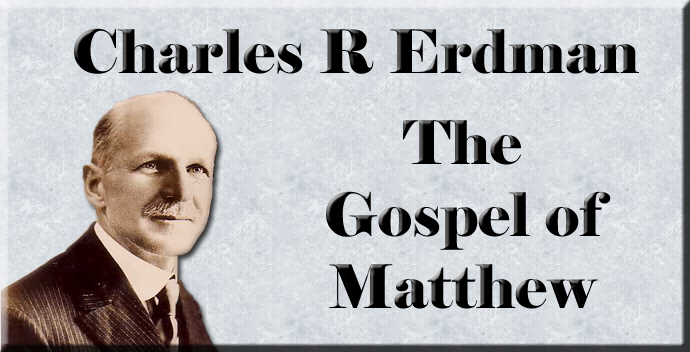
The Gospel of Matthew
By Charles R Erdman
Chapter 6
|
VI. THE PARABLES OF THE KING. Ch. 13 , 1. THE SOWER. Ch. 13:1-23
It is the usual method of Matthew to secure a heightened effect by massing material which is of the same character. Thus we find here a group of parables, as before we found a group of miracles. These parables are seven in number, arranged in divisions of four and three. They are all closely related and seem to have been delivered on the same day when Jesus had been so cruelly assailed by his enemies and when his rejection by the nation had been so clearly foretold. The parables relate to the period of time between his rejection and his final return to inaugurate his perfected Kingdom. Matthew is not only the Gospel of rejection, but it is the Gospel of fulfillment, and accordingly it is stated that the practice of Jesus in teaching by parables was in accordance with inspired prophecy, vs. 34, 35; and in explaining to his disciples the reason for his use of parables, Jesus quotes at great length from the prophecy of Isaiah stating that ancient predictions were thus definitely fulfilled. The purpose was fourfold: First of all, parables were illustrations which made spiritual truth more plain and clear to the mind of the hearer. Second, they put the truth in portable form so that it easily could be carried away and remembered. Third, they were designed to avoid offense to those who were hostile and who were not prepared to receive the truth; and fourth, they were used, as Isaiah declared, as a judgment upon those who were willfully blind. They shrouded the truth from such as lacked spiritual qualifications for its reception. Again Matthew is the “Gospel of the King” and these parables are designated as the “Mysteries of the Kingdom.” A “mystery,” according to New Testament usage, does not refer to something which cannot be understood, but it denotes a truth which once was hidden but now has been revealed. The truth of this chapter relates to the “kingdom.” It would be unwise to insist upon an exact definition of this term which would fit all the phrases of the chapter. In some instances it seems to refer to the will or reign of God; in others to the society in which the sovereignty of God is recognized, as the “Christian Church” or Christian civilization. It is probably best to understand the phrase as Matthew commonly employs it, to denote the perfected reign of Christ which is to be established at the end of the present age. In these parables are found statements concerning the nature, the reception, and the results of the proclamation of this Kingdom by the King and his followers. Thus in the case of the parable of the Sower, our Lord declares that its teaching concerns “the word of the kingdom.” The main point of the parable is to show that the effect of the word is dependent on the state of the heart. The parable is sometimes called “the parable of the soils,” for it illustrates the various spiritual conditions found among men to whom the word is preached. In some cases this “word of the kingdom,” whether preached by Christ or his followers, falls on hearts which are pictured by the hard trodden footpath which runs through a field of grain. No possible impression can be made. The word finds no entrance and Satan snatches it away as a bird would pick up the grain which has fallen by the wayside. Other hearers are compared to the “rocky places” where a thin layer of earth covers a bed of rock. Seed which falls into such soil springs up the more quickly because of the warmth of the underlying rock, but as the roots cannot strike downward, the grain soon withers beneath the glare of the sun. So there are hearers who receive with enthusiasm the message concerning the Kingdom but when confronted with the persecution which the followers of Christ must bear, they quickly desert his cause. Then there are hearers who are compared to the seed which falls where thorns are growing. It springs into life but has no room for development. Such hearers are so preoccupied by worldly interests, by wealth and pleasure that they can bear no spiritual fruit. There are those, however, who are likened to the “good ground” on which the seed falls and a harvest results, thirty, sixty, or a hundredfold. So there are honest and good hearts ready to receive this “word of the kingdom,” to meditate on it, to give their best efforts to its cultivation and development, until in their lives a golden harvest is produced. Such a parable is a warning to all who hear the Gospel message. They need to take heed how they hear. Yet further, it is an encouragement to all who proclaim the good news. They need not expect that every hearer will be eager for the message, nor that all who accept it will prove true to Christ. They are, however, to believe that if they faithfully perform their tasks, the Lord of the harvest will produce results which will bring an infinite reward. 2. THE TARES; THE MUSTARD SEED; AND THE LEAVEN. Ch. 13:24-43
As in the previous parable, it is evident that when our Lord speaks of “the kingdom of heaven,” he means the proclamation of that Kingdom and the results of this message. As he explained to his followers, “The field is the world,” it is not the Church, nor civilization, but the whole world of men to whom the Gospel is being preached. As a result of this proclamation many will be transformed and prepared to take their places in the coming Kingdom. However, at the same time, the enemy of mankind is at work. He is sowing tares and as a result there are found in this world those whom our Lord declares to be the “sons of the evil one.” Side by side with the “sons of the kingdom” they grow and develop. It is impossible to effect a separation between them. They continue together “until the harvest.” In this present age good and evil, virtue and vice, sin and holiness continue in spite of their antagonism and contrast. It is only at the “end of the age,” when the harvest takes place, that the Lord of the harvest will command the reapers to “gather the tares to be burned” and to gather the wheat into his garner. Universal righteousness and peace cannot be expected until the King comes to bring the right to its ultimate triumph. “Then shall the righteous shine forth as the sun in the kingdom of their Father.” Between the statement and the interpretation of the parable of the Sower, which illustrated the mingled good and evil of the present age, our Lord introduced two minor parables which he does not explain. The first is that of the Mustard Seed and the second that of the Leaven. As the parable of the Sower and the parable of the Tares were interpreted by our Lord to refer to the effect of his preaching and that of his followers during the present age, so it is probable that these two parables have the same purport. There are some who understand the growth of the mustard seed to suggest the sudden but unsubstantial development which characterizes certain present forms of what they designate “the kingdom”; and, as leaven is usually in the Scripture a symbol of corruption, the latter parable is taken to denote the false doctrine which often permeates the teaching of professed Christians. These interpretations are quite in accord with the mingling of good and evil, set forth by the previous parables. It is much more common however, to find in the “mustard seed” a symbol of the small beginnings and wide extension of the message of the Kingdom and of its effects; and to regard the leaven as typifying its silent work and permeating power. 3. THE TREASURE; THE PEARL; THE NET. Ch. 13:44-50
The familiar parables of the Hid Treasure and of the Pearl of Great Price are sometimes taken to illustrate how precious to the mind of Christ are his people and his Church, for which he gave up the glories of heaven and laid down his own life. This teaching is quite in accord with other Scripture, but it may be wiser to find here illustrations of the fact that one who really understands the Gospel message will be ready to make any possible sacrifice that he himself may become an heir of the Kingdom. He may have heard this message when busied in his usual tasks in the field or in the home; or he may be like the merchant who was seeking goodly pearls, he has a yearning for that which is highest and best; at last he finds in the Gospel of Christ the thing which satisfies his soul, and at the cost of all that he may have held dear, he takes Christ as his Lord and accepts his promise of eternal life. The last parable of the seven, like the two great parables which Jesus himself interprets, seems to show clearly that good and evil will be found, at the very end of the age, even among those who have been reached by the Gospel of Christ. The word of the Kingdom seems to be in its effect like a great net, gathering fish of all kinds out of the sea, but as the age comes to its close there is at last a separation; the angels come forth and sever the wicked from among the righteous. Thus there are those who appreciate the word of the Kingdom and who submit to the King, but there are others, even nominal followers of his, for whom there await only condemnation and punishment. 4. THE RESPONSIBILITY OF THE DISCIPLES AND THE REJECTION OF JESUS. Ch. 13:51-58
It is in keeping with this story that this chapter of parables, which indicates a partial rejection and a partial acceptance of the message of the Kingdom during this present age, closes with this story of the rejection of Jesus in his own home. Here for a second time in Nazareth, where he had spent so many years of his life, he is met with cruel unbelief. Here he pronounces that word of rebuke, “A prophet is not without honor, save in his own country, and in his own house.” This is not because a prophet is well-known in his own country, but because he is not really known. They thought they knew him, because they were acquainted with his brothers and his sisters. They failed to appreciate what his works suggested as to his unique nature. They refused to admit his claims. Those who had the best opportunity of knowing him rejected the King. It is this-incident which prepares the way for the next section of the Gospel which shows Jesus in retirement, withdrawing from unbelieving Israel and seeking in secret to instruct his disciples and those who like them believed and trusted him.
|
|
 |
 |
|
|
|
-
Site Navigation
 Home
Home What's New
 Bible
Bible Photos
 Hiking
 E-Books
 Genealogy
 Profile
Free Plug-ins You May Need
Profile
Free Plug-ins You May Need
 Get Java
.png) Get Flash
Get Flash Get 7-Zip
 Get Acrobat Reader
 Get TheWORD