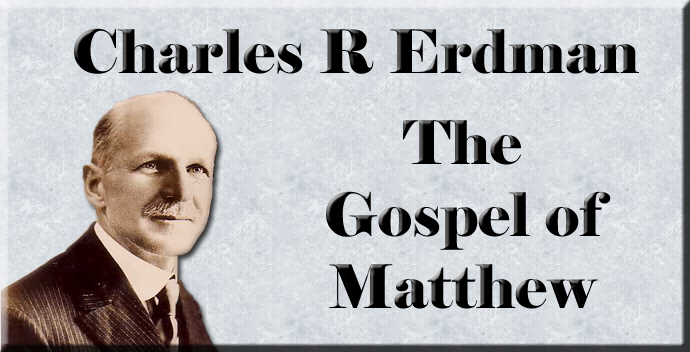
The Gospel of Matthew
By Charles R Erdman
Chapter 10
|
X. THE REJECTION OF THE KING. Chs. 21 to 23 1. THREE ACTED PARABLES OF WARNING. Ch. 21:1-22, a. The Royal Entry. Ch. 21:1-11
No incident in the life of our Lord is more in harmony with the purpose of Matthew than the royal entry into Jerusalem. Of course it forms an essential part of the story of all the Gospels, but in none does it constitute a more definite climax or conform to a more evident design. Matthew is the Gospel of the King, and here Jesus issues a royal command; he makes a royal progress; he receives a royal acclaim. To his command it is assumed that no refusal is possible; he enters the city mounted and attended: as an Oriental monarch; he is hailed by the multitude as the Son of David, the King, and as worthy of supreme homage and praise. Matthew is the Gospel of Fulfillment, and this incident is shown to correspond in minutest detail to a prophecy which is here quoted. However, Matthew is also the Gospel which emphasizes the rejection of Jesus; and here after the deadly hatred of his enemies has been revealed; after the predictions of his death have been so solemnly repeated; even while the multitudes shout with passing emotion, the silence of the rulers is ominous of tragedy. Jesus evidently is offering himself to the nation, but it is about to refuse him and to allow him to be destroyed. By this temporary outburst of popular enthusiasm no reader is for a moment deceived. Upon the bright picture there rests the shadow of the cross. This royal entry was an acted parable. No one supposes that Jesus meant the borrowed colt, or the caparisons of rustic garments, or the peasants who attended him, were to be parts of the furnishings of an Oriental court. They were the symbols of royalty by which he definitely presented himself to his people as the promised Messiah; he was making an appeal for the trust and obedience and homage of human hearts; but he was warning the rulers that in rejecting him they would be rejecting their King; they would be defeating their highest hopes. Some day, however, he is to appear in glory; that humble pageant which moves through the streets of Old Jerusalem is but the faint symbol of the true coming of the King. Those who now accept him and offer him the willing homage of their hearts will then rejoice and will enter with gladness into the blessedness of his perfected Kingdom. b. Cleansing the Temple. Ch. 21:12-17
The abuse, which Jesus here rebukes, had arisen from what was at first a public convenience, namely, the sale to pilgrims in the neighborhood of the Temple, of sacrifices which they could not bring from their distant homes: Gradually the traffic had pressed nearer until the merchants had entered the Temple area and were desecrating the sacred courts by their distracting noises, their greed, their extortions, and their fraud. The act of our Lord in expelling these intruders from the sacred courts was not merely an example of power which one man, conscious of the right and justice of his cause, may exercise over those whom guilt of conscience make weak and timid; nor yet was this merely the work of a reformer who was correcting an evil custom. It was on the part of our Lord an acted parable. It was a rebuke of the nation, the spiritual state of which was indicated by their apparent disregard of the sacredness of the house of God. It was a symbol, warning of the judgment which was to be visited upon them because of their apostasy and unbelief. Furthermore, this was a claim on the part of Jesus to be the real Lord of the Temple. He identifies himself with God whom he declares to be his own Father and he supports this claim by proceeding to perform miracles of healing within the Temple courts. He is thus making a public claim, as on the day before, to be the promised Messiah, and he emphasizes this claim by his reply to the rulers when they rebuke him for allowing the children to hail him with their “Hosannas.” He declares that they are justified in welcoming him as “the son of David”; and he further quotes, as applying to himself, a psalm which speaks of the universal sovereignty predicted as belonging to man, a psalm, however, which was to be fulfilled by the Messiah, and which picttred the unlimited rule which he would exercise as the appointed King. Jesus declares that such praises have the divine warrant and sanction and are appropriately bestowed upon himself. Such claims were so obvious, the meaning of his symbolic actions were becoming so clear, that the rulers were filled with even more deadly hate. It was, therefore, not merely for the sake of rest but to avoid a more open conflict that Jesus withdrew for the night to lodge with his friends in Bethany. c. The Barren Fig Tree. Ch. 21:18-22
The withering of the fruitless fig tree was not only a miracle wrought by the power of Christ, it was a parable of the punishment which was to be visited upon Israel for its sin and unbelief. On a fig tree the green fruit is first formed and then the foliage is produced, so that fruit might be expected on a tree in full leaf; but on this tree Jesus found none. This fruitless tree with its show of leaves was however a symbol of Israel; the nation had made a profession of holiness; it had maintained its pretentious ritual; it had preserved a form of godliness, but when the King had come, he had found none of the real fruits of righteousness; and now his rejection was to be followed by the national disaster of which the withering of the tree was a parable and a warning. The story may contain a note of admonition for all who now bear the name of Christ; their lives must correspond with their profession, their deeds with their claims. However, for his immediate followers the King found in the miracle a message of inspiration and cheer. As his disciples marveled at his power he declared that similar power was at their command; it was the power of believing prayer; it could remove mountains; not thata literal attempt was to be made, but that it could do things otherwise impossible. Of course there are other familiar conditions, but our temptation is to limit too far the implications of the promise, “All things, whatsoever ye shall ask in prayer, believing, ye shall receive.” 2. THE CLAIMS OF DIVINE AUTHORITY. Ch, 21:23-27
As Jesus reaches the city he is at once attacked by all the Jewish rulers and leaders. They challenge him to state by what authority he is acting in receiving honors as the Messiah or in driving the traders from the Temple as on the day past. Their question is framed with subtle skill, “By what authority doest thou these things? and who gave thee this authority?” They place Jesus in a dilemma; if he claims that authority had been delegated to him, then he may be accused of disloyalty and of schism, in supplanting the recognized “authorities” of the Jewish state; if he claims inherent divine authority, as one with God, he may be condemned for blasphemy. Jesus silences his enemies with a question which involves them in a counterdilemma, “The baptism of John, whence was it? from heaven or from men?” They cannot say “from heaven,” for they had rejected John; they do not dare to say “from men,” for they fear the people by whom John was regarded as a prophet. They try to escape by the cowardly reply, “We know not.” Agnosticism is usually cowardly and deserving of little respect. Jesus does more than silence them; he answers them. His question is no irrelevant riddle by which he meets a difficulty and delays the necessity of a reply. He definitely implies that the authority of John was divine, and that his own authority is the same; but as they were afraid to deny the divine authority of John they are powerless to deny that of Jesus; and further he implies that if they had accepted the message of John, they would be prepared to accept Jesus. It is true that if we are afraid to accept the logical conclusions of our doubts and denials, we never can hope to discover truth. = Jesus further rebukes and exposes his enemies. When they say, “We know not,” Jesus knows, and they know, and the crowd knows, that they are not honest; the Lord has laid bare their hypocrisy; he has made it perfectly evident that the real question at issue is not authority but obedience. The enemies of Jesus pretend that they want to know more of his credentials; they really want to discredit and to entrap him. The modern enemies of our Lord declare that they want more proofs, more evidence; what they really lack is love for him and submission to his will. Those who do not repent when John preaches, will not believe when Jesus offers to save. The world needs today, not more proof of divine authority, but more obedience to the divine will. Jesus absolutely discredited his enemies in the sight of the people. They were the constituted authorities in all matters civil and religious, and yet they were made to confess publicly that they were not competent to judge a clear, familiar, important case relating to religious authority. They really abdicated their position. They, therefore, were disqualified to pass an opinion on the exactly parallel case of the authority of Jesus. Jesus had defeated them with their own weapon. No wonder that subsequently, when on trial before such judges, he refused to answer them a word. He had shown their incompetence, their insincerity, their unbelief. Honest doubters are deserving of sympathy; but professed seekers after truth, who are unwilling to accept the consequences of belief, should expect to receive no further light. An increasing knowledge of divine truth is conditioned upon humble submission of the heart and the will to what already has been revealed. 3. THREE PARABLES OF JUDGMENT. Chs. 21:28 to 22:14 a. The Two Sons. Ch. 21:28-32
In replying to the hostile rulers, Jesus has made a claim of divine authority; he now adds three parables which condemn his enemies and pronounce judgment upon them and the nation. The first is very brief, but pointed. Two sons are described, one, who refused to obey his father, repented and served him; the other promised to serve but continued to disobey; to the one Jesus compared those of the publicans and harlots who, after lives of notorious sin, had repented at the preaching of John; to the other Jesus compared the rulers, who with all their profession of righteousness and with all their boasted ceremonies, continued to live in real rebellion against God. He thus rebuked the rulers for their pretense that they were willing to accept Jesus if only sure that his authority was divine; he declares that their real difficulty is unwillingness to obey the divine will. He-affirms that they, and all who like them are impenitent and insincere, can never enter the Kingdom of God; he promises that even the worst sinners may repent and be saved. b. The Wicked Husbandmen. Ch. 21:33-46
To the malicious challenge of his enemies Jesus has already replied, claiming for himself divine authority and condemning them for their guilty unbelief. He now adds a second parable more clearly stating his claims and more solemnly rebuking these hostile rulers and pronouncing judgment upon the nation they represent. He tells the story of a householder who establishes and equips a vineyard and lets it. to tenants. He lives at a distance and expects as rent a certain portion of the vintage. However, when he sends for the fruit, his messengers are abused and killed; at last his own son is slain. He determines to come and to exact justice and to deliver his vineyard to tenants who are more worthy. The parable was so plain that even the enemies of Jesus understood its meaning. The householder is Jehovah; the vineyard is Israel; the husbandmen are the rulers to whom the nation had been intrusted; the servants are the prophets sent to summon the people to repent and to render to God the fruits of righteousness; the son is Jesus himself, who thus claimed a unique relation to God, distinct from the prophets and all human messengers, and who definitely foresees his own rejection and death; the return of the householder is the coming visitation of divine judgment and the rejection of Israel, and the call of the Gentiles. It is aside from the present purpose of Jesus to refer to the individual Jews who will accept him and to the future conversion of the nation of which Paul writes. He wishes now to emphasize his own rejection, and the guilt and punishment of the nation. He declares, however, that his death will issue in his exaltation and triumph; he is “the stone which the builders rejected, the same was made the head of the corner.” He also warns his enemies that all who in unbelief stumble on that stone, all who reject him, will be “broken to pieces,” and all who attempt to drag down that stone will be ground and scattered as dust. c. The Marriage Feast. Ch. 22:1-14
The picture of the Kingdom of the Messiah as a banquet at which Israel would be seated and from which Gentiles would be excluded, was familiar enough to the Jews; but Jesus reverses the figure with details reported only by Matthew, and with the main purpose of pronouncing judgment upon the nation which is rejecting him. Matthew is the Gospel of the King and it is interesting to note that the parable which Jesus now gives presents to us a feast prepared by a King, it is indeed “a marriage feast for his son”; while the companion picture in Luke describes merely a great supper given by “a certain man.” So the treatment of the invitation, according to the story of Matthew, is a much more serious matter. It is despised and neglected while those who bear it are abused and killed. The consequent punishment of the offenders is more severe; they are destroyed and their city is burned. The whole incident is here narrated with marks of royalty which are in perfect harmony with the character of this Gospel. The purpose of our Lord, as in the similar parable in Luke, is to show by the picture the guilt of the nation which is rejecting the invitation to enter the Kingdom of heaven. He plainly indicates the consequent rejection of Israel, the suffering of the nation, and the destruction of Jerusalem. Quite as plainly it shows that from among the Gentiles many both good and bad will be gathered into the Christian Church. There is, however, to be a final separation before the blessings of the Kingdom will be enjoyed. This is pictured by the fate of the man who was found among the guests but “who had not on a wedding-garment.” He is cast “into the outer darkness.” Those who are to enjoy the glory of the Kingdom must be arrayed in the robe of righteousness which the King requires and which he is ready to provide for all who accept of Christ. “For many are called, but few chosen.” Eternal life is represented as a free choice on the part of man, and as a divine election on the part of God. As among the Jews “the many” rejected their Messiah, so among professed Christians there will be those who will lack the garment of righteous life and character and so will lose, at last, the approval of the King and the joys of his palace. Thus in this parable of the Marriage Feast Jesus predicts the judgment of Israel, the call of the Gentiles, and the demand for righteousness in those who are at last to share the glories of his Kingdom. 4, THREE ENSNARING QUESTIONS. Ch. 22:15-40 a. Tribute to Cesar? Ch. 22:15-22
Early in this memorable day of public teaching, Jesus has been attacked by the elders and chief priests and scribes; but he has defeated them, exposed them to ridicule, and indicted them as apostates and murderers. In their furious hate they would have him killed at once; but they fear the multitudes with whom Jesus is so popular. To compass his death, therefore, they must first discredit him with the people; they must entangle him in his teaching. Thus to entrap him, they now return with a series of three crafty questions; but Jesus evades each snare, he answers each question fairly and completely, and then asks a question by which his enemies are finally silenced. The first question relates to the payment of tribute to the Roman Government. The more conservative Jews held that God was the ruler of Israel and that it was possibly wrong to pay taxes to support a heathen state. The more liberal party sided with the Herods, who owed their power to Rome. Therefore the enemies of Jesus send to him representatives of both parties, Pharisees and Herodians, so that if he avoids offending one party he will displease the other. They approach Jesus with the flattering assurance that he is so truthful and courageous that he will not hesitate to express his true convictions; and then they propose their artful question, “Is it lawful to give tribute unto Cesar, or not?” Shall Jesus say, “Yes”? Then he will cease to be a popular idol, for the people loathe the hateful oppression of Rome. Shall Jesus say, “No”? Then his enemies will hurry him away to the Roman governor and the cross, as a traitor and a rebel. The dilemma seems complete; yet Jesus not only escapes the snare, but, in his reply, he enunciates a law for all time, “Render therefore unto Cesar the things that are Cæsar's; and unto God the things that are God's.” To make plain his meaning, Jesus first calls for a Roman coin, and asks whose image and superscription it bears. They, of course, reply, “Cæsar's.” Jesus therefore insists that if they accept the coins of Cæsar, they must pay taxes to Cesar. That is, if one accepts the protection of a government, and the privileges provided by a government, then one is under obligation to support that government. Christianity never should be identified with any political party or social theory, but Christians ever should take their stand for loyalty, for order, and for law. It is not the whole of life, however, to “render unto Cæsar the things that are Cesar's”; one must also “render unto God the things that are God's.” The latter higher allegiance includes the former. The enemies of Jesus suggested a conflict of duties; he showed that there was perfect harmony. He intimated, however, that there was danger of forgetting God, and our obligations to him of trust, service, worship, love. The true basis for citizenship is devotion to God, and no political theory or party allegiance can be taken as a substitute for loyalty to him. The enemies of Jesus were answered and rebuked, and his followers were given guidance for all the coming years. b. Is There a Resurrection? Ch. 22:23-33
Jesus defeated the Pharisees and the Herodians. He is now attacked by the Sadducees, who were the priestly, and most powerful, party among the Jews. They questioned the immortality of the soul, and believed neither in angels nor in spirits; they represented the modern materialists. It is to be noted, however, that the question with which they approached Jesus is not in reference to immortality but to the resurrection of the body. They propose the case of a woman, married successively to seven brothers from each of whom she was separated by death; and they ask, “In the resurrection therefore whose wife shall she be of the seven?” They hope that Jesus will either deny the orthodox belief as to the resurrection or make some statement which will contradict the Law of Moses which made the successive marriages lawful. The reply of Jesus is one which is applicable to many modern skeptics, “Ye do err, not knowing the scriptures, nor the power of God.” This twofold ignorance caused them to imagine a contradiction which really did not exist. First, as to “the power of God”: he is able to provide a life in which there is no death, or birth, or marriage, but where the relations are even higher than the most blessed relationship of earth. Such an existence, with its higher laws, is consistent with the facts and laws of our present life. Second, as to “the scriptures”; what do they declare that God has promised to do? Jesus answers this question by quoting from the very system of law to which the Sadducees have referred, “] am the God of Abraham, and the God of Isaac, and the God of Jacob,” and then he adds, “God is not the God of the dead.” He means to establish the fact of the continued existence of the dead; yet not merely this, but to prove the resurrection of the dead. The latter is the question at issue. Life, as used by our Lord, indicated normal life, not that of a disembodied soul, but of an immortal soul clothed with a deathless body. “The living” are therefore the risen. The confident expectation of such a future state is based on our relation to God. If he is truly our God, and we are his people, the triumph of death is not real and permanent, but will be ended by the glory of a resurrection from the dead. Many beliefs which men scout because they seem to contradict known laws of science will some day be explained by the discovery of higher laws. It is for us to ask what has been written, and then to believe in the power of God to perform. c. Which Is the Great Commandment? Ch. 22:34-40
The third question addressed to our Lord embodies a familiar problem which the scribes liked to discuss, namely, as to which among the Commandments is the most important. Their code of morality was most complex, and consisted in an infinite number of minute requirements and regulations. The reply of Jesus is startling in its insight and its simplicity; he declares that the whole duty of man, the full sum of moral obligations, the essence of all divine law, is embodied and expressed in one word, “ove.” This love must be exercised in two directions, first toward God, and second toward men. All the Ten Commandments and all other divine requirements are but expressions of .this one supreme principle. “The first commandment” therefore is love to God: this is the fulfillment of the “first table of the law”; but “the second” is inseparable from it; it comprehends the rest of the Commandments, as it requires love for men. What must have startled the hearers was the fact that both “these two commandments” are quoted from the Old Testament, and the first was so familiar that it was repeated twice daily by all Jews. So simple and so unquestioned is the principle of love, by which all moral problems can be solved, by which all moral obligations can be fulfilled. 5. THE QUESTION OF JESUS. Ch. 22:41-46
Three questions have been asked to entangle Jesus and to discredit him with the people; his answers not only foil his enemies but declare universal principles for the guidance of his followers. The first relates to political and civic duties, the second concerns natural and physical laws, the third, is in the realm of morals and ethics. Now Jesus proposes a counterquestion; it embodies the supreme problem in the sphere of philosophy and religion. The question concerns the person of Christ; is he to be regarded as man or God, or as at once God and man? Where is Christ to be placed in the scale of being? Or, as Jesus voiced the problem, how could David speak of the coming Messiah as both his Son and his Lord? There was but one answer; there can be but one: Christ is both human and divine, he is the Son of David and also the Son of God. The incarnation is the only solution of our most serious difficulties in the sphere of religious belief. Jesus has absolutely defeated and silenced his enemies; and he concludes the long controversy by this expression of his supreme claim to be the Christ of whom David has prophesied, the Messiah, the King. 6. THE WARNING AGAINST THE PHARISEES. Ch. 23:1-12
In no other Gospel is the guilt of rejecting Jesus made more prominent; in none is the cruel opposition of his enemies more emphasized; and correspondingly, no other writer records more severe condemnation uttered by Jesus against the hostile rulers. These rebukes reach their climax in this chapter. Jesus has vanquished his opponents in argument; he now publicly warns his followers against them and then pronounces upon them a series of seven solemn “woes.” The essence of his rebuke is embodied in the repeated term of bitter reproach “hypocrites.” It is the hypocrisy of the Pharisees which Jesus so severely condemns. It has always been remarked that the most bitter denunciations of our Lord are addressed to the men whose outward lives were respectable and whose religious professions were the loudest. We are to be on our guard, however, against concluding that open vice and flagrant sin are better than even selfish and proud morality. We are to be warned, however, that religious privileges and exalted position involve large responsibility, and that immorality and sin are especially repulsive when they accompany proud claims of spiritual leadership and ostentatious performances of religious rites. The hypocrisy of the Pharisees is stated in the first words of warning which Jesus spoke to his followers. He is careful, however, to distinguish between the office of those false religious teachers and their actual practice. He recognizes that they are worthy of being heard, as far as they upheld the Mosaic Law. They were said to “sit in Moses seat”; that is, to be acting in his place and to proclaim his laws as teachers of the revealed will of God. In so far as they were true to such a sacred office they were to be obeyed. It was their practices, however, which were to be avoided, especially their failure to follow their own precepts. While guilty of moral faults, they also were to be condemned for adding to the requirements of the law minute and countless rules, most of which they had received by tradition, which together formed a wearisome and confusing round of ritual observances and bound the conduct of men every hour of the day and in every act of life, so that they constituted a burden which was intolerable and which the Pharisees made no effort to relieve. Such teachers, lacking in sincerity and in sympathy, were neither to be trusted nor followed, least of all to be imitated. Jesus further warns against their ostentation, “All their works they do to be seen of men.” Jesus gives two examples of this pretentious ceremonialism. One is that “They make broad their phylacteries”; by which he referred to the cases of leather which the Jews bound upon their arms and upon their foreheads, and in which were written certain extracts from the law. They also “enlarge the borders of their garments,” making a display of their | careful observance of the minutest requirements of the ceremonial law. Jesus also warns against their pride and love of praise, as they desire the chief places at feasts and in synagogues and delight in public notice and in being recognized as religious leaders. In warning his followers against these Pharisees, our Lord specially emphasizes the last point. His warning is applicable in the present day. When he insists, however, that no man is to be called “Rabbi” or “Father” or “Master,” the terms are not to be interpreted too literally. “These very words might be used as titles of respect or to indicate definite duties and positions of responsibility and trust; but the warning is needed to-day which is implied in the prohibition which our Lord-here gives. There has always been danger in the Church arising from love of place and from a desire for special recognition and the longing to be regarded as superior to other followers of Christ. Our Lord does remind us of our equality as believers and that in the truest sense, he alone is the Teacher; he alone is to be regarded with reverence; he alone is Master and Lord. In contrast with the spirit of the Pharisee the follower of Christ is to be humble, the greatest among them is to take the part of a servant, lowliness is the true path to exaltation.: 7. THE WOES UPON THE PHARISEES. Ch. 23:13-39
No more terrible denunciations ever fell from the lips of Jesus than those which are recorded in this chapter. It may be imagined how his enemies must have quailed before these burning words of righteous indignation. There is, however, no trace of malice, no suggested loss of self-control. The scene forms a necessary complement to the more familiar picture of the weakness and gentleness of Jesus. He is not to be suspected of showing any weak tolerance of sin. He was great enough to be angry with evil. He was brave enough to denounce duplicity and corruption in high places and among the rulers of the people. There is such a thing as “the wrath of the Lamb.” Even in these stern judgments, however, there is some suggestion of pity and of sorrow, and the “woe” which Jesus pronounces possibly may be interpreted as meaning “Alas for you.” Yet these solemn sentences are of interest not merely for the light they throw upon the character of Christ, nor because they form the last words of the public ministry which began with Beatitudes and now ends with rebuke; but because they furnish for all coming ages a necessary warning against pretense and unreality in religion, against all ecclesiastical tyranny and proud proselyting bigotry, against all insincerity and shams. (a) The first of these “woes” is against religious leaders who actually make men irreligious. The picture is that of a great company moving toward the open gates of the Kingdom and led by the scribes and Pharisees, but the latter refuse to enter and obstruct the way and endeavor to close the gates. The enemies of Christ are really thus treating their followers by refusing to receive John the Baptist and by rejecting Jesus, both of whom came preaching repentance that men might be ready to enter the Kingdom. There are those to-day who profess the name of Christ, who even preach his Gospel, who, however, live so inconsistently, who are so uncharitable in their judgments, so narrow in their prejudices, so bitter in their enmities as to turn others away from Christ and his Church. (b) The second of these “woes” rebukes the fanatical party spirit which masquerades as zeal for religion. The Pharisees spared no effort to win proselytes not to Judaism merely, but to their own sect, and they showed such bitterness and selfishness that those whom they won became more truly deserving of condemnation than they were before. So many to-day who press some peculiar religious propaganda and win adherence to their own narrow party imagine that they are serving God, whereas in reality their bigotry and spiritual pride infect and corrupt and debase those whose support they secure. (c) The third “woe” accuses the Pharisees of spiritual blindness, of pitiful, moral stupidity. It exhibits the absurdity of the casuistry which distinguishes between oaths which are binding and those which need not be regarded because differing slightly in form; as though one could break a promise to which he had sworn by one oath but was bound to perform the same promise if he swore by another even less solemn. The fault includes the perversion of conscience which is too prevalent at the present day, according to which it is felt that actual wrong can be affected by circumstances, that things absolutely sinful are justified under certain conditions, and that the laws of God are altered by accidents and details of time and place. (d) The first three “woes” deal with false teaching, the last three concern wrong actions; the fourth rebukes a fault both in precept and in practice. It warns against the loss of moral perspective. The Pharisees were in some particulars even more scrupulous than the law required; tithes were exacted from all who reaped the harvests of corn and of fruit, but the Pharisees extended their tithing to small garden herbs like mint and cummin. Jesus does not rebuke them for their excessive zeal. To be most scrupulous is not wrong in itself, but when it is combined with indifference to the broad principles of morality, then it is monstrous and forms the truest badge and proof of insincerity and hypocrisy. (e) The fifth “woe” is a warning against mere external purity. It is folly to cleanse the outside of the cup and platter, thus to insist that they shall be ceremonially clean, when the contents of these vessels have been secured by dishonesty, cruelty, and wrong. It is surely wise to maintain a proper demeanor and to preserve a fair reputation among men, but what is far more necessary is the maintenance of a clean heart and of purity in thought and motive and desire. (f) The sixth “woe” was a severe rebuke to all those who maintained merely an outward show of morality, while their inner lives were impure and full of uncleanness. It was the special fault of the Pharisees, who outwardly appeared righteous to men, but who were like the sepulchers which were painted white that they might be clearly seen so that men might avoid the pollution which contact with these sepulchers might cause. Jesus somewhat alters the figures and intimates the peril which the Pharisees caused to all who approached them, who, instead of being warned against their impurity, were only deceived, and therefore the more endangered by the outward show of holiness and ceremonial purity. (g) The last “woe” rebukes those who are self-deceived, or who falsely profess to surpass their forefathers in righteousness. They build the tombs of the prophets who are dead, even at the time they are plotting to kill a prophet who is living in their midst. While professing themselves to be so superior to the ancient murderers, they show that they are of the same moral character even as they are children by physical descent. It is always easy to feel we are superior to others simply because our faults are of a different kind and our sins are committed under different conditions. (h) Our Lord follows these seven “woes” by a stern word of judgment. He insists that the crimes of the fathers have been shared by their sons, and that God will visit upon them the punishment due to their sins. The rulers whom Jesus is denouncing will be responsible for the faults of the people whom they guide and represent. They cannot escape the sentence of condemnation which rests upon them. Jesus sums up the guilt of the past generations as it is recorded from the first to the last book of their Scriptures, that is, from the murder of Abel recorded in Genesis, to the murder of Zacharias recorded in Chronicles; and he declares that the judgment was hastening, it was about to come on that very generation. (i) It is with this doom in view that Jesus pronounces his matchless lament over the cities which he loved. His heart seems to be breaking as he remembers how long God has sought in vain to secure the repentance of his people and how he himself has pleaded with them to receive him and his salvation. It is the pathetic cry of rejected love. It is the prediction of approaching penalty and destruction for the sacred city. Yet the last word contains a note of hope: Jesus is finishing his public ministry, he clearly foresees his own rejection and the consequent desolation of Jerusalem; but he looks forward to a time when he would return in glory, when his people would look in penitence “upon him who they pierced,” when they would cry, “Blessed is he that cometh in the name of the Lord.” The hope of Israel and of the world centers in the coming of the King.
|
|
 |
 |
|
|
|
-
Site Navigation
 Home
Home What's New
 Bible
Bible Photos
 Hiking
 E-Books
 Genealogy
 Profile
Free Plug-ins You May Need
Profile
Free Plug-ins You May Need
 Get Java
.png) Get Flash
Get Flash Get 7-Zip
 Get Acrobat Reader
 Get TheWORD