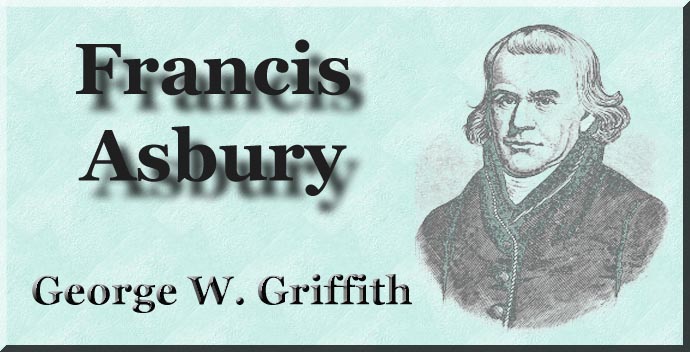
Francis Asbury
By George W. Griffith
Chapter 5
DEDICATION OF THE ASBURY MEMORIALMarch 31, 1916 was the one hundredth anniversary of the death of Bishop Francis Asbury, the founder, under God, of American Methodism. That year was observed as Asbury Centennial by many branches of American Methodism. By a special act of Congress, ground was donated in the National Capital for an equestrian statue of Bishop Asbury, to be paid for by popular subscriptions taken in the Methodist churches of the United States and Canada. The prospective cost was $50,000. The Executive Committee of the Free Methodist church, in its annual meeting in October, 1915, adopted a long series of preambles and resolutions relative to the Bishop Asbury Centenary, of which the last three resolutions were as follows: Resolved: That we earnestly recommend our societies and preachers throughout the entire connection to observe the proposed Centenary by appropriate services in connection with which a sermon shall be preached emphasizing Asbury's deep spirituality, his great influence in promoting and conserving Scriptural holiness in the New World, and magnifying his work as "the pioneer, the builder, the hero of the first half century of American Methodism." Resolved, That we also recommend each annual conference to plan for an appropriate service during its session in 1916 in celebration of the Asbury Centenary; and, unless others have been designated for so doing, we request our district elders in the several conferences to act in advance as a committee on preparation of a program for the occasion. Resolved, That we recommend that at each Centenary service a voluntary offering be lifted towards the erection of a bronze equestrian statue in the City of Washington, D. C., in commemoration of this devoted man among the statues of the other great men of the nation. The late Bishop Wilson T. Hogue was deeply interested in the project and was largely responsible for the definite action taken by the Executive Committee. By pen and voice he gave the matter his heartiest support and constantly urged a general observance of the Centenary by our people. The Asbury statue is the first purely religious memorial erected on public ground in the National Capital. The Act of Congress donating the ground referred to Bishop Asbury as "a pioneer itinerant, whose continuous journeyings through our cities, towns, villages and early settlements, from 1771 to 1816, greatly promoted the interests of patriotism, education, morality and religion and were a distinct aid to the American republic." Bishop Asbury was born in Staffordshire,
England, August 20, 1745; landed in the United States, October 27,
1771; was ordained bishop in 1784; and died at Spottsylvania, Va.,
March 31, 1816. He has been most appropriately called, "The Prophet
of the Long Road." It is estimated that he traveled 270,000 miles
and preached 16,000 sermons. When he landed in The completion of the statue and its dedication was long delayed on account of the late war and other reasons. The formal dedication has just been observed and those who contributed to this worthy object will be interested in reading the following account of the ceremonies connected with the unveiling, by Rev. F. F. Shoup, of Washington, D. C.: The equestrian statue of Francis Asbury, pioneer Methodist bishop in America, was unveiled and dedicated October 15 at Washington, D. C. It occupies a beautiful and prominent site on Sixteenth and Mt. Pleasant Streets. The statue is a full-sized figure in bronze of Bishop Asbury on horseback. The faithful horse is trudging wearily along, while the bishop sits erect with the reins in the left hand and the Bible in the right. Representatives from the following churches occupied seats on the platform: Methodist Episcopal; Methodist Episcopal, South; Methodist of Canada Methodist Protestant; Free Methodist; African Methodist Episcopal; African Methodist Episcopal Zion; Colored Methodist Episcopal. Bishop Sellew was to have represented the Free Methodist Church, but as he was providentially hindered, the invitation was extended to the writer. The monument was presented to the government by Bishop Wm. F. McDowell, and accepted for the government by Lieut. Clarence D. Sherrill, Corps of Engineers, U. S. Army. With the assistance of a great amplifier the voices of the different speakers were carried out in every direction, making it possible for the large audience to hear distinctly. Music for the occasion was furnished by the United States Army Band. President Coolidge occupied a seat on the platform and delivered an address. The President said, "We can not depend upon the government to do the work of religion. An act of Congress may indicate that a reform is being or has been accomplished, but it does not itself bring about a reform. The government of a country never gets ahead of the religion of a country." Religion was described by the President as the foundation of this government. "It is as a result of the preaching of Bishop Asbury, his associates, and other religious organizations," he declared, "that our country has developed so much freedom." "It is well to remember this," he added, "when we are seeking for social reforms. Of course we can help to restrain the vicious and furnish a fair degree of security and protection by legislation and police control, but the real reforms which society in these days is seeking will come as a result of our religious convictions, or they will not come at all. We can not escape a personal responsibility for our own conduct. We can not regard those as wise or safe counselors in public affairs who deny these principles and seek to support the theory that society can succeed when the individual fails." "There is no way by which we can substitute the authority of law for the virtue of man. Peace, justice, humanity, charity-these can not be legislated into being, they are the result of a Divine grace." From the life of Bishop Asbury, who came to this country as a preacher before the Revolutionary War, the President drew a lesson of sacrifice and devotion which he said "has gone into the making of our country." He recalled that the pioneer bishop traveled about 6000 miles a year, preaching about 16,100 sermons and receiving as his highest salary eighty-five dollars a year." "He had no idea," Mr. Coolidge said, "that he was preparing men the better to take part in a great liberal movement, the better to take advantage of free institutions, and the better to perform the functions of self-government. He did not come for political motives. He came to bring the gospel to the people." Two hymns were sung, "Jesus, the name high over all," by Charles Wesley, and "Behold the Christian warrior stands," by James Montgomery. The services were simple and deeply impressive; and in every way a splendid tribute to the memory of the man who literally wore himself out in the service of his Lord and Master for the salvation of men. |
|
 |
 |
FOR DISCUSSION AND MEDITATION1. Why has Bishop Asbury been called "The Prophet of the Long Road?" 2. Describe the statue of Bishop Asbury. 3. How did the Act of Congress donating the ground in the National Capitol refer to Bishop Asbury? 4. What tribute did President Coolidge pay to religion in his address at the dedication of the monument? 5. What contribution has the reading of this booklet made to your life? |
|
-
Site Navigation
 Home
Home What's New
 Bible
Bible Photos
 Hiking
 E-Books
 Genealogy
 Profile
Free Plug-ins You May Need
Profile
Free Plug-ins You May Need
 Get Java
.png) Get Flash
Get Flash Get 7-Zip
 Get Acrobat Reader
 Get TheWORD