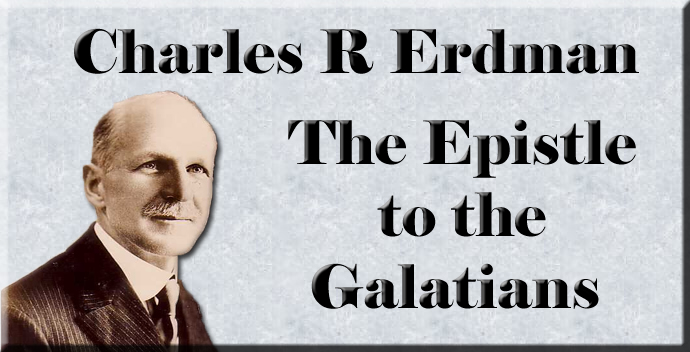
The Epistle to the Galatians
Introduction
|
I. The Authorship and Aim As to the authorship of this epistle there need be no doubt. It was written by Paul to defend the purity of the gospel against those who were insisting that Christians must observe the Mosaic law. Every paragraph is stamped with the personality of the great apostle. In him a powerful mind, a tender heart, and an indomitable will were united with the deepest spiritual insight; and this unusual combination of qualities in the author has given to the epistle its striking and characteristic features. Never does Paul argue with more clearness, more incisiveness, more convincing power. Nowhere does he reveal more indignation, more scorn, more affection, more devotion to Christ, more consciousness of a divine call, more determination to accomplish a sacred task. The style is unmistakable. Its vigor, its irony, its pathos, its abruptness, its vehemence, its spiritual revelation reveal Paul at the very height of his powers. The special problem with which the epistle is concerned also argues for its authorship and its genuineness. By the end of the first century the relation of Gentile believers to Jewish ritual had ceased to agitate the Church; but in the time of Paul it was a burning question, and its discussion held a central place in his career. It was a matter of far greater difficulty and importance than one might suppose. The modern world has placed an unfortunate and an unnecessary gulf between Christian and Jew. No one to-day would dream that a Christian should be compelled to observe Jewish rites in order to attain the highest spiritual privileges and experiences. Yet this was exactly what many in the Early Church believed, and their contention was the occasion not only ol this letter but of much of the writings and the anxieties and the labors of Paul. Judaism and Christianity are vitally related. Israel was the nation chosen of God to reveal to the world his being and nature, and his law and grace. Judaism is the flower of which Christianity is the fruit. Israel is the olive tree on to which Gentile Christians have been grafted as branches. The Old Testament prophets predicted the coming of Christ, the Messiah. The law of Moses, with its priesthood and altars and ceremonies, foreshadowed the redeeming work of Christ and the holiness expected of his followers. However, Paul saw that, when the substance had come, the shadow could disappear; when Christ had fulfilled the law, he had become "the end of the law" to everyone who believed in him. Paul realized that even in Old Testament times men were saved by grace through faith in God as he had revealed himself; and Paul understood the great "mystery" that in Christ the law which separated Jew and Gentile had been done away, and that by faith in him Jews and Gentiles formed one body, the Christian Church. Many, however, did not share the vision of Paul. They insisted that even though Jesus were accepted as the Messiah, it was necessary for all who professed their faith in him to observe also with all strictness the ritual which Moses had established. These legalists had much to support their contention. The inspired Scriptures showed the sanctity of the law. When Christ came he was careful, during all his ministry, to observe the requirements of the law. The apostles he ordained continued to frequent the Temple and to live and worship as other Jews. Even Paul, while proclaiming to Gentiles freedom from the law, continued to keep the Jewish feasts to take upon himself Jewish vows, and to glory in his relation to the Jewish race. It is no wonder that the legalists hated him, declared him to be a timeserver, denied his authority as an apostle, opposed his work, and pursued him to distant cities. It fell to the lot of Paul not only to meet these enemies but to establish for all time the relation between law and grace, the doctrine of justification by faith, and the great fact that the Christian Church is not a mere Jewish sect but a universal brotherhood, composed of all who trust in Christ and find in him the predicted Messiah, the fulfillment of all the types of ancient Scriptures and of all the hopes of the inspired prophets. Paul was well prepared for his task. He was a Hebrew by birth, and belonged to the strictest of the Jewish sects, that of the Pharisees. He had studied the Mosaic law in Jerusalem as a pupil of Gamaliel, one of the leading Jewish teachers of the day. Yet Paul knew, also, the Gentile world. His birthplace was Tarsus, in consequence of which he had the high privileges of Roman citizenship. His early surroundings were those of Greek culture, for, after Athens and Alexandria, Tarsus was the most important university center of the age. Such a man might well be selected as the one who was to teach the true relation between Judaism and Christianity. He had attained eminence as a student and teacher of the law. He passionately loved his own Jewish people, their history, their customs, their traditions and beliefs. He hated the Church and sought to destroy all who accepted its doctrines. However, when he caught a vision of the glorified Christ, he saw that his atoning death was the fulfillment of all the Jewish sacrifices, and that his resurrection was a vindication of all his claims. Henceforth, to Paul, Jewish ceremonies were matters of indifference. He observed them that he might give no offense to his Jewish friends, but he taught that they need not be kept by Gentile believers. He insisted further that to observe the law as a ground of salvation was in reality to turn from Christ and his atoning work. On his First Missionary Journey Paul had made many converts among the Gentile inhabitants of Asia Minor, and had compelled none of them to observe the Mosaic ritual. When he returned to Antioch, he was attacked by Christian converts from Judaism, who insisted that all believers must keep the whole ceremonial law. A great Church council was called to meet in Jerusalem. There it was determined that the burden of the ceremonial law should not be bound upon Gentile believers. They were urged to avoid giving needless offense to their Jewish brethren, refraining from the use of food which had been sacrificed to idols and from blood; but they were completely emancipated from all observance of the Mosaic law. However, the trouble was not ended. Not long after, Peter visited Antioch and, in rightful disregard of Jewish usages, sat at the same table with Gentile Christians. Then certain Jewish converts arrived from Jerusalem, who insisted that Jewish Christians would be defiled by contact with those who disregarded the ceremonial law. To their influence both Peter and Barnabas yielded. Paul, however, stood boldly by the doctrine of Christian liberty. He rebuked Peter before the whole Church and completely discomfited the legalists from Jerusalem. Nevertheless, the same difficulties arose wherever a Christian church was established. Judaizers appeared who attacked the doctrine of Paul, undermined his influence, and denied his apostolic authority. This was true in Corinth quite as much as in Antioch. In no place, however, was the attack so violent, so serious, and so successful as among the churches of Galatia. Here, as in the other churches, doctrinal difficulties had not arisen within the circle of the converts, but Judaizers had come from abroad and had invaded these churches, turning believers from the gospel of Christ, and insisting that they must observe the Mosaic law. The entire membership of these churches seems to have been affected. The situation demanded extreme measures. Therefore Paul wrote this epistle. In no other letter does he set forth so clearly the perils of legalism, the glory of the cross, and the freedom from law which belong to the followers of Christ. This epistle is rightly called the "Magna Charts of Christian Liberty." It establishes the essential Christian truth of justification by faith, and by faith alone. No rites, no ceremonies, no form of worship or of words are necessary to salvation. All that is needed is faith in Christ. This faith, however, must be so real as to involve complete submission to his will, so vital as to manifest his virtues, so true as to follow his perfect law of love. II. The Destination and Date Which were the exact churches here addressed, it is difficult to decide. Did they belong to Galatia proper, or were they found within the larger Roman province known by that name? According to the former view, they were churches in the cities of Ancyra, Pessinus, and Tavium, which were established by Paul on his Second Missionary Journey. According to the latter view, they were the churches in Antioch of Pisidia, in Iconium and Lystra and Derbe, organized by Paul on his First Journey through Asia Minor. The very name "Galatia" is of interest. Every schoolboy knows that "all Gaul" was "divided into three parts," but not every student of the Bible knows that certain Gallic tribes fought their way eastward through Europe, ?78-297 B.C.; crossed the Hellespont; pillaged, plundered, and ravaged Asia Minor; and finally settled in the northern central plateau in a region which was designated Galatia, or "the country of the Gauls." The section to which the Galatians were finally confined, and which constituted Galatia proper, was a rough oval extending some two hundred miles east and west and some one hundred miles from north to south. It was inhabited in the time of Paul by a mixed population in which the descendants of the Gaulish tribes formed only a minority, while the larger number were of the ancient population, and to these were added many Greeks, Romans, and Jews. By the time of the apostle the region had passed under the power of Rome and formed part of a province which included within its southern borders the cities which Paul visited upon his First Missionary Journey. In writing to the Galatians was Paul addressing churches of Galatia proper or churches of the Roman province, which included not merely Galatia but Paphlagonia and parts of Pontus, Phrygia, Lycaonia, and Pisidia? Was he addressing the churches of northern or southern Galatia? In favor of the southern Galatia theory much can be said. In fact many modern commentators dismiss the traditional northern Galatia theory as no longer worthy of serious thought. First of all, Paul frequently grouped the churches he addressed according to the Roman provinces in which they were located. Thus he wrote of the churches of Macedonia and of Achaia, and so possibly of Galatia. Secondly, the cities of southern Galatia, such as Antioch and Lystra and Derbe, lay along the main routes of travel and were of far greater prominence than those of Galatia proper. It is probable that Paul addressed this important letter to the churches of these cities rather than to obscure churches of the north. Thirdly, the establishment of the churches in southern Galatia is fully described in The Acts, whereas the visit of Paul to northern Galatia is mentioned by Luke only incidentally, if at all. In the fourth place, the doctrinal question discussed by the apostle is said to have belonged to an earlier period of his ministry than that required by the northern Galatia theory. To all this it has been replied: (1) Luke, the companion and biographer of Paul, certainly uses the term "region of Galatia" to denote not the Roman province but the northern part of the province. Acts 16:6; 18:23. Peter likewise seems to refer to northern Galatia, rather than to the Roman province, when he uses the term "Galatia," 1 Peter 1:1. (2) Paul may have written many letters to the churches of southern Galatia. We have only a fraction of his correspondence, and the letters which have been preserved do not owe their place in the New Testament to the prominence of the parties addressed. Nor did Paul select the churches to which he wrote because of their size or importance, but because of their need and his concern for their welfare. (3) As to the establishment of churches in northern Galatia, Luke does refer to a visit there; and Paul's own description of his founding of the Galatian churches is almost conclusive in favor of the northern Galatia theory. He declares that his work in Galatia was not a part of his missionary program. It was due to an illness which turned him aside from his journey and detained him among the Galatians. To them, under such circumstances, he "preached the gospel." These circumstances seem quite unlike the description given by Luke of the first active, unresting, rapid itineration of southern Galatia, when Paul established churches in Antioch, Iconium, Lystra, and Derbe. Of this itinerary Luke has given a full description, and the more carefully it is read the less ground does it give for believing that this strenuous itineration could be attributed by Paul to a painful and repulsive "infirmity of the flesh." Gal. 4:13-15. (4) As to the statement that the doctrinal questions concerning the relation between law and gospel, between legalism and grace, had been settled earlier than the time of Paul's Third Missionary Journey, and that this letter must therefore have been written at an earlier date, just the reverse is the contention of many careful students. In fact some assert that this epistle is so similar to the Epistle to the Romans that it was quite probably written at nearly the same time. , Evidently there is much ground for divergent views. However, there does not appear to be any absolute reason for abandoning the traditional belief that the epistle was addressed to the churches of Galatia proper, in the northern portion of the province which bore that name. According to this theory, the course of events in the life of Paul is as follows: On his First Missionary Journey he founds churches in Antioch of Pisidia, in Iconium, in Lystra, and in Derbe. On his Second Journey he passes through these cities, and then, when detained by an illness, preaches in old Galatia, and founds "the churches of Galatia," passing on thence to Troas and to Europe. On his Third Missionary Journey, he returns to Galatia, visits the churches he has established, and then, following the ancient royal road which traversed this region, he moves westward to Phrygia on his way to Ephesus. Either from Ephesus, or a few months later from Corinth, this letter is written, possibly in the year A.D. 57 or 58. According to the southern Galatia theory, Paul's second visit to Galatia was identical with his return to Antioch, Iconium, Lystra, and Derbe on his Second Journey. He moves westward to Troas and Philippi and Corinth, and probably from the last of these cities writes this letter, which may be the earliest of the epistles of Paul extant. Thus it is quite evident that the supposed location of these churches, whether in northern or southern Galatia, does affect one's view of the date of this epistle, and its place in the life of Paul. However, it does not affect the interpretation of the letter or its message for the present day. It is a question of real historical and biographical interest. It cannot be said to be of deep practical concern. The substance of the letter is of supreme importance. Wherever the first readers of the letter may have resided, they received from Paul a document of priceless value. He was answering for them the question which concerned the very essence of Christianity. Was Christ sufficient for salvation? Must something be added to his atoning work? What must one do to be saved? Wherever written, by whomsoever first read, here is an epistle of vital concern to every human soul. III. The Contents and Analysis Every portion of the epistle is closely related to its one great theme; namely, Christian liberty. No other letter written by Paul is marked by a greater unity of purpose. The enemies of the apostle had discredited his gospel message and attempted to bind upon Christian believers the burden of the Mosiac law. With this in view they had denied his claims to be an apostle; while their own false teachings had resulted in serious irregularities of conduct. Therefore Paul found it necessary first to establish his apostolic authority, then to defend his doctrine, and finally to exhort to right living. Thus the epistle falls into three sections of two chapters each. The first is personal; the second is doctrinal; the third is practical. The first concerns Paul's divine commission; the second, his doctrine of freedom from the law; the third, the life of believers. The first presents the apostle of liberty; the second, the doctrine of Liberty; the third, the life of liberty. In the first the doctrine is stated; in the second the doctrine is defended; in the third the doctrine is applied. The very salutation with which the epistle opens states Paul's apostolic authority as absolutely divine. Ch. 1:1-5. It is followed by a stern rebuke in which he expresses surprise at the fickleness of the Galatians; he charges the false teachers with heresy, and he repudiates insinuations against his own sincerity. Vs. 6-10. Paul then asserts that the authority for his gospel has come from no human source, but directly from Jesus Christ. Vs. 11, 12. This is the theme on which he enlarges during the remainder of the first two chapters. He proves the fact by a brief review of certain personal experiences which demonstrate his standing as an apostle. a. He was an apostle before he had met the Twelve Apostles, whose recognized authority was alleged to disprove his own. He had been a leader among the Jews; he had been a persecutor of the Christian Church; but by a direct revelation from Christ he had been converted and appointed a messenger to the Gentiles. As to this call to service, he had consulted with no one. Three years later he did become acquainted with Peter and James. From them, however, he received no commission and asked no indorsement. He preached in Syria and Cilicia, and the churches of Judea thanked God for the task he was achieving. These churches recognized the divine call which his enemies were denying. Vs. 13-24. b. When Paul met the apostles they recognized him as an equal. He had been preaching for fourteen years and went up to Jerusalem to consult about the gospel he was proclaiming. Here Peter, James, and John added nothing to his enlightenment or authority. They acknowledged him to be the apostle to the Gentiles, and, in recognition of his equality with themselves, they extended to him the right hand of fellowship. Ch. 2:1-10,
The mention of this incident was a third proof of Paul's dignity and of his apostolic authority, and its recital gave Paul an opportunity of stating the great principle involved, the very theme of his epistle; namely, justification by faith in Christ and freedom from the bondage of the Mosaic law. Ch. 2:11-21. Paul now turns to demonstrate his great theme. He brings forward a threefold argument and then makes a threefold appeal. Chs. 3; 4. He argues first from the experience of the Galatians. They had received the Holy Spirit. This was the supreme and comprehensive Christian blessing. Had this come to them by their obedience to the law, or by their faith in Christ? They knew it was a free gift accepted by faith. Would they now abandon the principle of faith? Would they now seek by legal observances to perfect what had been begun by the Spirit? Nor was their case exceptional. Their experience was the same as that of Abraham. He was justified by faith; and he was typical of all believers. By faith men become sons of Abraham; by faith they become heirs of the promises. On the other hand, the law, with its requirement of perfect obedience, has the power only to curse and not to bless. For this very reason Christ came to redeem us from the curse, that by faith in him we might receive tb«> promised blessing of the Spirit Ch. 3:1-14. In the second place, Paul argues from the character of the covenant made with Abraham. It was a gracious promise to be accepted by faith. It was made centuries before the law. It was not conditioned upon the law, nor could it be annulled by the law. Such a subsequent institution could not affect the promise made to Abraham and to his seed. Yet the law had its purpose and its place. It was added to make men conscious of their sin. It was not given as a means of salvation, but to show the need of salvation. By its influence men might be led to accept the promise which could be received by faith in Christ. Vs. 15-22. Paul argues, in the third place, from the state of immaturity of those living under the law. They were like children, minors, "infants," who had not attained to the age of "heirs," or of full-grown sons. The law was indeed their tutor, their pedagogue, their schoolmaster, sent to lead them to Christ. However, now that they had found Christ, they were no longer "under a tutor." They were full-grown sons; they formed the true seed of Abraham; they were "heirs according to promise." Even though heirs, children, while still under age, need the tutelage of guardians, and have no part in their inheritance. Such was the condition of those under law. Now Christ has come. He has redeemed those under the law that they may be brought into the position of fullgrown sons. As sons, God has sent forth his Spirit into their hearts, so that they call him Father and are no longer in a condition of immaturity and servitude, but are sons of God, enjoying their heritage, as heirs of the promises, by faith in Christ. Chs. 3:23 to 4:7. To this threefold argument, Paul now adds a threefold appeal. First of all he appeals to the pride of the Galatians. In accepting the obligation of the law they felt that they had been admitted to a spiritual aristocracy among Christians. Paul assured them that on the contrary they were in effect turning back to their former paganism. To trust for salvation to the performance of rites and ceremonies is no better than to trust in idols. Ceremonialism may be but baptized heathenism. Ch. 4:8-11. In the second place Paul appeals to their affection. He recalls the fervent reception they had given him when they first welcomed him as a messenger of the gospel. In spite of his physical infirmity, he had been received "as an angel of God." He deplores the alienation of their hearts which the false teachers have selfishly secured. He confesses his perplexity that his spiritual children should have turned against him and have doubted his message. Vs. 12-20. In the third place he appeals to their intelligence. They who made their boast in the law should be able to see what the law itself teaches as to spiritual bondage and spiritual freedom. This is shadowed forth in the familiar story of Sarah and Hagar. Who received the blessing? Who became heir of the promises? Was it the son of the bondwoman or of the free? Was it the child "after the flesh" or the child of faith? So then those who trust in Christ are like children of the free. Instead of bondsmen to the law they are heirs of the liberty wherewith Christ has made them free. Vs. 21-31. In the fifth and sixth chapters, Paul makes a practical application of his teaching. He shows that: a. Christian liberty is imperiled by legalism. He urges his readers to maintain their freedom. He warns them that to accept circumcision will be to cut themselves off from Christ. It will bind them to keep the whole Mosaic law. It is either law or grace. They must choose between them. To the true Christian outward ceremonies are of little significance. "Faith working through love" — this is supreme. Ch. 5:1-6. He cannot believe that they who started so well are to be turned from the Christian course. His own persecutions attest his loyalty to the cross. He believes that one who perverts the truth will not and ought not to escape punishment. Vs. 7-12. b. Christian liberty is perverted as license. Its real complement is love, which is in essence the fulfillment of the whole moral law. This will be possible only as, by faith in Christ, one is energized by the Spirit. It is true that the Spirit will ever be opposed by "the flesh." But those who by the Spirit are set free from the bondage of law will by the Spirit be delivered also from the assaults of the flesh. The work of the flesh and of the Spirit are easily distinguished. Those that have been crucified with Christ and are living by his Spirit will keep the law, without either falling under the bondage of the law, or yielding to the. license of the flesh. Vs. 13-26. c. Christian liberty is perfected in love. This is illustrated by two examples. First, in relieving others of their burdens of moral fault. By a humble, gentle restoration of a fallen brother, one may fulfill Christ's perfect law. Ch. 6:1-5. As a second example, love should lead one to share his material goods with those who teach spiritual truth. Otherwise he will be mocking God. Sowing to the flesh or to the Spirit is preparing for an eternal harvest. Therefore one should do good to all men, assured that the time of reaping will come. Vs. 6-10. The conclusion of the letter, written in bold characters by Paul's own hand, forms a compact summary of its entire contents: (1) In connection with chapters 5 and 6, Paul rebukes the Judaizers, as men who are not walking by the Spirit, but are insincere and sin'ster in their motives. Ch. 6:11-13. (2) In accordance with the teaching of chapters 3 and 4, Paul declares his whole ground of boasting to be the cross of Christ. Vs. 14—16. (3) As to his apostolic authority, established in chapters 1 and 2, no one should further question it. He bears, as brands of Christ's lordship over him, the marks of bodily sufferings received in the service of his Master. V. 17. The last line of the letter is in the form of an affectionate farewell. V. 18.
|
|
 |
 |
|
|
|
-
Site Navigation
 Home
Home What's New
 Bible
Bible Photos
 Hiking
 E-Books
 Genealogy
 Profile
Free Plug-ins You May Need
Profile
Free Plug-ins You May Need
 Get Java
.png) Get Flash
Get Flash Get 7-Zip
 Get Acrobat Reader
 Get TheWORD