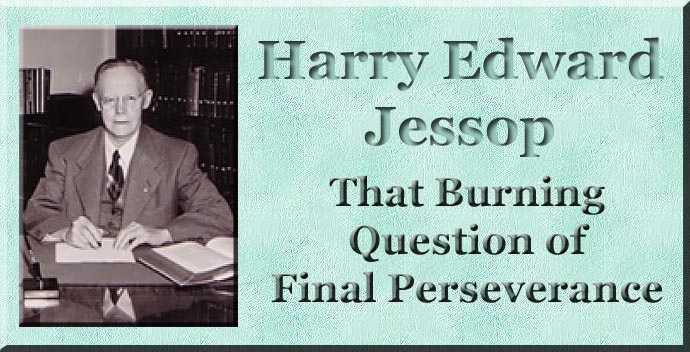
That Burning Question of Final Perseverance
By Harry E. Jessop
Chapter 5
EMPHASIZING THE TRUTH WHAT DO THE SCRIPTURES TEACH?"But the God of all grace, who hath called us unto his eternal glory by Christ Jesus, after ye have suffered a while, make you perfect, stablish, strengthen, settle you" (1 Peter 5:10). "But ye beloved, building up yourselves on your most holy faith, praying in the Holy Ghost, keep yourselves in the love of God, looking for the mercy of our Lord Jesus Christ unto eternal life . . . Now unto Him who is able. to keep you from falling, and to present you faultless before the presence of his glory with exceeding joy . . ." (Jude. 20:24). If it be true that the Scriptures do not teach the unconditional security of those who have once believed ill Christ for salvation without further concern about its continuance, some closing word will be needed concerning the character of the salvation which the opponents of Calvinism profess to enjoy. Controversy is never without its attendant dangers for either side. Too often slogans are adopted, epithets hurled and personalities discussed when the sole purpose of all concerned should be a mutual helpfulness to see and to enjoy the truth. In the Arminian-Calvinistic controversy this very thing has frequently happened. Arminians have labeled the Calvinists, "Once. in grace, always in grace -- no matter how disgraceful you may be." On the other hand, the Calvinists have sneeringly said of the Arminians, "Saved today and lost tomorrow -- and often a dozen times in between." Such religious mudslinging will get us nowhere. It will not help us to respect each other, which as followers of a common Lord we should endeavor to do despite all our theological differences. To say that those who oppose the doctrine of the unconditional security of those who have once believed in Christ for salvation have swung to the other extreme and teach a doctrine of alternations, being in Christ one day and out of Christ another day, is far from stating the truth. We venture to say that, so far as we have been able to observe, there seem to have been fewer backslidings among Arminians than among Calvinists, the difference seeming to be that among Arminians the personal-life standard required by their doctrine is higher. Calvinistic backsliders are more easily concealed; they may go on in their sin and yet talk about imputed righteousness, declaring it is not what they are in themselves but what they are in Christ, while Arminian backsliders are conscious how useless it is to claim the merits of Christ as a protective covering before God when their lives are so unfaithful before their fellows. They realize that we may not continue in sin that grace may abound, and that it is only if we walk in the light as He is in the light that the blood of Jesus Christ, God's Son, cleanseth us from all sin. What then, is the actual position taken by those who refuse to endorse what appears to them to be the pernicious doctrines of predestination and unconditional final perseverance? To those who have had theological training, what follows will hardly be necessary. We write, however, not for the theologian but for the layman who amid these mazes is groping to find his way. We believe that when dying on Calvary's cross, the Son of God made an atonement which was full and sufficient. That atonement provided a way whereby a corrupt and guilty soul might approach a just and holy God. Rom. 3:23-26; Gal. 3:13; Col. 1:14; Titus 2:14; 1 Peter 3:18; and other Scriptures. We further believe that this atonement is unrestricted in its reach, comprehending an entire world. John 1:29; 3:16; Rom. 5:18; 2 Cor. 5:14; 1 Tim. 2:4-6; Titus 2:11; Heb. 2:9; 1 John 2:1, 2, and other Scriptures. We insist, however, that according to the plain teaching of the Word of God, the benefits of this atonement are necessarily conditioned. a. As to its reception.
b. As to its retention.
|
|
 |
 |
|
|
|
-
Site Navigation
 Home
Home What's New
 Bible
Bible Photos
 Hiking
 E-Books
 Genealogy
 Profile
Free Plug-ins You May Need
Profile
Free Plug-ins You May Need
 Get Java
.png) Get Flash
Get Flash Get 7-Zip
 Get Acrobat Reader
 Get TheWORD