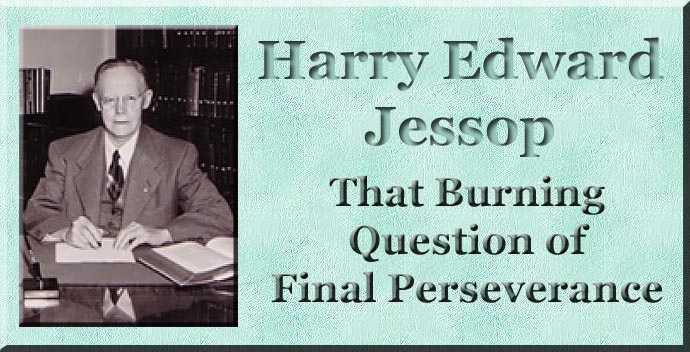
That Burning Question of Final Perseverance
By Harry E. Jessop
Chapter 2
REVIEWING THE DOCTRINE CALVINISM AND FINAL PERSEVERANCE"For whom he did foreknow, he also did predestinate. to be conformed to the image of his Son, that he might be the firstborn among many brethren. Moreover whom he did predestinate, them he also called: and whom he. called, them he also justified: and whom he justified, them he also glorified. What shall we. then say to these things r' (Romans 8:29-31a). It is impossible to enter upon an intelligent discussion of any doctrine, and certainly unfair to attempt to refute it unless we are clear in our thinking as to what that doctrine really is. Moreover, if we are to be unbiased in our judgment our approach must be made, not through the criticisms of its antagonists but through the teaching of its exponents. Until we are thoroughly conversant with it we have no right to discuss it; and having sufficiently acquainted ourselves with it, care must be taken that we correctly state it. The relationship of the atonement of Calvary to the race of which we are a part may be broadly stated as expressed in three distinctive schools of thought: the Arminian, the Calvinistic and the Universal. Within these, of course, may be numerous divisions and phases of teaching, but in broad outline these divisions cover the field. At the one extreme stands the Universalist. According to his teaching the atonement of Calvary reaches everybody. If there is any suffering in the life beyond it is remedial and temporary and not punitive and lasting. A God of love, through the death of His Son will have all men to be saved. At the opposite end stands the Calvinist who stubbornly insists that in the atonement provision has been made for a limited number only; these were predestinated to salvation far back in eternity. To them will come the effectual call which it will not be possible to resist; nor can they ever be lost no matter how far they may then go astray. The rest of mankind are left to their fate, and in it God is glorified. Between the two stands the Arminian who declares that in the Calvary work of Jesus, God has made a bountiful provision for all who will accept it. The conditions of salvation are repentance toward God and faith in Jesus Christ, a renunciation of all known sin, and a continued obedience to the claims of God as long as they live. Those who meet these conditions are eternally saved; those who reject them are hopelessly lost. It is with the Calvinistic and Arminian schools that we are here concerned. The Arminian school of thought originated in a movement headed by James Harmensen, more generally called Arminius, then professor of theology at the University of Leyden in Holland. The best form of his teaching was endorsed by the Wesleys and became the basic doctrine of the Methodist Churches and later denominations of kindred thought. The Calvinistic school, while perpetuating the name of John Calvin, goes farther back than Calvin for its origin, and has for its real founder the monk Augustine, who became bishop of Hippo in North Africa. Augustine was born A. D. 354 and died A. D. 430. Before Augustine the unanimous doctrine of the church, so far as it was developed at all, was that the divine decrees so far as the individual was concerned, were governed by that soul's personal faith and obedience; this of course, was regarded as having been foreseen, though not fore-ordained in the divine mind. There was no fixity of eternal status until death ended probation. Around this man Augustine history throws an interesting story. His earlier life had been dissolute and wild, but God in His mercy had graciously saved him. So marvelous and thorough had been his conversion that he sought in all sincerity to magnify the grace of God in his testimony and teaching. It should be remembered, however, that in every doctrine there is a place where, unless special care is taken, the overemphasis of truth tends to turn it into error. It was at this point that Augustine overreached himself and became responsible for a twisted doctrinal presentation which in its various points of emphasis has persisted through the centuries until the present hour. His teaching centered around three main thoughts: Concerning Human Sin. According to Augustine, man is utterly corrupt -- so much so that sin is an ingrained disease in his humanity which not even the energies of divine grace can cure in the present life. Man is sinful through and through and will remain so despite the fact of the imparted God-life in regeneration and all else that an Almighty God can do for him while here on earth. Despite all the agencies of divine grace "that which is born of the flesh is flesh"; that flesh is sinful and until this mortal puts on immortality it must so remain. Concerning the Human Will. According to Augustine the will of man by nature is fettered and bound, and only an act of divine grace can liberate it. Concerning Saving Grace. That grace, according to Augustine has three outstanding characteristics -- it is selective, irresistible and eternal.
But this teaching, even in Augustine's day was not without its challenge, and among those who entered the arena was Pelagius, a British monk. It is reported that Pelagius, having gone to Rome found conditions in the church which gave him a tremendous shock. The prevailing corruption, indifference to ethical standards, even common morality, amazed him. These conditions the monk attacked, only to receive the reply that such a state was unavoidable, human nature being altogether too weak to resist the manifold temptations surrounding it. This, Pelagius withstood, raising the questions of the freedom of the will and the nature of sin, the problem of inherited corruption and the value of external help to enable man to do right. Controversy drove him to take extreme positions and his pupil, Caelestius, seems to have become even more radical and committed his master to further difficulties. The teaching of Pelagius ultimately resolved itself into salvation by human endeavor. Neither church, nor sacraments, nor even the grace of God were essential; if man tried hard enough he could do it of himself. Thus came the Pelagian error. The doctrine of predestination as Augustine taught it continued until the ninth century, when Gottschalk, the Saxon monk, introduced a further development declaring not only the unconditional salvation of the elect, but also the foreordination of the rest of mankind to eternal death; they were irrecoverably damned by divine decree. As we pass over to the Reformation period, we have, therefore, the corruption of Rome on the one hand and the rationalistic leanings of Pelagianism on the other, and facing the two a band of desperate men in a determined struggle for spiritual freedom. The Romanistic practices and teachings must be abolished and other doctrines established in their place. John Calvin and his contemporaries reveled in the glorious truth of the sovereignty of God, and this they emphasized in displacing the then current teaching of the supreme authority of the church, but in their desire to be emphatic they overreached in their emphasis, establishing another error which has proved itself to be as deadly as that which they were seeking to destroy. So utterly disgusted were they with the brazen error which they encountered, that, like the swinging of a mighty pendulum, they reached back through the centuries for something which they conceived to be authoritative, and laying hold of the teaching of Augustine they embellished it with that of Gottschalk, thereby forming what they conceived to be a bulwark against the flood-tide of corruption and error by which they were opposed. Thus, the unconditional foreordination to eternal life as taught by Augustine and the unconditional foreordination of the reprobate to eternal death as taught by Gottschalk became the basis of the Geneva doctrine which has come down to us under the designation of Calvinism. In a purely Calvinistic presentation the ideas of predestination and eternal security are found as corollaries; there is a tendency, however, among the more evangelistic element today to embrace what might be termed a semi-Calvinism in which the predestination idea is not openly stressed, but a doctrine of salvation for all is freely declared. Alongside of this is the insistent harping on the teaching of the eternal preservation of all who have once believed, thereby establishing a sort of hybrid doctrine within the limits of Calvinistic thought. In Calvinism proper, as we have already seen, the thought is much more rigid. There, certain elect souls are born to be saved; for this they were chosen before the world began -- far back in the councils of eternity. Sooner or later they will hear the effectual call and when that call is heard they will obey it -- they can do no other. From that moment they will be eternally saved; no matter what manner of sin they may afterward commit, they cannot be finally lost. God looks at them, not as they actually are, but in the person and through the passion of His beloved Son and they are eternally secure. Having said this concerning the Calvinistic teaching, it is only fair that we should also say that among those holding this doctrine there are many who in actual spiritual experience are far better than their creed. Choice souls there are who, we are fully convinced, would rather die than willfully grieve their Lord, yet so bound are they by their doctrine that they continually lament their sinfulness, seeing no hope of deliverance while here on earth although all the time insisting that they are eternally secure. The fact of the sincerity of these good people, however, by no means makes the doctrine less dangerous; it rather adds to the difficulty of younger believers when it becomes necessary for them to face it. In theological thought then, the doctrine of eternal security does not stand alone; it is the counterpart of that companion error, the teaching of predestination, both of which come under what is known as the doctrine of decrees -- according to which God in the beginning by His sovereign choice and decree determined the number and names of those who should be called, thus making it impossible that any other than they should be saved, and equally impossible for them, the called ones, to be lost. It will be seen, we trust, that in dealing with this error our purpose is not to attack people, however wrong we may deem their teaching to be. Even in political life men may differ and yet remain good friends; it would be a poor mark of grace on either side if men and women professing a mutual relationship to Jesus Christ could not differ in their interpretations and still show Christian love the one to the other. But why, it may be asked, do some people take what seems to many of us to be such an absurd position? Various reasons may be stated in reply: Some are Calvinistic in their thinking because of the atmosphere in which they have been brought up. This doctrine has been taught them from their infancy. Others there are who take this position because of the disappointments they have met. Some have been in modernistic churches and have become so tired of the teaching there given that they have sought for something else; or they have been in churches flooded with worldliness and have looked for a more spiritual ministry and hearing a man with what seemed to be a positive note based on the Word of God, the whole thing has seemed so wonderful that they have wholeheartedly accepted it. There is another reason -- shall we call it a psychological reaction? It is possible that at heart many of these people believe exactly the opposite; they fear they are likely to fall and that very fear drives them to the declaration that it cannot happen; psychologists call it the building up of a defense mechanism. Fear preys upon the mind; they meet it with a positive declaration, and in so doing, they go to unreasonable lengths and try to find authority for their attitude in the Word of God. They cannot fall, they bluntly assert; they are saved for eternity! They do not want to face reality. There is a final possible reason for this attitude which it would be grossly unfair to attribute to all, but which may nevertheless be predicated of some. The fact of eternal salvation is sometimes claimed as a cover for the fact of hidden sin. Refusing to quit their sinning, yet not daring to relinquish their hope of eternal life, they boldly proclaim that since they have been once saved, they are saved forever. The devil deludes them and onward they go; their eyes having been deliberately closed, they walk ever nearer the precipice, yet all the time declaring there is no precipice, until one day the tragedy occurs and they awaken all too late. It will be of interest here to consider some of the actual statements of the exponents of this doctrine and the Scriptures they use. We shall begin with the standard statement, acknowledged by all Calvinists found in the Westminster Confession, and following this we shall quote from four representative writers, Dr. Augustus Strong, Dr. A. A. Hodge, Dr. Lewis Sperry Chafer and Dr. Donald Barnhouse. It will be noticed that two of these are older advocates and two preachers of today. The Westminster Confession (1647). "By the decree of God, for the manifestation of his glory some men and angels are predestined to eternal life, and others foreordained to everlasting death. These angels and men, thus predestinated and foreordained, are particularly and unchangeably designated; and their number is so certain and definite that it can neither be increased nor diminished. Those of mankind that are predestinated unto life, God before the foundation of the world was laid, according to His eternal and immutable purpose, and the secret counsel and good pleasure of His will, hath chosen in Christ unto everlasting glory, out of His mere free grace and love, without any foresight of faith or good works, or perseverance in any of them, or any other thing in the creature, as conditions, or causes moving him thereunto; and all to the praise of His glorious grace. Therefore they are elected, being fallen in Adam are redeemed by Christ, are effectually called unto faith in Christ by his Spirit working in due season; are justified, adopted, sanctified, and kept by His power through faith unto salvation. Neither are any others redeemed by Christ, effectually called, justified, adopted, sanctified and saved, but the elect only. "The rest of mankind, God was pleased, according to the unsearchable counsel of his own will, whereby he extendeth or withholdeth mercy as He pleaseth for the glory of His sovereign power over His creatures, to pass by, and to ordain them to dishonor and wrath for their sin, to the praise of His glorious justice . . . ." "Elect infants, dying in infancy are regenerated and saved by Christ through the Spirit who worketh when, and where, and how He pleases. So are all other elect persons . . . Others not elected . . . cannot be saved . . . and to assert and maintain that they may is very pernicious and to be detested. "They whom God hath accepted in His Beloved, effectually called and sanctified by His Spirit, can never totally nor finally fall away from the state of grace; but they shall certainly persevere therein to the end and be eternally saved. This perseverance of the saints depends not upon their own free will, but upon the immutability of the decree of election." Dr. A. H. Strong states: "The Scriptures declare that in view of the original purpose and continuous operation of God, all united to Christ by faith will infallibly continue in a state of grace and will finally attain to everlasting life." -- Systematic Theology) p.491. Dr. A. A. Hodges writes: "They whom God hath accepted in His Beloved, effectually called and sanctified by His Spirit can neither totally and finally fall away from the state of grace; but shall certainly persevere therein to the end, and be eternally saved." -- Outlines of Theology, p.542. Dr. Lewis Sperry Chafer says: "It is nowhere taught that any feature of salvation depends upon the faithfulness of man." "There is no salvation contemplated for man in this age that does not guarantee perfect preservation here, and a final preservation of the saved one in Glory. There may be an issue between the Father and His child as to the daily life . . . the Christian's sin may call for the chastening hand of God, but those questions which enter into the daily life of the believer are never made to condition the promise of God concerning the eternal salvation of those whom he has received in grace . . . Those who believe are saved and saved forever because it is according to the unconditioned covenant of God." -- Major Bible Themes, p.155. Dr. Donald Barnhouse has put it thus: "I have no doubt whatsoever, though some may disagree with me, that Ananias and Sapphira, as well as the Old Testament characters of whom we have spoken, were saved people. When death came to them from the hand of God, I believe they went directly to heaven." -- Sermon in the Keswick Week 1935. Dr. Barnhouse had already spoken of several Old Testament characters who had been smitten in judgment because of sin, and then, as we have quoted above made the astounding statement concerning Ananias and Sapphira. According to Dr. Barnhouse these two lying, cheating, devil-filled hypocrites "went directly to heaven." It will be well to notice what the inspired record has to say about them: "But a certain man named Ananias, with Sapphira his wife, sold a possession, and kept back part of the price, wife also being privy to it, and brought a certain part, and laid it at the apostles' feet. "But Peter said, Ananias, why hath Satan filled thine heart to lie to the Holy Ghost, and to keep back part of the price of the land? While it remained, was it not thine own? and after it was sold, was it not in thine own power? why hast thou conceived this thing in thine heart? thou hast not lied unto men, but unto God. "And Ananias hearing these words fell down, and gave up the ghost: and great fear came on all them that heard these things. And the young men arose, wound him up, and carried him out, and buried him. And it was about the space of three hours after, when his wife, not knowing what was done, came in. And Peter answered unto her, Tell me whether ye sold the land for so much? And she said, Yea, for so much. Then Peter said unto her, How is it that ye have agreed together to tempt the Spirit of the Lord? behold, the feet of them which have buried thy husband are at the door, and shall carry thee out. Then fell she down straightway at his feet, and yielded up the ghost: and the young men came in, and found her dead, and, carrying her forth, buried her by her husband. And great fear came upon all the church, and upon as many as heard these things" (Acts 5:1-11). As we read this inspired record and then link with it such an amazing comment, we are staggered by what seems to us to be a most unwarrantable assumption, and are compelled to ask some pertinent questions. Do liars go straight to heaven? Do men and women whose hearts are filled with the devil go straight to heaven? Do people on whom the judgment of God has fallen because of their hypocrisy go straight to heaven? Do lying and hypocrisy become any the less heinous when under a religious cloak? Is Christ the minister of sin? If a complete renunciation of these things was necessary in order to reach believing ground, will anything less than a continued separation from them enable us to stay there? We know of nothing short of a continued separation from sin that will keep us in the place of assured salvation. |
|
 |
 |
|
|
|
-
Site Navigation
 Home
Home What's New
 Bible
Bible Photos
 Hiking
 E-Books
 Genealogy
 Profile
Free Plug-ins You May Need
Profile
Free Plug-ins You May Need
 Get Java
.png) Get Flash
Get Flash Get 7-Zip
 Get Acrobat Reader
 Get TheWORD