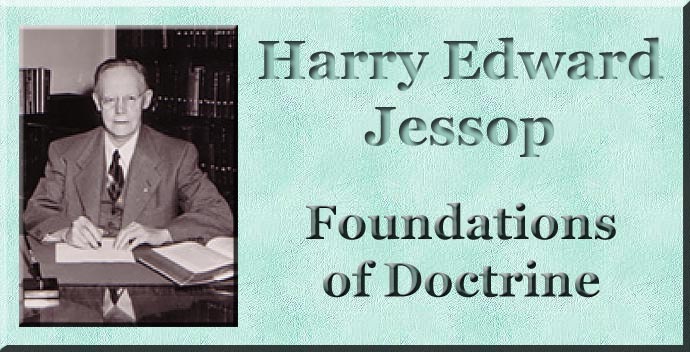
Foundations of Doctrine
By Harry E. Jessop
Chapter 17
SYMBOLISMThe Second Blessing In Bible Pictures (1) Old Testament (2) New Testament (1) Old Testament -- Some suggestive volumes have been written on the subject of Second Blessing symbolism, setting forth the symbolic evidences of the second work of grace as found in the Scriptures. Some of these declared "symbols" have seemed to us to bear evidences of ingenious straining on the part of the writers to make them fit into a general Second Blessing scheme, and to be such as would not commend themselves to the thoughtful mind. Let us settle it once for all that as honest exponents of God's Word we are not called upon to see Second Blessing holiness when it is obviously not there. Neither text nor type is ours to torture on the rack of pious imagination until it cries out just what we want it to say. The "workman that needeth not to be ashamed" must "rightly divide the word of truth" (2 Tim. 2:15). There are, however, in the Scriptures what appear to be some well-defined foreshadowings of this second work of grace, and to them we shall do well to take heed. Concerning ancient Israel's experiences, Paul wrote as follows: "Moreover, brethren, I would not that you should be ignorant; how that all our fathers were under the cloud; and all passed through the sea, and were all baptized unto Moses in the cloud and in the sea; and did all eat of the same spiritual meat; and did all, drink of the same spiritual drink: for they drank of that spiritual Rock that followed them: and that Rock was Christ. But with many of them God was not well pleased: for they were overthrown in the wilderness. Now these things were our examples [figures, types], to the intent that we should not lust after evil things, as they also lusted. Neither be ye idolaters, as were some of them; as it is written, The people sat down to eat and drink, and rose up to play. Neither let us commit fornication as some of them committed, and fell in one day three and twenty thousand. Neither let us tempt Christ, as some of them also tempted, and were destroyed of serpents. Neither murmur ye, as some of them also murmured, and were destroyed of the destroyer. Now all these things happened unto them for examples (types): and they are written for our admonition, upon whom the ends of the world are come" (I Cor. 10:1-11). We may therefore claim New Testament authority for finding in the ancient incidents Spirit-pictures of some phases of the believer's life in God. We have selected seven pictures which we think might reasonably be taken to represent the Second Blessing in symbol, in the Old Testament. 1. The Levites and the priests. (Num. 3; Ex. 28, 29). The differences between the Levites and priests were marked. There was a difference of dress, of table fare, of approach to and waiting upon the tabernacle or temple. The priests went where the Levites did not and could not go. There are priests and Levites in spiritual life today. There are followers of Christ who are clothed in the white linen of purity which others do not wear. They eat of heavenly fare that their brethren neither have nor believe in. They come boldly "into the holiest," that is hidden by a veil from the eyes of other followers of God. Christ came to "purify the sons of Levi" (Mal. 3:3) and to make His people "a royal priesthood" (1 Pet. 2:9) , "a kingdom of priests unto God" (Rev. 1:6). It is better to be a priest than a Levite; better because it brings us into a higher religious experience than we had before; better because it gives easier and greater access to God; and better because it plants in the heart and writes on the face "holiness unto the Lord. " 2. Dealing with leprosy. Leprosy in the Bible, is a pronounced type of sin. The leper is the sinner. God's dealing with the leper in Jewish ritual is indicative of the divine method of dealing with those spiritually unclean. This is seen in the two washings of the leper himself (Lev. 14:1-9). Three things are to be noted here: a. Two distinct "washings" or "cleansings are recorded. b. There is a distinct time interval between them. c. The word cleanness is not pronounced until the second cleansing has taken place. This is also seen in two washings of the leprous garment (Lev. 13:47-59). Leprosy being a type of sin, the garment or robe of the leper is not without significance. The New Testament tells of redeemed souls who were "before the throne of God" because they had "washed their robes, and made them white in the blood of the Lamb" (Rev. 7:9-17). This is seen in the two anointings of the leper (Lev. 14:10 -20). a. Two distinct applications are recorded. He is touched with "blood." It is the blood of the "slain lamb." This can have only one meaning, which every spiritually enlightened soul will readily understand. The blood of the slain Lamb (see John 1:36; Rev. 1:5; Heb. 9:14; 13:12; 1 Pet. 1:18, 19). He is touched with "oil." Oil, in the Scriptures, is a recognized emblem of the Holy Spirit. b. There was a distinct time interval between them. c. The word of cleanness was pronounced after the anointing oil. 3. The two chambers of the sanctuary (Ex. 26:31-33; Heb. 10:19 -22). The tabernacle was divided into rooms or sanctuaries. They have been variously called the first and the second, the outer and the inner, and Holy and Most Holy Place, or the Holy of Holies. The brazen altar, with its sacrifice before the tabernacle, stood for Christ's suffering and death and so represented our justification. The laver with its pure water, standing between the altar and the tabernacle, symbolized regeneration. The first room, or outer sanctuary, stood for the regenerated life. There stood:
a. The sevenfold candlestick, representing spiritual light. b. The table of shewbread with its twelve loaves, representing spiritual nourishment. c. The altar of incense, representing the ministry of prayer. It was here that the priests accomplished the service of God, but one thing ever before their eyes suggested something better beyond; the "veil" hid the "holiest" from their view. The second room, or "Holy of Holies," stood for the sanctified life. This inner shrine was distinguished by: a. A deep quite. No human voice was ever heard there, and except for the high priest's entrance on the Day of Atonement each year, no human foot ever trod its floor. The heavy folds of drapery excluded every earth-sound. The "silence of eternity" remained unbroken there. b. A divine light. Concerning this light there has been some difference of opinion. One writer speaks of "the abiding light." "A luminous glory," says he, "filled the room, and it was abiding. Unlike the lamp in the outer sanctuary, which burned high or low, this light continued in a steady, soft splendor all the while." Another writer expresses a different idea. "Now this most holy place was dark inside. No lamp, no candle, no sunlight; all were excluded by the thick curtain. At certain seasons God would blaze out from between the wings of the cherubim, and thus the only light in the second veil was the Shekinah." While these two writers differ as to when and how the light shone, they are agreed on this, that the only light which illumined the Holy of Holies was the light of God. c. The divine presence. This, of course, is already suggested by the fact of the divine light, but it is essential to notice that standing there in the holiest of all were cherubim of beaten gold looking down on a blood-sprinkled Mercy Seat. There stood the Ark of the Covenant, in which were the tables of the law, Aaron's rod, and a pot of manna. That Ark symbolized the presence of God. The "second room" is an outstanding portraiture of the sanctified life. 4. The two crossings. (Ex. 14; Josh. 3). The Second Blessing is seen in the two crossings made by the children of Israel: one over the Red and the other over the River Jordan. As the two crossings took place under the special direction of God, and as they are so markedly different, it is reasonable to believe that they are typical of different spiritual truths and experiences. This is seen in the following contrasts: At the Red Sea the Israelites were fleeing from an enemy, and were delivered; at Jordan they were not in flight, but were drawn by the goodness and beauty of the land of Canaan, and entered into rest. The sinner has much to dread, but the believer is drawn on toward the experiences of holiness by the promise of rest, plenty, and victory. At the Red Sea the children of Israel were in great haste; at Jordan we have evidence of calm and deliberate action. Conversion is found in a hurry, but the blessing of sanctification comes invariably after deep reflection and full deliberation and conclusion of mind. At the Red Sea the Israelites went down into the sea, a multitude of empty-handed and unarmed fugitives; at Jordan they went in fully armed. How clearly here appears the state of the fleeing penitent seeking safety, and the consecrated Christian coming with all his powers to God, seeking for a life of holiness. At the Red Sea the children of Israel stepped into a dry and open path between the waters; at Jordan they had to place their feet in the water before the waves receded and the path became open. In the way of pardon the path is clear. At such a time we are weak and could not face the difficulties before us; but in seeking the experience of sanctification our faith is naturally stronger. We claim the blessings by a strong faith before there is an indication or assurance of the great salvation. There is a great difference in the emotional life after the two crossings. At the Red Sea the Israelites were in transports. They sang, danced, struck the timbrel, and the burden of their song was short-lived. It soon gave way to murmuring; at Jordan there seems to have been an unutterable sense of peace, a calm, a holy joy, a triumph. As you read the description you cannot but feel the voiceless emotion of the multitudes. It was an hour too blessed and holy for noisy cymbals. In conversion, the timbrel is frequently. brought forth. But the crossing of the Jordan of death into Canaan of life is marked by a joy that is too profound for words; it is an experience full of glory, but unutterable. 5. The rite of circumcision. (Deut. 30:6; Rom. 2:28, 29; Col. 2:11). Here is another outstanding picture of a second work of grace. To the Jew this metaphor was full of meaning -- a physical operation with which the whole nation was familiar and with recognized spiritual values behind. It was the seal of covenant relationship (Gen. 17:10-14). It was the sign of covenant blessing -- the outward representation of a work to be accomplished within, and the symbol of a spiritual operation upon the heart. Three things are taught us by the rite of circumcision: a. There is a surgery of grace and inward operation divinely wrought upon the heart which removes sin. It is definite -- a work wrought upon the heart. "The heart" in Scriptural imagery is the seat of sin. It is drastic. To circumcise is to cut. In the spiritual surgery what is to the spiritual detriment is taken away. It is divine. The "knife" is in the hand of God Himself. Only He can see the inward need, and only He can go within to do the work. b. There is a special class of people on whom this operation is performed. God's own people. This is obvious for three reasons: First, the nature of the metaphor. The act of circumcision is of necessity performed only on those previously born and still alive. Consequently, in point of experience, John 3:7 must precede Deut. 30:6. Second, the people addressed. It was not the surrounding heathen nations, but the nation specially His own, and later the church, whom He addressed. Third, the manner of the address. "The Lord thy God will. .."God never spoke like that to any but His own. c. There is an assured result when this work is accomplished. An unadulterated love. "To love the Lord thy God with all thy heart . . ." An unhindered life. "That thou mayest live. " 6. The two kinds of service (Ex. 21:1-6). That there should be two kinds of service rendered to God strikes the mind with surprise. That there is such a thing is plainly taught in the terms "servants" and "friends" used by Christ (John 15:14-16). In this Exodus passage one man is seen in two relations to his master: first, as a bond servant, and, second, as a love slave. As a bond servant he stands for the regenerated man. The fact that he had been bought, that his life was one of service, and that he at the end of six years was free to leave his master is a faithful picture of the regenerated man. In this passage we see the bond servant suddenly becoming a love slave by the act of making a voluntary gift of himself to his master. He is now no longer his own. He has literally given himself away. He has now no right to anything that was formerly his. a. It was an eternal gift. He said he would serve forever. b. He enters on a love service. He that doubts that there are two kinds of service, let him study the difference between a faithful servant and a devoted wife. c. He feels free to stay. To the world it looks like a life of hopeless bondage; but while there is law in it, it is the "law of liberty." The bond servant is brought to the door-post and his ear is bored through with an awl. By reason of this act there now remains no question as to whose he is. The mark in the ear indicating this voluntary, perpetual slavehood, brings upon him both jest and a life of servitude; but by this life he now comes into deepest intimacy with his master. So it is in sanctification, the blessing is obtained by the death route. The Cross now comes into view. The old man must die. The soul must be willing for its own measure of reproach, which will surely come. 7. The highway and the way of holiness. (Isa. 35). There are two ways in the spiritual life leading to heaven. Not two ways leading in different directions which are contrary to each other, but both pointing and leading harmoniously. Regeneration is a highway. In the highway is a way -"the way of holiness." (2) New Testament -- This holiness symbolism is not confined to the Old Testament. We follow with six pictures from the New. 1. The two rests (Matt. 11:28-30). This passage speaks of two rests for the soul. They are different "rests," obtained in different ways and at different times. The first rest. a. It is offered to the unconverted. The word "come" unmistakably teaches the fact of moral distance. b. This rest is "given." "I will give you rest." c. It is obtained by coming to Christ. The second rest. What John Wesley called "The Second Blessing," his brother called "that Second Rest." This is the "rest" of Heb. 4-5. a. It is "found." The first rest was "given." b. It is obtained by consecration and faith. "Take my yoke, . . ."; "learn of me . . ." 2. Lazarus: Life -- then liberty (John 11:20-45). Lazarus dead is a type of the sinner. Lazarus brought to life is a type of the regenerated man. Lazarus set free is a type of the sanctified man. 3. The two baptisms (Matt. 3:11; Rom. 6:3-5). The Word of God has two distinct "baptisms," one of water, the other of fire. The baptism of water has to do with the confession of sins, and is indicative of repentance. The baptism of fire deals with the inward man and destroys carnality from the soul. This baptism is undoubtedly the Pentecostal experience. Water, of course, is the outward sign, but the spiritual fact may be known without the water ordinance, and the ordinance may be administered without the knowledge of the spiritual fact. Baptism is not a synonym for "birth" No person was ever "baptized" into existence. In point of experience John 3:7 must precede Matt. 3:11. 4. The two touches (Mark 8:22 -26). The miracle on the blind man wrought in two touches is in perfect harmony with other teaching of the Word of God, and goes to establish the fact of a subsequent and perfecting work of grace. The first touch brought sight. However, it was defective sight. Men were seen out of due proportion. After the first work of grace there is often man fear and man exaltation left in the heart. The second touch brought perfect sight. He saw clearly. The second touch of grace realized in sanctification brings a clear and proper vision of things to the soul. 5. In the throne and before the throne (Rev. 3:21; 7:15). Those in the throne are the Bridehood company, Christ's reigning partners (see Phil. 3:7-14; Rev. 20:4-6). Those before the throne are tribulation saints who miss the Rapture at Christ's Second Coming, but in the period of suffering which follows, faithfully endure. They come in late and therefore miss the best. 6. The fact of crucifixion (Rom. 6:6; Gal. 2:20; 6:14). Even more drastic than the thought of circumcision is the idea of crucifixion, again a spiritual experience, which can be known only to the children of God. It will be noticed that this crucifixion is said to be "with Christ," an identification which cannot be predicated of the sinner. Here again "crucifixion" cannot be made a synonym for "birth," for none ever to live by an act of crucifixion," consequently John 3:7 must precede Gal. 2:20. |
|
 |
 |
|
|
|
-
Site Navigation
 Home
Home What's New
 Bible
Bible Photos
 Hiking
 E-Books
 Genealogy
 Profile
Free Plug-ins You May Need
Profile
Free Plug-ins You May Need
 Get Java
.png) Get Flash
Get Flash Get 7-Zip
 Get Acrobat Reader
 Get TheWORD