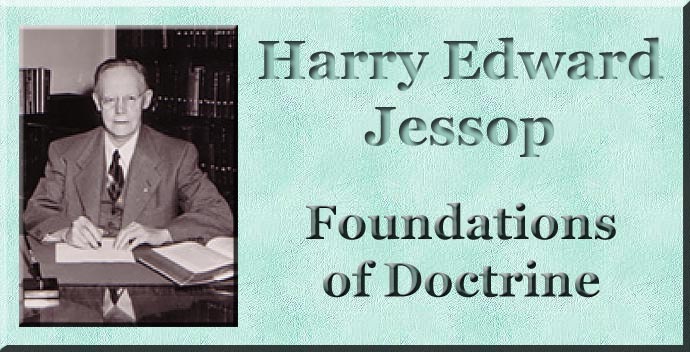
Foundations of Doctrine
By Harry E. Jessop
Chapter 10
THE ABIDING BLESSING(1) Evidences (2) The Secret of Going On While the fact of our sanctification is in no way dependent on our fluctuating feelings -- for feelings are physical, and the work of entire sanctification takes us into a far deeper realm the blessing received becomes a fact of conscious enjoyment, for the indwelling Holy Spirit gives abundant evidence of His presence. This evidence is threefold: 1. The witness of the Spirit. Answering the question, "What is the character of the evidence of a state of entire sanctification?" Rev. J. A. Wood replies: "It is just as strong, positive, and reliable as can be given to substantiate any fact. Indeed, it is the very strongest of all evidence. The testimony of consciousness. This testimony we can no more doubt than we can doubt our existence. No testimony is more certain than this. By it we know we live and breathe, love or hate, sit or stand, or walk, and that we are joyful or sorrowful, happy or wretched. The sanctified soul may be as clearly and fully conscious of purity as the unsanctified is of impurity. While on the one hand pride, anger, unbelief, love of the world, are matters of positive consciousness, on the other hand love, peace, humility, patience, faith, are equally so. Indeed, conscience usually speaks louder and clearer in the latter case than in the former, because it has received more gracious energy. Sin paralyzes; grace quickens. The testimony of God -- 'The witness of the Spirit.' This testimony is divined, direct, and positive. The Holy Ghost is the witnessing Spirit. He speaks first to the sinner's heart. Every convicted sinner has the witness of the Spirit, testifying to his guilt, condemnation, and exposure to the displeasure of God. He speaks to every justified soul. Every truly regenerated soul has, or may have, the witness of the Spirit testifying that he is born of God, and in a state of justification. He speaks to every sanctified soul. Every truly sanctified soul has, or may have, the witness of the Spirit testifying that the blood of Jesus Christ hath cleansed him from all sin. Now while all this testimony is given by the infallible Spirit, the latter testimony is given under more favorable circumstances, and, consequently, is quite as clear and strong, if not more so, than either of the others. We sum up the testimony as follows: "(1) The convicted penitent sinner may know by the testimony of his spirit, and the witness of the Holy Spirit, that he is guilty and unsaved. This testimony is stronger and clearer than in the impenitent. "(2) The justified soul may know, and be equally certain, by the testimony of his spirit and the witness of the Holy Spirit, that God has regenerated his nature, and pardoned his sins. This testimony is stronger and clearer than that of the convicted sinner. "(3) The sanctified soul may know with equal certainty by his spirit, and the testimony of the Holy Spirit, that God has cleansed his heart from all sin. This testimony is still clearer and stronger than that of the merely regenerated. The inferential and corroborating evidences are equally as strong for the fully sanctified as in either of the other cases." (Perfect Love, pp. 119, 120). Rev. John Wesley: "But how do you know that you are sanctified, saved from your inbred corruption? I can know it no otherwise than I know that I am justified, Hereby know we that we are of God, in either sense, 'by the Spirit that he hath given us.' We know it by witness and by the fruit of the Spirit." (Plain Account of Christian Perfection). Bishop O. C. Baker: "We have been accustomed to believe that our standard authors have presented the doctrine of Christian holiness in a very perspicuous light; and if they have never declared that it is the privilege of the sanctified believer to enjoy the direct witness of the Spirit, so far as their influence goes, it would check the panting soul from seeking after the direct evidence of internal purity. May God grant that we may know by happy experience that the doctrine is true, and that the pure in heart enjoy the comforting indwelling of the Holy Spirit, assuring us that sin in us is all destroyed" (Letter in "Guide," 1844). Dr. Jesse T. Peck: "As surely as the Holy Ghost is our Sanctifier, we may have satisfactory and reliable evidence that we are sanctified wholly, and that evidence must be the witness of the Spirit." The soul in which the work is wrought recognizes and understands the divine testimony. It has been aware of a supernatural agency, operating with silent power to produce a state of perfect purity and giving distinct assurance that the work is accomplished" (The Central Idea of Christianity, p. 252). Defining the Witness of the Spirit: Rev. J. A. Wood: "It is a sweet, inward persuasion of the Spirit that God, for Christ's sake, has either pardoned my sins and regenerated my soul, or that the blood of Jesus Christ has cleansed it from all sin." (Perfect Love, p. 121). When real faith is exercised, and the work of entire sanctification fully wrought, the witness of the Spirit may be expected, and it is usually apprehended then with greater or less distinctness. Although the witness of the Spirit is usually given in connection with saving faith, yet it may not always be distinctly apprehended as such at the time. It may please the Lord to withhold it temporarily sometimes, in order to teach important lessons and discipline and test the faith of the believer. St. John says, 'He that believeth on the Son of God hath the witness in himself'" (Perfect Love, p. 123). Rev. John Wesley: "By the testimony of the Spirit I mean an inward impression on the soul, whereby the Spirit of God immediately and directly witnesses to my spirit that I am a child of God; that Jesus Christ hath loved me and given Himself for me; that all my sins are blotted out, and I, even I, am reconciled to God. Some have the testimony both of their justification and sanctification without any intermission at all, which, I presume, more might have did they walk humbly and closely with God. "It is inevitably destroyed, not only by the commission of any outward sin, or the omission of any known duty, but by giving way to any inward sin; in a word, by whatever grieves the Holy Spirit of God" (Wesley's Plain Account of Christian Perfection). Dr. R. S. Foster: "The method of the Spirit's witness we do not conceive to be by sensible signs. It may be accompanied by such, but not ordinarily; not by an audible voice, not by a visible manifestation, not by a sensible touch -- not anything of this kind; and yet the witness is direct and assured, as much as though accompanied by outward manifestations. It is a consciousness wrought in the soul that a change is effected. The soul takes knowledge of itself, of its own state, and so bears witness to the change; the Spirit of God joins with ours, in that manner in which spirit can impress other spirit, and asserts also the same truth" (Christian Purity, p. 227). Dr. Jesse T. Peck -- "There is no audible voice through the outward ear ... nor would we call the state of mind produced by the witness of the Spirit an impression; for there is much which is misleading in the doctrine of impressions ... We prefer, however, to speak of the mental state produced by the witness of the Spirit as a divine persuasion or conviction of the truth communicated and under the authority of revelation, to a mind suitably prepared; there is no necessity of mistake, . ..God undertakes to make Himself understood and succeeds. ..There is a spirit-voice to a spirit-ear and the communication is intelligible ... To reason ourselves into the belief that we are wholly sanctified in the absence of this witness would be wholly perilous" (The Central Idea of Christianity, pp. 252-273). We recommend the students to read the entire section from the book itself, Ch. 5, Section 8, "The Evidence Received"). Bishop W. F. Mallalieu: "It is equally clear and certain that the Holy Spirit does testify to the reality and actual possession of the fullness of the blessing. The Spirit witnesses just as definitely to the experience of sanctification as to that of adoption. By whatever name the experience may be called, it is found by the gracious help of the Holy Spirit, and the Spirit will bear witness to His own work. This witness may be delayed -- it may not come in accordance with preconceived notions, it may not involve any anticipated manifestations, but it will come. Let it be clearly understood that the witness of the Holy Spirit does not involve the idea of anything that can he perceived by any or all of the five senses. It is surely not impossible to imagine that the Spirit might communicate with us in this way, and possibly He has done so in some instances; but no one has any good ground for supposing that such will be his experience (The Fullness of the Blessing of the Gospel of Christ, pp. 58-60). Rev. C. W. Ruth: "The witness of the Spirit is the divine assurance, the voice of God in the soul, that gives the conviction or knowledge to our inner consciousness that the blessing sought is now mine" (Entire Sanctification a Second Blessing, p. 93). While not to be confused with mere emotionalism, the fact of such an experience is not likely to be entirely destitute of emotion. Rev. J. A. Wood: "There is doubtless as great a variety as in justification and regeneration. Some are exercised in one way, some in another; some have one class of emotions, and some another. Sometimes there is an unusual illumination of soul. Sometimes a sweet resting and sinking into Christ. Sometimes great joy and ecstasy, though this is not the general experience. Sometimes there is an astonishing increase of faith, and assurance that all sin is gone. Sometimes an overwhelming sense of the divine presence. Sometimes the cleansing energy comes in a mighty torrent, and sometimes in a gentle breeze. Glory to God! Although there is a diversity of operation both with respect to the divine and human spirit, yet the blessed results are the same. Let us never mark out a way for God, but seek the cleansing power of the Holy Ghost, until it comes, just as he is pleased to manifest it. Let the prayer of your heart be: 'Come as thou wilt -- I that resign -- But oh, my Jesus, come.' Sanctified souls are inclined to name the blessing after their principal sensation, harmonizing with their emotional experience. "One person realizes principally a marked increase of faith, and he calls it 'the rest of faith.'" Another is conscious of a deep, sweet resting in Christ, and he calls it 'resting in God.'" Another is permeated with a sense of the divine presence, and filled with ecstatic rapture, and calls it 'the fullness of God.'" Another feels his heart subdued, melted, refined and filled with God, and calls it 'holiness.' "Another realizes principally a river of sweet, holy love flowing through the soul, and he calls it 'perfect love.'" Another is prostrated under the power of the refining and sin-killing Spirit, and calls it 'the baptism of the Holy Ghost.' "And another realizes principally a heaven of sweetness in complete submission to God, and he calls it 'entire sanctification.' "While another may feel clearly and strongly conscious of complete conformity to all the will of God, and call it 'Christian perfection.' If genuine, the work wrought in each case is essentially the same" (Perfect Love, pp. 124, 125). 2. The manifestation of the Spirit. By "manifestation" here we do not mean anything in the nature of the spectacular. (The gifts of the Spirit will be dealt with elsewhere). We are rather concerned with that consistent outworking which betokens His perpetual indwelling, giving power in service, unction in prayer, and fragrance in the life (see John 7:37-39). 3. The fruit of the Spirit. Says Rev. John Wesley, answering the question, "By what fruit of the Spirit may we know that we are of God?" "By love, joy, peace, always abiding; by invariable longsuffering, patience, resignation; by gentleness triumphing over all provocation; by goodness, mildness, sweetness, tenderness of spirit; by fidelity, simplicity, godly sincerity; by meekness, calmness, and evenness of Spirit; by temperance, not only in food and sleep, but in all things natural and spiritual" (Plain Account of Christian Perfection). See Gal. 5:22, 23. This "Fruit of the Spirit" is not the production of our natural energy but it is the spontaneous product of the divine life within the soul. (2) The Secret of Going On It is one thing to start in the holy way, but quite another thing to endure. 1. A note of warning. This glorious blessing may be lost. We quote from Wesley. Numerous references to and illustrations of this vital fact are found in his writings which, for lack of space, we limit here to five: a. Sermons. "It is a common thing for those who are sanctified to believe they can not fall; to suppose themselves pillars in the temple of God to go out no more. Nevertheless, we have seen some of the strongest of them, after a time, moved from their steadfastness. Sometimes suddenly, but oftener by slow degrees, they have yielded to temptation; and pride, or anger, or foolish desires have again sprung up in their hearts. Nay, sometimes they have utterly lost the life of God, and sin hath regained dominion over them. "Several of these, after being thoroughly sensible of their fall and deeply ashamed before God, have been filled again with love, and not only perfected therein, but stablished, strengthened, and settled. They have received the blessing they had before with abundance. " b. To Miss Jane Hilton (1769) : "I rejoice to hear that you stand fast in the liberty wherewith Christ hath made you free; and the more because, although many taste of that heavenly gift, deliverance from inbred sin, yet so few, so exceedingly few, retain it for one year; hardly one in ten; nay, one in thirty. Many hundreds in London were made partakers of it within sixteen or eighteen months; but I doubt whether twenty of them are now as holy and happy as they were. " c. To Mrs. Elizabeth Bennis (1769) : "Some years since I was inclined to think that none who had once enjoyed and then lost the pure love of God must ever look to enjoy it again until they were just stepping into eternity. But experience has taught us better things; we have at present numerous instances of those who had cast away that unspeakable blessing, and now enjoy it in a larger measure than ever." d. To Miss Jane Hilton (1770) : Two things are certain: the one, that it is possible to lose even the pure love of God; the other, that it is not necessary -- it is not unavoidable; it may be lost, but it may be kept. Accordingly, we have some in every part of the kingdom who have never been moved from their steadfastness. And from this moment you need never be moved; His grace is sufficient for you. But you must continue to grow if you continue to stand; for no one can stand still" (Journal, July, 1774). e. "I went to Sheffield, and on Tuesday met the Select Society. But it was reduced from sixty to twenty; and but half of these retained all that they once received! What a grievous error, to think those that are once saved from sin can not lose what they have gained! It is a miracle if they do not, seeing all earth and hell are enraged against them." 2. A Word of Direction How this blessing may be retained. While it is evident that the soul has no ground for presumption, it is also clear that there is every reason for confidence. It is the will of God that we should enjoy an unbroken continuance of this glorious experience. Five simple words will comprehend all that needs to be said concerning direction here: a. Abide: Remember, this experience is not primarily something you are to "live up to" but to "live in." It is a life, a sphere, a spiritual contact. Read John l5:1-10. Note the expressions "abide" and "in me." This continual abiding knows nothing of the need of periodical re-consecration, but steps into each new ray of light as it is given, and thus continually walks with God. b. Obey: Here let it be remembered that true obedience is not the sudden rush at some blind impulse, but the intelligent "Yes, Lord!" to the known will of God. When you know God's will, obey promptly, but if you are not sure then wait! Light will come. c. Watch: This word takes in far more than at first it seems, and covers every sphere. There will be that rigorous watch of oneself, which on the other hand must not be allowed to deteriorate into a morbid self-introspection. I f you want to be discontented-look within. If you wait to be distracted-look around, If you want to be delivered-look to Jesus. Continual self-introspection is extremely unwise and is bound to end in disaster. Moods must not be allowed to regulate experience. There is, however, a self-examination which will deepen our lives. The following rules of the saintly John Fletcher, if faithfully practiced, can but result in great spiritual blessing. 1. Did I awake spiritual, and was I watchful in keeping my mind from wandering this morning? 2. Have I this day got nearer to God in prayer, or have I given way to a lazy, idle spirit? 3. Has my faith been weakened by a lack of watchfulness, or quickened by diligence? 4. Have I walked by faith, and have I seen God in all things? 5. Have I made the most of my time as I have had light, strength and opportunity? 6. Have I kept the issues of my heart in the means of grace, so as to profit by them? 7. What have I done this day for the souls and bodies of God's dear saints? 8. Have I laid out anything to please myself, when I might have saved money for the cause of God? 9. Have I governed well my tongue this day, remembering that "in the multitude of words there wanteth not sin" 10. In how many instances have I denied myself this day? 11. Do my life and conversation adorn the gospel of Jesus Christ? d. Pray: Let nothing crowd out the precious season which the soul loves to spend with its beloved. Have set prayer periods. Cultivate that underflow of constant communion. e. Take care not to presume even here. Don't make your "holiness talk" so cheap and light that people will be inclined to turn some other way rather than meet you. But on every suitable occasion as He leads, tell out the glorious witness to full salvation. |
|
 |
 |
|
|
|
-
Site Navigation
 Home
Home What's New
 Bible
Bible Photos
 Hiking
 E-Books
 Genealogy
 Profile
Free Plug-ins You May Need
Profile
Free Plug-ins You May Need
 Get Java
.png) Get Flash
Get Flash Get 7-Zip
 Get Acrobat Reader
 Get TheWORD