|
About the Author
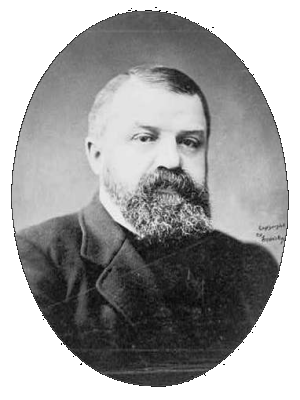 Dwight Lyman Moody (February 5, 1837 - December 22, 1899), also
known as D.L. Moody, was an American evangelist and publisher who
founded the Moody Church, Northfield School and Mount Hermon School
in Massachusetts (now the Northfield Mount Hermon School), the Moody
Bible Institute and Moody Publishers.
Dwight Lyman Moody (February 5, 1837 - December 22, 1899), also
known as D.L. Moody, was an American evangelist and publisher who
founded the Moody Church, Northfield School and Mount Hermon School
in Massachusetts (now the Northfield Mount Hermon School), the Moody
Bible Institute and Moody Publishers.
Early life
Dwight Moody was born in Northfield, Massachusetts to a large
family. His father, a small farmer and stonemason, was an alcoholic
and died at the age of 41 when Dwight was only four years old. He
had five older brothers and a younger sister, with an additional
twin brother and sister born one month after his father's death. His
mother struggled to support the family, but even with her best
effort, some of her children had to be sent off to work for their
room and board. Dwight too was sent off, where he went he received
cornmeal porridge and milk, three times a day. He complained to his
mother, but when she found out that he had all that he wanted to
eat, she sent him back. Even during this time, she continued to send
them to church. Together with his eight siblings he was raised in
the Unitarian church. His oldest brother ran away and was not heard
from by the family until many years later.
When Moody turned 17, he moved to Boston to (after many job
rejections) work in his uncle's shoe store. One of his uncle's
requirements was that Moody attend the Congregational Church of
Mount Vernon where Dr. Edward Norris Kirk was pastor. In April 1855
Moody was then converted to evangelical Christianity when his Sunday
school teacher, Edward Kimball talked to him about how much God
loved him. His conversion sparked the start of his career as an
evangelist. However his first application for church membership, in
May 1855, was rejected. He was not received as a church member until
May 4, 1856. As his teacher, Mr. Edward Kimball, stated:
“ I can truly say, and in saying it I magnify the infinite grace of
God as bestowed upon him, that I have seen few persons whose minds
were spiritually darker than was his when he came into my Sunday
School class; and I think that the committee of the Mount Vernon
Church seldom met an applicant for membership more unlikely ever to
become a Christian of clear and decided views of Gospel truth, still
less to fill any extended sphere of public usefulness. ”
Chicago and the Civil War
Moody moved to Chicago, Illinois in September, 1856, where he joined
the Plymouth Congregational Church, and began to take an active part
in the prayer meetings. In the spring of 1857, he began to minister
to the welfare of the sailors in Chicago's port, then gamblers and
thieves in the saloons. A contemporary witness, William Reynolds,
recalled a few years later:
“ The first meeting I ever saw him at was in a little old shanty
that had been abandoned by a saloon-keeper. Mr. Moody had got the
place to hold the meetings in at night. I went there a little late;
and the first thing I saw was a man standing up with a few tallow
candles around him, holding a negro boy, and trying to read to him
the story of the Prodigal Son and a great many words he could not
read out, and had to skip. I thought, 'If the Lord can ever use such
an instrument as that for His honor and glory, it will astonish me.
As a result of his tireless labor, within a year the average
attendance at his school was 650, while 60 volunteers from various
churches served as teachers. It became so well known that the
just-elected President Lincoln visited and spoke at a Sunday School
meeting on November 25, 1860. ”
After the Civil War started, he was involved with the U.S. Christian
Commission of the YMCA, and paid nine visits to the battle-front,
being present among the Union soldiers after the conflicts of
Shiloh, Pittsburgh Landing, and Murfreesboro, and ultimately entered
Richmond with the army of General Grant. He married Miss Emma C.
Revell, on August 28, 1862, with whom he had a daughter, Emma
Reynolds Moody, and two sons, William Revell And Paul Dwight Moody.
The growing Sunday School congregation needed a permanent home, so
Moody started a church in Chicago, the Illinois Street Church.
In June 1871, Moody met Ira D. Sankey, the Gospel singer, with whom
he soon partnered. In October the Great Chicago Fire destroyed his
church, his home, and the dwellings of most of his members. His
family had to flee for their lives, and, as Mr. Moody said, he saved
nothing but his reputation and his Bible. His church was rebuilt
within three months at a near-by location as the Chicago Avenue
Church. His lay follower William Eugene Blackstone was a prominent
American Zionist.
In the years after the fire, Moody's wealthy Chicago supporter J.A.
Farwell attempted to persuade him to make his permanent home in
Chicago, offering to build Moody and his family a new house. But the
now-famous Moody, also sought by supporters in New York,
Philadelphia and elsewhere, chose the tranquil farm he had purchased
next door to his birthplace in Northfield, MA. He felt he could
better recover from his lengthy and exhausting preaching trips in a
rural setting. Northfield became an important location in
evangelical Christian history in the late 19th century as Moody
organized summer conferences which were led and attended by
prominent Christian preachers and evangelists from around the world.
It was also in Northfield where Moody founded three schools which
later merged into today's Northfield Mount Hermon School.
England
It was while on a trip to England in Spring of 1872 that he became
well known as an evangelist. Some have claimed he was the greatest
evangelist of the 19th century. He preached almost a hundred times
and came into communion with the Plymouth Brethren. On several
occasions he filled stadiums of 2,000 to 4,000 capacity. In the
Botanic Gardens Palace, a meeting had between 15,000 to 30,000
people.
This turnout continued throughout 1874 and 1875, with crowds of
thousands at all of his meetings. During his visit to Scotland he
was helped and encouraged by Andrew A. Bonar. The famous London
Baptist preacher, Charles Spurgeon invited him to speak and promoted
him as well. When he returned to the United States, crowds of 12,000
to 20,000 were just as common as in England. President Grant and
some of his cabinet attended a meeting on January 19, 1876. His
evangelistic meetings were held from Boston to New York, throughout
New England and as far as San Francisco, and other West coast towns
from Vancouver to San Diego.
Moody aided in the work of cross-cultural evangelism by promoting
"The Wordless Book", a teaching tool that had been invented by
Charles Spurgeon in 1866. In 1875 he added a fourth color to the
design of the three-color evangelistic device: gold - to "represent
heaven". This "book" has been and is still used to teach uncounted
thousands of illiterate people - young and old - around the globe
about the Gospel message.
Dwight L. Moody visited Britain with Ira D. Sankey, Moody preaching
and Sankey singing. Together they published books of Christian
hymns. In 1883 they visited Edinburgh and raised £10,000 for the
building of a new home for the Carrubbers Close Mission. Moody later
preached at the laying of the foundation stone for what is one of
the few buildings on the Royal Mile which continues to be used for
its original purpose and is now called the Carrubbers Christian
Centre.
Moody greatly influenced the cause of cross-cultural Christian
missions after he met the pioneer missionary to China, Hudson
Taylor. He actively supported the China Inland Mission and
encouraged many of his congregation to volunteer for service
overseas.
His influence was felt among Swedes despite the fact that he was of
English heritage, never visited Sweden or any Scandinavian country,
and never spoke a word of the Swedish language. Nevertheless, he
became a hero revivalist among Swedish Mission Friends in Sweden and
America.
News of Moody’s large revival campaigns in Great Britain from
1873–1875 traveled quickly to Sweden, making “Mr. Moody” a household
name in homes of many Mission Friends. Moody’s sermons published in
Sweden were distributed in books, newspapers, and colporteur tracts,
and led to the spread of Sweden’s “Moody fever” from 1875–1880.
He preached his last sermon on November 16, 1899 in Kansas City,
Kansas. Becoming ill, he returned home by train to Northfield.
During the preceding several months, friends had observed he had
added some 30 pounds to his already ample frame. Although his
illness was never diagnosed, it has been speculated that he suffered
congestive heart failure. He died on December 22, surrounded by
family. Already installed by Moody as leader of his Chicago Bible
Institute, R. A. Torrey succeeded Moody as its president. Ten years
after Moody's death, the Chicago Avenue Church was renamed The Moody
Church in his honor, and the Chicago Bible Institute was likewise
renamed Moody Bible Institute. |