|
Introduction
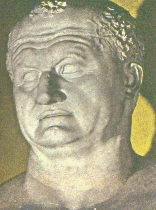 Titus
Flavius Vespasianus (b. A.D. 9, d. A.D. 79, emperor
A.D. 69-79) restored peace and stability to an
empire in disarray following the death of Nero in
A.D. 68. In the process he established the Flavian
dynasty as the legitimate successor to the Imperial
throne. Although we lack many details about the
events and chronology of his reign, Vespasian
provided practical leadership and a return to stable
government - accomplishments which, when combined
with his other achievements, make his emperorship
particularly notable within the history of the
Principate. Titus
Flavius Vespasianus (b. A.D. 9, d. A.D. 79, emperor
A.D. 69-79) restored peace and stability to an
empire in disarray following the death of Nero in
A.D. 68. In the process he established the Flavian
dynasty as the legitimate successor to the Imperial
throne. Although we lack many details about the
events and chronology of his reign, Vespasian
provided practical leadership and a return to stable
government - accomplishments which, when combined
with his other achievements, make his emperorship
particularly notable within the history of the
Principate.
Early Life and Career
Vespasian was born at Falacrina near Sabine Reate on
17 November, A.D. 9, the son of T. Flavius Sabinus,
a successful tax collector and banker, and Vespasia
Polla. Both parents were of equestrian status. Few
details of his first fifteen years survive, yet it
appears that his father and mother were often away
from home on business for long periods. As a result,
Vespasian's early education became the
responsibility of his paternal grandmother,
Tertulla. [[1]] In about A.D. 25 Vespasian assumed
the toga virilis and later accepted the wearing of
the latus clavus, and with it the senatorial path
that his older brother, T. Flavius Sabinus, had
already chosen. [[2]] Although many of the
particulars are lacking, the posts typically
occupied by one intent upon a senatorial career soon
followed: a military tribunate in Thrace, perhaps
for three or four years; a quaestorship in
Crete-Cyrene; and the offices of aedile and praetor,
successively, under the emperor Gaius. [[3]]
It was during this period that Vespasian married
Flavia Domitilla. Daughter of a treasury clerk and
former mistress of an African knight, Flavia lacked
the social standing and family connections that the
politically ambitious usually sought through
marriage. In any case, the couple produced three
children, a daughter, also named Flavia Domitilla,
and two sons, the future emperors Titus and Domitian
. Flavia did not live to witness her husband's
emperorship and after her death Vespasian returned
to his former mistress Caenis, who had been
secretary to Antonia (daughter of Marc Antony and
mother of Claudius). Caenis apparently exerted
considerable influence over Vespasian, prompting
Suetonius to assert that she remained his wife in
all but name, even after he became emperor. [[4]]
Following the
assassination of Gaius on 24 January, A.D. 41,
Vespasian advanced rapidly, thanks in large part to
the new princeps Claudius, whose favor the Flavians
had wisely secured with that of Antonia, the mother
of Germanicus, and of Claudius' freedmen, especially
Narcissus. [[5]] The emperor soon dispatched
Vespasian to Argentoratum (Strasbourg) as legatus
legionis II Augustae, apparently to prepare the
legion for the invasion of Britain. Vespasian first
appeared at the battle of Medway in A.D. 43, and
soon thereafter led his legion across the south of
England, where he engaged the enemy thirty times in
battle, subdued two tribes, and conquered the Isle
of Wight. According to Suetonius, these operations
were conducted partly under Claudius and partly
under Vespasian's commander, Aulus Plautius.
Vespasian's contributions, however, did not go
unnoticed; he received the ornamenta triumphalia and
two priesthoods from Claudius for his exploits in
Britain. [[6]] By the
end of A.D. 51 Vespasian had reached the consulship,
the pinnacle of a political career at Rome. For
reasons that remain obscure he withdrew from
political life at this point, only to return when
chosen proconsul of Africa about A.D. 63-64. His
subsequent administration of the province was marked
by severity and parsimony, earning him a reputation
for being scrupulous but unpopular. [[7]] Upon
completion of his term, Vespasian returned to Rome
where, as a senior senator, he became a man of
influence in the emperor Nero's court. [[8]]
Important enough to be included on Nero's tour of
Greece in A.D. 66-67, Vespasian soon found himself
in the vicinity of increasing political turbulence
in the East. The situation would prove pivotal in
advancing his career.
Judaea and the Accession to Power
In response to rioting in Caesarea and Jerusalem
that had led to the slaughter in the latter city of
Jewish leaders and Roman soldiers, Nero granted to
Vespasian in A.D. 66 a special command in the East
with the objective of settling the revolt in Judaea.
By spring A.D. 67, with 60,000 legionaries,
auxiliaries, and allies under his control, Vespasian
set out to subdue Galilee and then to cut off
Jerusalem. Success was quick and decisive. By
October all of Galilee had been pacified and plans
for the strategic encirclement of Jerusalem were
soon formed. [[9]] Meanwhile, at the other end of
the empire, the revolts of Gaius Iulius Vindex,
governor of Gallia Lugdunensis, and Servius
Sulpicius Galba , governor of Hispania
Tarraconensis, had brought Nero's reign to the brink
of collapse. The emperor committed suicide in June,
A.D. 68, thereby ensuring chaos for the next
eighteen months, as first Galba and then Marcus
Salvius Otho and Aulus Vitellius acceded to power.
Each lacked broad-based military and senatorial
support; each would be violently deposed in turn.
[[10]]
Still occupied with plans against Jerusalem,
Vespasian swore allegiance to each emperor. Shortly
after Vitellius assumed power in spring, A.D. 69,
however, Vespasian met on the border of Judaea and
Syria with Gaius Licinius Mucianus, governor of
Syria, and after a series of private and public
consultations, the two decided to revolt. [[11]] On
July 1, at the urging of Tiberius Alexander, prefect
of Egypt, the legions of Alexandria declared for
Vespasian, as did the legions of Judaea two days
later. By August all of Syria and the Danube legions
had done likewise. Vespasian next dispatched
Mucianus to Italy with 20,000 troops, while he set
out from Syria to Alexandria in order to control
grain shipments for the purpose of starving Italy
into submission. [[12]] The siege of Jerusalem he
placed in the hands of his son Titus.
Meanwhile, the Danubian legions, unwilling to wait
for Mucianus' arrival, began their march against
Vitellius ' forces. The latter army, suffering from
a lack of discipline and training, and unaccustomed
to the heat of Rome, was defeated at Cremona in late
October. [[13]] By mid-December the Flavian forces
had reached Carsulae, 95 kilometers north of Rome on
the Flaminian Road, where the Vitellians, with no
further hope of reinforcements, soon surrendered. At
Rome, unable to persuade his followers to accept
terms for his abdication, Vitellius was in peril. On
the morning of December 20 the Flavian army entered
Rome. By that afternoon, the emperor was dead.
[[14]] Tacitus records
that by December 22, A.D. 69, Vespasian had been
given all the honors and privileges usually granted
to emperors. Even so, the issue remains unclear,
owing largely to a surviving fragment of an enabling
law, the lex de imperio Vespasiani, which conferred
powers, privileges, and exemptions, most with
Julio-Claudian precedents, on the new emperor.
Whether the fragment represents a typical granting
of imperial powers that has uniquely survived in
Vespasian's case, or is an attempt to limit or
expand such powers, remains difficult to know. In
any case, the lex sanctioned all that Vespasian had
done up to its passing and gave him authority to act
as he saw fit on behalf of the Roman people. [[15]]
What does seem clear is that Vespasian felt the need
to legitimize his new reign with vigor. He zealously
publicized the number of divine omens that predicted
his accession and at every opportunity he
accumulated multiple consulships and imperial
salutations. He also actively promoted the principle
of dynastic succession, insisting that the
emperorship would fall to his son. The initiative
was fulfilled when Titus succeeded his father in
A.D. 79.[[16]]
Emperorship
Upon his arrival in Rome in late summer, A.D. 70,
Vespasian faced the daunting task of restoring a
city and a government ravaged by the recent civil
wars. Although many particulars are missing, a
portrait nevertheles emerges of a ruler
conscientiously committed to the methodical renewal
of both city and empire. Concerning Rome itself, the
emperor encouraged rebuilding on vacated lots,
restored the Capitol (burned in A.D. 69), and also
began work on several new buildings: a temple to the
deified Claudius on the Caelian Hill, a project
designed to identify Vespasian as a legitimate heir
to the Julio-Claudians, while distancing himself
from Nero ; a temple of Peace near the Forum; and
the magnificent Colosseum (Flavian Amphitheatre),
located on the site of the lake of Nero 's Golden
House. [[17]]
Claiming that he needed forty thousand million
sesterces for these projects and for others aimed at
putting the state on more secure footing, Vespasian
is said to have revoked various imperial immunities,
manipulated the supply of certain commodities to
inflate their price, and increased provincial
taxation. [[18]] The measures are consistent with
his characterization in the sources as both obdurate
and avaricious. There were occasional political
problems as well: Helvidius Priscus, an advocate of
senatorial independence and a critic of the Flavian
regime from the start, was exiled after A.D. 75 and
later executed; Marcellus Eprius and A. Alienus
Caecina were condemned by Titus for conspiracy, the
former committing suicide, the latter executed in
A.D. 79. As Suetonius
claims, however, in financial matters Vespasian
always put revenues to the best possible advantage,
regardless of their source. Tacitus, too, offers a
generally favorable assessment, citing Vespasian as
the first man to improve after becoming emperor.
[[19]] Thus do we find the princeps offering
subventions to senators not possessing the property
qualifications of their rank, restoring many cities
throughout the empire, and granting state salaries
for the first time to teachers of Latin and Greek
rhetoric. To enhance Roman economic and social life
even further, he encouraged theatrical productions
by building a new stage for the Theatre of
Marcellus, and he also put on lavish state dinners
to assist the food trades. [[20]]
In other matters the emperor displayed similar
concern. He restored the depleted ranks of the
senatorial and equestrian orders with eligible
Italian and provincial candidates and reduced the
backlog of pending court cases at Rome. Vespasian
also re-established discipline in the army, while
punishing or dismissing large numbers of Vitellius '
men. [[21]] Beyond Rome,
the emperor increased the number of legions in the
East and continued the process of imperial expansion
by the annexation of northern England, the
pacification of Wales, and by advances into Scotland
and southwest Germany between the Rhine and the
Danube. Vespasian also conferred rights on
communities abroad, especially in Spain, where the
granting of Latin rights to all native communities
contributed to the rapid Romanization of that
province during the Imperial period. [[22]]
Death and Assessment
In contrast to his immediate imperial predecessors,
Vespasian died peacefully - at Aquae Cutiliae near
his birthplace in Sabine country on 23 June, A.D.
79, after contracting a brief illness. The occasion
is said to have inspired his deathbed quip: "Oh my,
I must be turning into a god!" [[23]] In fact,
public deification did follow his death, as did his
internment in the Mausoleum of Augustus alongside
the Julio-Claudians.
A man of strict military discipline and simple
tastes, Vespasian proved to be a conscientious and
generally tolerant administrator. More importantly,
following the upheavals of A.D. 68-69, his reign was
welcome for its general tranquility and restoration
of peace. In Vespasian Rome found a leader who made
no great breaks with tradition, yet his ability ro
rebuild the empire and especially his willingness to
expand the composition of the governing class helped
to establish a positive working model for the "good
emperors" of the second century.
Bibliography
Since the scholarship on Vespasian is more
comprehensive than can be treated here, the works
listed below are main accounts or bear directly upon
issues discussed in the entry above. A comprehensive
modern anglophone study of this emperor is yet to be
produced.
- Atti congresso internazionale di studi
Flaviani, 2 vols. Rieti, 1983.
- Atti congresso internazionale di studi
Vespasianei, 2 vols. Rieti, 1981.
- Bosworth, A.B. "Vespasian and the Provinces:
Some Problems of the Early 70s A.D." Athenaeum
51 (1973): 49-78.
- Brunt, P. A. "Lex de imperio Vespasiani."
JRS (67) 1977: 95-116.
- D'Espèrey, S. Franchet. "Vespasien, Titus et
la littérature." ANRW II.32.5: 3048-3086.
- Dudley, D. and Webster, G. The Roman
Conquest of Britain. London, 1965.
- Gonzalez, J. "The Lex Irnitana: A New Copy
of the Flavian Municipal Law." JRS 76 (1986):
147-243.
- Grant, M. The Roman Emperors: A Biographical
Guide to the Rulers of Rome, 31 B.C. - A.D. 476.
New York, 1985.
- Homo, L. Vespasien, l'Empereur du bons sens
(69-79 ap. J.-C.). Paris, 1949.
- Levi, M.A. "I Flavi." ANRW II.2: 177-207.
- McCrum, M. and Woodhead, A. G. Select
Documents of the Principates of the Flavian
Emperors Including the Year of the Revolution.
Cambridge, 1966.
- Nicols, John. Vespasian and the Partes
Flavianae. Wiesbaden, 1978.
- Scarre, C. Chronicle of the Roman Emperors.
The Reign-by-Reign Record of the Rulers of
Imperial Rome. London, 1995.
- Suddington, D. B. The Development of the
Roman Auxiliary Forces from Caesar to Vespasian,
49 B.C. - A.D. 79. Harare: U. of Zimbabwe, 1982.
- Syme, R. Tacitus. Oxford, 1958.
- Wardel, David. "Vespasian, Helvidius Priscus
and the Restoration of the Capitol." Historia 45
(1996): 208-222.
- Wellesley, K. The Long Year: A.D. 69.
Bristol, 1989, 2nd ed.
Notes
[[1]] Suet. Vesp. 2.1. Suetonius remains the major
source but see also Tac. Hist. 2-5; Cass. Dio 65;
Joseph. BJ 3-4.
[[2]] Suetonius (Vesp. 2.1) claims that Vespasian
did not accept the latus clavus, the broad striped
toga worn by one aspiring to a senatorial career,
immediately. The delay, however, was perhaps no more
than three years. See J. Nicols, Vespasian and the
Partes Flavianae (Wiesbaden, 1978), 2.
[[3]] Military tribunate and quaestorship: Suet.
Vesp. 2.3; aedileship: ibid., 5.3, in which Gaius,
furious that Vespasian had not kept the streets
clean, as was his duty, ordered some soldiers to
load him with filth;,they complied by stuffing his
toga with as much as it could hold. See also Dio
59.12.2-3; praetorship: Suet. Vesp. 2.3, in which
Vespasian is depicted as one of Gaius' leading
adulators, an account consistent with Tacitus'
portrayal (Hist 1.50.4; 2.5.1) of his early career.
For a more complete discussion of these posts and
attendant problems of dating, see Nicols, Vespasian,
2-7. [[4]] Marriage
and Caenis: Suet. Vesp. 3; Cass. Dio 65.14.
[[5]] Nicols, Vespasian, 12-39.
[[6]] Suet. Vesp. 4.1 For additional details on
Vespasian's exploits in Britain, see D. Dudley and
G. Webster, The Roman Conquest of Britain (London,
1965), 55 ff., 98.
[[7]] Concerning Vespasian's years between his
consulship and proconsulship, see Suet. Vesp. 4.2
and Nicols, Vespasian, 9. On his unpopularity in
Africa, see Suet. Vesp. 4.3, an account of a riot at
Hadrumentum, where he was once pelted with turnips.
In recording that Africa supported Vitellius in A.D.
69, Tacitus too suggests popular dissatisfaction
with Vespasian's proconsulship. See Hist. 2.97.2.
[[8]] This despite the
fact that the sources record two rebukes of
Vespasian, one for extorting money from a young man
seeking career advancement (Suet. Vesp. 4.3), the
other for either leaving the room or dozing off
during one of the emperor's recitals (Suet. Vesp.
4.4 and 14, which places the transgression in
Greece; Tac. (Ann. 16.5.3), who makes Rome and the
Quinquennial Games of A.D. 65 the setting; A.
Braithwaite, C. Suetoni Tranquilli Divus
Vespasianus, Oxford, 1927, 30, who argues for both
Greece and Rome).
[[9]] Subjugation of Galilee: Joseph. BJ 3.65-4.106;
siege of Jerusalem: ibid., 4.366-376, 414.
[[10]] Revolt of Vindex: Suet. Nero 40; Tac. Ann.
14.4; revolt of Galba: Suet. Galba 10; Plut. Galba,
4-5; suicide of Nero: Suet. Nero 49; Cass. Dio
63.29.2. For the most complete account of the period
between Nero's death and the accession of Vespasian,
see K. Wellesley, The Long Year: A.D. 69, 2nd. ed.
(Bristol, 1989).
[[11]] Tac. Hist. 2.76.
[[12]] Troops in support of Vespasian: Suet. Vit.
15; Mucianus and his forces: Tac. Hist. 2.83;
Vespasian and grain shipments: Joseph. BJ 4.605 ff.;
see also Tac. Hist. 3.48, on Vespasian's possible
plan to shut off grain shipments to Italy from
Carthage as well.
[[13]] On Vitellius' army and its lack of
discipline, see Tac. Hist. 2.93-94; illness of army:
ibid., 2.99.1; Cremona: ibid., 3.32-33.
[[14]] On Vitellius' last days, see Tac. Hist.
3.68-81. On the complicated issue of Vitellius'
death date, see L. Holzapfel, "Römische
Kaiserdaten," Klio 13 (1913): 301.
[[15]] Honors, etc. Tac. Hist 4.3. For more on the
lex de imperio Vespasiani, see P. A. Brunt, "Lex de
imperio Vespasiani," JRS (67) 1977: 95-116.
[[16]] Omens: Suet. Vesp. 5; consulships and honors:
ibid., 8; succession of sons: ibid., 25.
[[17]] On Vespasian's restoration of Rome, see Suet.
Vesp. 9; Cass. Dio 65.10; D. Wardel, "Vespasian,
Helvidius Priscus and the Restoration of the
Capitol," Historia 45 (1996): 208-222.
[[18]] Suet. Vesp. 16.
[[19]] Ibid.; Tac. Hist. 1.50.
[[20]] Suet. Vesp. 17-19.
[[21]] Ibid., 8-10.
[[22]] On Vespasian's exploits in Britain, see esp.
Tac., Agricola, eds. R. M. Ogilvie and I. A.
Richmond (1967), and W. S. Hanson, Agricola and the
Conquest of the North (1987); on the granting of
Latin rights in Spain, see, e.g., J. Gonzalez, "The
Lex Irnitana: a New Copy of the Flavian Municipal
Law." JRS 76 (1986): 147-243.
[[23]] For this witticism and other anecdotes
concerning Vespasian's sense of humor, see Suet.
Vesp. 23. |