|
Introduction and Sources
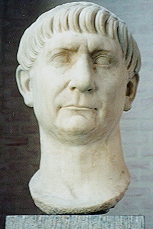 "During
a happy period of more than fourscore years, the
public administration was conducted by the virtue
and abilities of Nerva, Trajan, Hadrian, and the two
Antonines. It is the design of this and of the two
succeeding chapters to describe the prosperous
condition of their empire, and afterwards, from the
death of Marcus Antoninus, to deduce the most
important circumstances of its decline and fall, a
revolution which will ever be remembered and is
still felt by the nations of the earth." [[1]] "During
a happy period of more than fourscore years, the
public administration was conducted by the virtue
and abilities of Nerva, Trajan, Hadrian, and the two
Antonines. It is the design of this and of the two
succeeding chapters to describe the prosperous
condition of their empire, and afterwards, from the
death of Marcus Antoninus, to deduce the most
important circumstances of its decline and fall, a
revolution which will ever be remembered and is
still felt by the nations of the earth." [[1]]
This is perhaps the most important and best known of
all Edward Gibbon's famous dicta about his vast
subject, and particularly that period which he
admired the most. It was a concatenation of chance
and events which brought to the first position of
the principate five men, each very different from
the others, who each, in his own way, brought
integrity and a sense of public duty to his tasks.
Nerva's tenure was brief, as many no doubt had
expected and hoped it would be, and perhaps his
greatest achievement was to choose Trajan as his
adoptive son and intended successor. It was a
splendid choice. Trajan was one of Rome's most
admirable figures, a man who merited the renown
which he enjoyed in his lifetime and in subsequent
generations. The
sources for the man and his principate are
disappointingly skimpy. There is no contemporaneous
historian who can illuminate the period. Tacitus
speaks only occasionally of Trajan, there is no
biography by Suetonius, nor even one by the author
of the late and largely fraudulent Historia Augusta.
(However, a modern version of what such a life might
have been like has been composed by A. Birley,
entirely based upon ancient evidence. It is very
useful.) Pliny the Younger tells us the most, in his
Panegyricus, his long address of thanks to the
emperor upon assuming the consulship in late 100,
and in his letters. Pliny was a wordy and congenial
man, who reveals a great deal about his senatorial
peers and their relations with the emperor, above
all, of course, his own. The most important part is
the tenth book of his Epistulae, which contains the
correspondence between him, while serving in
Bithynia, and the emperor, to whom he referred all
manner of problems, important as well as trivial.
Best known are the pair (96,97) dealing with the
Christians and what was to be done with them. These
would be extraordinarily valuable if we could be
sure that the imperial replies stemmed directly from
Trajan, but that is more than one can claim. The
imperial chancellery had developed greatly in
previous decades and might pen these communications
after only the most general directions from the
emperor. The letters are nonetheless unique in the
insight they offer into the emperor's mind. [[2]]
Cassius Dio, who wrote
in the decade of the 230s, wrote a long imperial
history which has survived only in abbreviated form
in book LXVIII for the Trajanic period. [[3]] The
rhetorician Dio of Prusa, a contemporary of the
emperor, offers little of value. Fourth-century
epitomators, Aurelius Victor and Eutropius, offer
some useful material. Inscriptions, coins, papyri,
and legal texts are of major importance. Since
Trajan was a builder of many significant projects,
archaeology contributes mightily to our
understanding of the man.
Early Life and Career
The patria of the Ulpii was Italica, in Spanish
Baetica [[4]], where their ancestors had settled
late in the third century B.C. This indicates that
the Italian origin was paramount, yet it has
recently been cogently argued that the family's
ancestry was local, with Trajan senior actually a
Traius who was adopted into the family of the
Ulpii.[[4a]] Trajan's father was the first member of
the family to pursue a senatorial career; it proved
to be a very successful one. Born probably about the
year 30, he perhaps commanded a legion under Corbulo
in the early sixties and then was legate of legio X
Fretensis under Vespasian, governor of Judaea.
Success in the Jewish War was rewarded by the
governorship of an unknown province and then a
consulate in 70. He was thereafter adlected by the
emperor in patricios and sent to govern Baetica.
Then followed the governorship of one of the major
military provinces, Syria, where he prevented a
Parthian threat of invasion, and in 79/80 he was
proconsul of Asia, one of the two provinces (the
other was Africa) which capped a senatorial career.
His public service now effectively over, he lived on
in honor and distinction, in all likelihood seeing
his son emperor. He probably died before 100. He was
deified in 113 and his titulature read divus
Traianus pater. Since his son was also the adoptive
son of Nerva, the emperor had officially two
fathers, a unique circumstance. [[5]]
The son was born in Italica on September 18, 53; his
mother was Marcia, who had given birth to a
daughter, Ulpia Marciana, five years before the
birth of the son. In the mid seventies, he was a
legionary legate under his father in Syria. He then
married a lady from Nemausus (Nimes) in Gallia
Narbonensis, Pompeia Plotina, was quaestor about 78
and praetor about 84. In 86, he became one of the
child Hadrian's guardians. He was then appointed
legate of legio VII Gemina in Hispania
Tarraconensis, from which he marched at Domitian's
orders in 89 to crush the uprising of Antonius
Saturninus along the Rhine. He next fought in
Domitian's war against the Germans along Rhine and
Danube and was rewarded with an ordinary consulship
in 91. Soon followed the governorship of Moesia
inferior and then that of Germania superior, with
his headquarters at Moguntiacum (Mainz), whither
Hadrian brought him the news in autumn 97 that he
had been adopted by the emperor Nerva, as co-ruler
and intended successor. Already recipient of the
title imperator and possessor of the tribunician
power, when Nerva died on January 27, 98, Trajan
became emperor in a smooth transition of power which
marked the next three quarters of a century.
Early Years through the Dacian Wars
Trajan did not return immediately to Rome. He chose
to stay in his German province and settle affairs on
that frontier. He showed that he approved Domitian's
arrangements, with the establishment of two
provinces, their large military garrisons, and the
beginnings of the limes. [[6]] Those who might have
wished for a renewed war of conquest against the
Germans were disappointed. The historian Tacitus may
well have been one of these. [[7]]
Trajan then visited the crucial Danube provinces of
Pannonia and Moesia, where the Dacian king Decebalus
had caused much difficulty for the Romans and had
inflicted a heavy defeat upon a Roman army about a
decade before. Domitian had established a modus
vivendi with Decebalus, essentially buying his good
behavior, but the latter had then continued his
activities hostile to Rome. Trajan clearly thought
that this corner of empire would require his
personal attention and a lasting and satisfactory
solution. [[8]] Trajan
spent the year 100 in Rome, seeing to the honors and
deification of his predecessor, establishing good
and sensitive relations with the senate, in sharp
contrast with Domitian's "war against the senate."
[[9]] Yet his policies essentially continued
Domitian's; he was no less master of the state and
the ultimate authority over individuals, but his
good nature and respect for those who had until
recently been his peers if not his superiors won him
great favor. [[10]] He was called optimus by the
people and that word began to appear among his
titulature, although it had not been decreed by the
senate. Yet his thoughts were ever on the Danube.
Preparations for a great campaign were under way,
particularly with transfers of legions and their
attendant auxiliaries from Germany and Britain and
other provinces and the establishment of two new
ones, II Traiana and XXX Ulpia, which brought the
total muster to 30, the highest number yet reached
in the empire's history.
In 101 the emperor took
the field. The war was one which required all his
military abilities and all the engineering and
discipline for which the Roman army was renowned.
Trajan was fortunate to have Apollodorus of Damascus
in his service, who built a roadway through the Iron
Gates by cantilevering it from the sheer face of the
rock so that the army seemingly marched on water. He
was also to build a great bridge across the Danube,
with 60 stone piers (traces of this bridge still
survive). When Trajan was ready to move he moved
with great speed, probably driving into the heart of
Dacian territory with two columns, until, in 102,
Decebalus chose to capitulate. He prostrated himself
before Trajan and swore obedience; he was to become
a client king. Trajan returned to Rome and added the
title Dacicus to his titulature.
Decebalus, however, once left to his own devices,
undertook to challenge Rome again, by raids across
the Danube into Roman territory and by attempting to
stir up some of the tribes north of the river
against her. Trajan took the field again in 106,
intending this time to finish the job of Decebalus'
subjugation. It was a brutal struggle, with some of
the characteristics of a war of extirpation, until
the Dacian king, driven from his capital of
Sarmizegethusa and hunted like an animal, chose to
commit suicide rather than to be paraded in a Roman
triumph and then be put to death.
The war was over. It had taxed Roman resources, with
11 legions involved, but the rewards were great.
Trajan celebrated a great triumph, which lasted 123
days and entertained the populace with a vast
display of gladiators and animals. The land was
established as a province, the first on the north
side of the Danube. Much of the native population
which had survived warfare was killed or enslaved,
their place taken by immigrants from other parts of
the empire. The vast wealth of Dacian mines came to
Rome as war booty, enabling Trajan to support an
extensive building program almost everywhere, but
above all in Italy and in Rome. In the capital,
Apollodorus designed and built in the huge forum
already under construction a sculpted column,
precisely 100 Roman feet high, with 23 spiral bands
filled with 2500 figures, which depicted, like a
scroll being unwound, the history of both Dacian
wars. It was, and still is, one of the great
achievements of imperial "propaganda." [[11]] In
southern Dacia, at Adamklissi, a large tropaeum was
built on a hill, visible from a great distance, as a
tangible statement of Rome's domination. Its effect
was similar to that of Augustus' monument at La
Turbie above Monaco; both were constant reminders
for the inhabitants who gazed at it that they had
once been free and were now subjects of a greater
power. [[12]]
Administration and Social Policy
The chief feature of Trajan's administration was his
good relations with the senate, which allowed him to
accomplish whatever he wished without general
opposition. His auctoritas was more important than
his imperium. At the very beginning of Trajan's
reign, the historian Tacitus, in the biography of
his father-in-law Agricola, spoke of the newly won
compatibility of one-man rule and individual liberty
established by Nerva and expanded by Trajan (Agr.
3.1, primo statim beatissimi saeculi ortu Nerva
Caesar res olim dissociabiles miscuerit, principatum
ac libertatem, augeatque cotidie felicitatem
temporum Nerva Traianus,….) [13] At the end of the
work, Tacitus comments, when speaking of Agricola's
death, that he had forecast the principate of Trajan
but had died too soon to see it (Agr. 44.5, ei non
licuit durare in hanc beatissimi saeculi lucem ac
principem Traianum videre, quod augurio votisque
apud nostras aures ominabatur,….) Whether one
believes that principate and liberty had truly been
made compatible or not, this evidently was the
belief of the aristocracy of Rome. Trajan, by
character and actions, contributed to this belief,
and he undertook to reward his associates with high
office and significant promotions. During his
principate, he himself held only 6 consulates, while
arranging for third consulates for several of his
friends. Vespasian had been consul 9 times, Titus 8,
Domitian 17! In the history of the empire there were
only 12 or 13 privati who reached the eminence of
third consulates. Agrippa had been the first, L.
Vitellius the second. Under Trajan there were 3:
Sex. Iulius Frontinus (100), T. Vestricius Spurinna
(100), and L. Licinius Sura (107). There were also
10 who held second consulships: L. Iulius Ursus
Servianus (102), M.' Laberius Maximus (103), Q.
Glitius Atilius Agricola (103), P. Metilius Sabinus
Nepos (103?), Sex. Attius Suburanus Aemilianus
(104), Ti. Iulius Candidus Marius Celsus (105), C.
Antius A. Iulius Quadratus (105), Q. Sosius Senecio
(107), A. Cornelius Palma Frontonianus (109), and L.
Publilius Celsus (113). These men were essentially
his close associates from pre-imperial days and his
prime military commanders in the Dacian wars.
One major administrative innovation can be credited
to Trajan. This was the introduction of curatores
who, as representatives of the central government,
assumed financial control of local communities, both
in Italy and the provinces. Pliny in Bithynia is the
best known of these imperial officials. The
inexorable shift from freedmen to equestrians in the
imperial ministries continued, to culminate under
Hadrian, [[14]] and he devoted much attention and
considerable state resources to the expansion of the
alimentary system, which purposed to support orphans
throughout Italy. [[15]] The splendid arch at
Beneventum represents Trajan as a civilian emperor,
with scenes of ordinary life and numerous children
depicted, which underscored the prosperity of Italy.
[[16]] The satirist
Juvenal, a contemporary of the emperor, in one of
his best known judgments, laments that the citizen
of Rome, once master of the world, is now content
only with "bread and circuses."
Nam qui dabat olim / imperium, fasces, legiones,
omnia, nunc se / continet, atque duas tantum res
anxius optat, / panem et circenses. (X 78-81)
Trajan certainly took advantage of that mood, indeed
exacerbated it, by improving the reliabilty of the
grain supply (the harbor at Ostia and the
distribution system as exemplified in the Mercati in
Rome). [[17]] Fronto did not entirely approve, if
indeed he approved at all. [[18]] The plebs esteemed
the emperor for the glory he had brought Rome, for
the great wealth he had won which he turned to
public uses, and for his personality and manner.
Though emperor, he prided himself upon being
civilis, a term which indicated comportment suitable
for a Roman citizen. [[19]]
There was only one major addition to the Rome's
empire other than Dacia in the first decade and a
half of Trajan's reign. This was the province of
Arabia, which followed upon the absorption of the
Nabataean kingdom (105-106). [[20]]
Building Projects
Trajan had significant effect upon the
infrastructure of both Rome and Italy. His greatest
monument in the city, if the single word "monument"
can effectively describe the complex, was the forum
which bore his name, much the largest, and the last,
of the series known as the "imperial fora."
Excavation for a new forum had already begun under
Domitian, but it was Apollodorus who designed and
built the whole. Enormous in its extent, the
Basilica Ulpia was the centerpiece, the largest wood
roofed building in the Roman world. In the open
courtyard before it was an equestrian statue of
Trajan, behind it was the column; there were
libraries, one for Latin scrolls, the other for
Greek, on each side. A significant omission was a
temple; this circumstance was later rectified by
Hadrian, who built a large temple to the deified
Trajan and Plotina. The
column was both a history in stone and the intended
mausoleum for the emperor, whose ashes were indeed
placed in the column base. An inscription over the
doorway, somewhat cryptic because part of the text
has disappeared, reads as follows:
Senatus populusque Romanus imp. Caesari divi Nervae
f. Nervae Traiano Aug. Germ. Dacico pontif. Maximo
trib. pot. XVII imp. VI p.p. ad declarandum quantae
altitudinis mons et locus tant[is oper]ibus sit
egestus
(Smallwood 378) On the
north side of the forum, built into the slopes of
the Quirinal hill, were the Markets of Trajan, which
served as a shopping mall and the headquarters of
the annona, the agency responsible for the receipt
and distribution of grain. [[21]]
On the Esquiline hill
was constructed the first of the huge imperial
baths, using a large part of Nero'sDomus Aurea as
its foundations. On the other side of the river a
new aqueduct was constructed, which drew its water
from Lake Bracciano and ran some 60 kilometers to
the heights of the Janiculum Hill. It was dedicated
in 109. A section of its channel survives in the
basement of the American Academy in Rome. [[22]]
The arch in Beneventum is the most significant
monument elsewhere in Italy. It was dedicated in
114, to mark the beginning of the new Via Traiana,
which offered an easier route to Brundisium than
that of the ancient Via Appia. [[23]]
Trajan devoted much attention to the construction
and improvement of harbors. His new hexagonal harbor
at Ostia at last made that port the most significant
in Italy, supplanting Puteoli, so that henceforth
the grain ships docked there and their cargo was
shipped by barge up the Tiber to Rome. Terracina
benefited as well from harbor improvements, and the
Via Appia now ran directly through the city along a
new route, with some 130 Roman feet of sheer cliff
being cut away so that the highway could bend along
the coast. Ancona on the Adriatic Sea became the
major harbor on that coast for central Italy in
114-115, and Trajan's activity was commemorated by
an arch. The inscription reports that the senate and
people dedicated it to the providentissimo principi
quod accessum Italiae hoc etiam addito ex pecunia
sua portu tutiorem navigantibus reddiderit
(Smallwood 387). Centumcellae, the modern
Civitavecchia, also profited from a new harbor. The
emperor enjoyed staying there, and on at least one
occasion summoned his consilium there. [[24]]
Elsewhere in the empire the great bridge at
Alcantara in Spain, spanning the Tagus River, still
in use, [[25]] testifies to the significant
attention the emperor gave to the improvement of
communication throughout his entire domain.
Family Relations; the Women
After the death of his father, Trajan had no close
male relatives. His life was as closely linked with
his wife and female relations as that of any of his
predecessors; these women played enormously
important roles in the empire's public life, and
received honors perhaps unparalleled. His wife,
Pompeia Plotina, is reported to have said, when she
entered the imperial palace in Rome for the first
time, that she hoped she would leave it the same
person she was when she entered. [[26]] She received
the title Augusta no later than 105. She survived
Trajan, dying probably in 121, and was honored by
Hadrian with a temple, which she shared with her
husband, in the great forum which the latter had
built. His sister
Marciana, five years his elder, and he shared a
close affection. She received the title Augusta,
along with Plotina, in 105 and was deified in 112
upon her death. Her daughter Matidia became Augusta
upon her mother's death, and in her turn was deified
in 119. Both women received substantial monuments in
the Campus Martius, there being basilicas of each
and a temple of divae Matidiae. Hadrian was
responsible for these buildings, which were located
near the later temple of the deified Hadrian, not
far from the column of Marcus Aurelius. [[27]]
Matidia's daughter, Sabina, was married to Hadrian
in the year 100. The union survived almost to the
end of Hadrian's subsequent principate, in spite of
the mutual loathing that they had for each other.
Sabina was Trajan's great niece, and thereby
furnished Hadrian a crucial link to Trajan.
The women played public roles as significant as any
of their predecessors. They traveled with the
emperor on public business and were involved in
major decisions. They were honored throughout the
empire, on monuments as well as in inscriptions.
Plotina, Marciana, and Matidia, for example, were
all honored on the arch at Ancona along with Trajan.
[[28]] The Parthian
War In 113, Trajan
began preparations for a decisive war against
Parthia. He had been a "civilian" emperor for seven
years, since his victory over the Dacians, and may
well have yearned for a last, great military
achievement, which would rival that of Alexander the
Great. Yet there was a significant cause for war in
the Realpolitik of Roman-Parthian relations, since
the Parthians had placed a candidate of their choice
upon the throne of Armenia without consultation and
approval of Rome. When Trajan departed Rome for
Antioch, in a leisurely tour of the eastern empire
while his army was being mustered, he probably
intended to destroy at last Parthia's capabilities
to rival Rome's power and to reduce her to the
status of a province (or provinces). It was a great
enterprise, marked by initial success but ultimate
disappointment and failure.
In 114 he attacked the enemy through Armenia and
then, over three more years, turned east and south,
passing through Mesopotamia and taking Babylon and
the capital of Ctesiphon. He then is said to have
reached the Persian Gulf and to have lamented that
he was too old to go further in Alexander's
footsteps. In early 116 he received the title
Parthicus. The
territories, however, which had been handily won,
were much more difficult to hold. Uprisings among
the conquered peoples, and particularly among the
Jews in Palestine and the Diaspora, caused him to
gradually resign Roman rule over these
newly-established provinces as he returned westward.
The revolts were brutally suppressed. In mid 117,
Trajan, now a sick man, was slowly returning to
Italy, having left Hadrian in command in the east,
when he died in Selinus of Cilicia on August 9,
having designated Hadrian as his successor while on
his death bed. Rumor had it that Plotina and Matidia
were responsible for the choice, made when the
emperor was already dead. Be that as it may, there
was no realistic rival to Hadrian, linked by blood
and marriage to Trajan and now in command of the
empire's largest military forces. Hadrian received
notification of his designation on August 11, and
that day marked his dies imperii. Among Hadrian's
first acts was to give up all of Trajan's eastern
conquests. Trajan's
honors and reputation
Hadrian saw to it that Trajan received all customary
honors: the late emperor was declared a divus, his
victories were commemorated in a great triumph, and
his ashes were placed in the base of his column.
Trajan's reputation remained unimpaired, in spite of
the ultimate failure of his last campaigns. Early in
his principate, he had unofficially been honored
with the title optimus, "the best," which long
described him even before it became, in 114, part of
his official titulature. His correspondence with
Pliny enables posterity to gain an intimate sense of
the emperor in action. His concern for justice and
the well-being of his subjects is underscored by his
comment to Pliny, when faced with the question of
the Christians, that they were not to be sought out,
"nor is it appropriate to our age." [[29]] At the
onset of his principate, Tacitus called Trajan's
accession the beginning of a beatissimum saeculum,
[[30]] and so it remained in the public mind.
Admired by the people, respected by the senatorial
aristocracy, he faced no internal difficulties, with
no rival nor opposition. His powers were as
extensive as Domitian's had been, but his use and
display of these powers were very different from
those of his predecessor, who had claimed to be deus
et dominus. Not claiming to be a god, he was
recognized in the official iconography of sculpture
as Jupiter's viceregent on earth, so depicted on the
attic reliefs of the Beneventan arch. [[31]] The
passage of time increased Trajan's aura rather than
diminished it. In the late fourth century, when the
Roman Empire had dramatically changed in character
from what it had been in Trajan's time, each new
emperor was hailed with the prayer, felicior
Augusto, melior Traiano, "may he be luckier than
Augustus and better than Trajan." [[32]] That
reputation has essentially survived into the present
day. Bibliography
- Bennett, J., Trajan Optimus Princeps. A Life
and Times (London and New York, 1997)
- Birley, A., Lives of the Later Caesars: The
First Part of the Augustan History with Newly
Compiled Lives of Nerva and Trajan (London,
1976)
- Bourne, F.C., "The Roman Alimentary Program
and Italian Agriculture," TAPA 91 (1960) 47-75
- Bowersock, G.W., Roman Arabia (Cambridge,
MA, 1983)
- Canto, A.M., "Los Traii béticos: revisiones
y novedades sobre la familia y el origen de
Trajano," in XIX Centenario del emperador
Trajano, Actas del Curso de Verano 1998,
Universidad Complutense de Madrid, dir. J.M.
Blázquez Martinez, in press.
- Cizek, E., L'Epoque de Trajan. Circonstances
Politiques et Problèmes Idéologiques (Paris,
1983)
- Duncan-Jones, R., "The Purpose and
Organisation of the Alimenta," PBSR 32 (1964)
123-46
- Durry, M., Pline le Jeune. Panégyrique de
Trajan (Paris, 1938)
- ________. "Sur Trajan père," in Les
Empereurs Romains d'Espagne (Paris 1965) 48-57
- Fears, J.R., Princeps A Diis Electus: The
Divine Election of the Emperor as a Political
Concept at Rome (Rome, 1977)
- Fell, M., Optimus princeps?: Anspruch und
Wirklichkeit der imperialen Programmatik Kaiser
Traians (Munich, 1992)
- Garzetti, A., From Tiberius to the Antonines
(translated by J.R. Foster, London, 1974)
- Gibbon, E., The Decline and Fall of the
Roman Empire, vol. 1, (London, 1776)
- Hammond, M., The Antonine Monarchy (Rome,
1959)
- ________. "Res olim dissociabiles:
Principatus ac Libertas - Liberty Under the
Early Roman Empire," HSCP 67 (1963) 93-113
- Hands, A.R., Charities and Social Aid in
Greece and Rome (Ithaca, NY, 1968)
- Hassel, F.J., Der Trajansbogen in Benevent:
ein Bauwerk des römischen Senates (Mainz, 1966)
- Lepper, F.A., Trajan's Parthian War (Oxford,
1948)
- Lepper, F., and S. Frere, Trajan's Column. A
New Edition of the Cichorius Plates (Gloucester,
1988)
- Longden, R.P., "Nerva and Trajan" and "The
Wars of Trajan," in Cambridge Ancient History
(Cambridge, 1936) 188-252
- Masi, F., Traiano (Il principe che portò
l'Impero Romano alla massima espansione) (Rome,
1993)
- Millar, F., A Study of Cassius Dio (Oxford,
1964)
- ________. The Emperor in the Roman World
(Ithaca, NY, 1977)
- Nash, E., Pictorial Dictionary of Ancient
Rome, two volumes (London, 1961-62)
- Packer, J.E., The Forum of Trajan in Rome: A
Study of the Monuments (Berkeley, CA, 1997)
- Paribeni, R., Optimus Princeps: Saggio sulla
storia e sui tempi dell'imperatore Traiano, two
vols., (Messina 1926-27)
- Raepsaet-Charlier, M.-T., Prosopographie des
Femmes de l'Ordre Sénatorial(Ier-IIe siècles)
(Louvain, 1987)
- Richmond, I.A., "Trajan's Army on Trajan's
Column," PBSR 13 (1935) 1-40
- ________. "Adamklissi," PBSR 35 (1967) 29-39
- ________. "The Arch of Beneventum," in P.
Salway, ed., Roman Archaeology and Art (London,
1969) 229-38
- Rossi, L., Trajan's Column and the Dacian
Wars (London, 1971)
- Sherwin-White, A.N., The Letters of Pliny. A
Historical and Social Commentary (Oxford, 1966)
- Smallwood, E.M., Documents Illustrating the
Principates of Nerva Trajan and Hadrian
(Cambridge, 1966)
- Strobel, K., Untersuchungen zu den
Dakerkriegen Trajans: Studien zur Geschichte des
mittleren und unteren Donauraumes in der Hohen
Kaiserzeit (Bonn, 1984)
- Syme, R., Tacitus (Oxford, 1958)
- Talbert, R.J.A., The Senate of Imperial Rome
(Princeton, NJ, 1984)
- Temporini, H., Die Frauen am Hofe Trajans:
Ein Beitrag zur Stellung der Augustae im
Prinzipat (Berlin, 1978)
- Waters, K.H., "Traianus Domitiani
Continuator," AJP 90 (1969) 385-404
- ________. "Trajan's Character in the
Literary Tradition," in J.A.S. Evans, ed., POLIS
AND IMPERIUM. Studies in Honour of Edward Togo
Salmon (Toronto, 1974) 233-52
- ________. "The Reign of Trajan, and its
Place in Contemporary Scholarship (1960-72)," in
ANRW II 2 (Berlin/New York, 1975) 381-431
Footnotes
[[1]] The end of Gibbon's first paragraph
[[2]] See Sherwin-White and Millar, Emperor
[[3]] See Millar, Cassius Dio
[[4]] Syme, Tacitus, 30-44; PIR Vlpivs 575
[[4a]] See Canto.
[[5]] Durry, "Sur Trajan père"
[[6]] Syme, CAH XI (Cambridge, 1936) 158-87; A.
King, Roman Gaul and Germany (Berkeley, CA, 1990);
C.-M. Ternes, Die Römer an Rhein und Mosel
(Stuttgart, 1975)
[[7]] See H.W. Benario, Tacitus Germany (Warminster,
1999) [[8]] See Syme,
"Domitian: The Last Years," in idem, Roman Papers IV
(Oxford, 1988) 252-77
[[9]] Tacitus, Agricola 1-3
[[10]] Waters, "Traianus Domitiani Continuator"
[[11]] See Lepper and Frere, Packer, and Richmond,
"Trajan's Army" [[12]]
See P. MacKendrick, Roman France (London, 1971)
86-89 [[13]] See
Hammond, "Res olim"
[[14]] See Millar, Emperor
[[15]] See Bourne, Duncan-Jones, and Hands
[[16]] See Hassel
[[17]] R. Meiggs, Roman Ostia (Oxford, 19732) and
Packer [[18]] Principia
Historiae 20, ut qui sciret populum Romanum duabus
praecipue rebus, annona et spectaculis, teneri;
imperium non minus ludicris quam seriis probari
atque maiore damno seria, graviore invidia ludicra
neglegi. [[19]] I.
Lana, "Civilis, cililiter, civilitas in Tacito e in
Suetonio. Contributo alla storia del lessico
politico-romano nell'età imperiale," Atti Acc. Sc.
Torino. Cl. Sc. Mor. Stor. Filol. 106 (1972) f.II,
465-87 [[20]] See
Bowersock [[21]] See
G. Rickman, The Corn Supply of Ancient Rome (Oxford,
1980) [[22]] See P.J.
Aicher, Guide to the Aqueducts of Ancient Rome
(Wauconda, IL, 1995) 44, 76-79
[[23]] See G. Radke, Viae publicae Romanae
(Stuttgart, 1971) cols. 96-98
[[24]] Epist. 6.31
[[25]] Smallwood 389; C. O'Connor, Roman Bridges
(Cambridge, 1993) 109-11
[[26]] Dio 68.5.5
[[27]] See Nash [[28]]
See Temporini, Raepsaet-Charlier 631, 681, 802, 824
[[29]] Epist. 10.97.2, nam et pessimi exempli nec
nostri saeculi est
[[30]] Agr. 44.5
[[31]] See Fears
[[32]] Eutropius, Breviarium 8.5.3 |