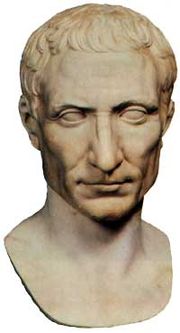
 Gaius
Julius Caesar [1] (Latin pronunciation [ˈgaːius
ˈjuːlius ˈkaɪsar]; English pronunciation [ˈgaɪəs
ˈdʒuːliəs ˈsiːzəɹ]; July 12 or July 13, 100 BC or
102 BC – March 15, 44 BC), was a Roman military and
political leader and one of the most influential men
in classical antiquity. He played a critical role in
the transformation of the Roman Republic into the
Roman Empire. Gaius
Julius Caesar [1] (Latin pronunciation [ˈgaːius
ˈjuːlius ˈkaɪsar]; English pronunciation [ˈgaɪəs
ˈdʒuːliəs ˈsiːzəɹ]; July 12 or July 13, 100 BC or
102 BC – March 15, 44 BC), was a Roman military and
political leader and one of the most influential men
in classical antiquity. He played a critical role in
the transformation of the Roman Republic into the
Roman Empire. A
politician of the populares faction, he formed an
unofficial triumvirate with Marcus Licinius Crassus
and Pompey the Great which dominated Roman politics
for several years, although fiercely opposed by
optimates like Cato the Younger. His conquest of
Gaul extended the Roman world all the way to the
Atlantic Ocean, and he was also responsible for the
first Roman invasion of Britain in 55 BC, but the
collapse of the triumvirate led to a stand-off with
Pompey and the Senate.
Leading his legions across the Rubicon, Caesar
sparked civil war in 49 BC that left him the
undisputed master of the Roman world. After assuming
control of the government, he began extensive
reforms of Roman society and government. He was
proclaimed dictator for life, and he heavily
centralized the bureaucracy of the Republic. These
events incited a friend of Caesar, Marcus Junius
Brutus, and a number of other senators, to
assassinate the dictator on the Ides of March (March
15) in 44 BC. The assassins hoped to restore the
normal running of the Republic, but their actions
led to another Roman civil war, and eventually to
the establishment of the autocratic Roman Empire by
Caesar's adopted heir, Augustus. In 42 BC, two years
after his assassination, the Roman Senate officially
sanctified him as one of the Roman deities.
Much of Caesar's life is known from his own
Commentaries (Commentarii) on his military
campaigns, and other contemporary sources such as
the letters and speeches of Caesar's political rival
Cicero, the historical writings of Sallust, and the
poetry of Catullus. Many more details of his life
are recorded by later historians, such as Appian,
Suetonius, Plutarch, Cassius Dio and Strabo.
Early life
Caesar was born circa 100BC (or possibly 102 BC)
into a patrician family, the gens Julia, which
claimed descent from Iulus, the son of the Trojan
prince Aeneas, himself the son of the goddess
Venus.[2] The branch of the gens Julia which bore
the cognomen "Caesar" was descended, according to
Pliny the Elder, from a man who was born by
caesarian section (from the Latin verb to cut,
caedo, -ere, caesus sum).[3] The Historia Augusta
suggests three alternative explanations of the name:
that the first Caesar killed an elephant (caesai in
Moorish) in battle; that he had a thick head of hair
(Latin caesaries); or that he had bright grey eyes
(Latin oculis caesiis).[4]
Although of impeccable aristocratic patrician stock,
the Julii Caesares had not historically been
especially politically influential, having produced
only three consuls. Caesar's father, also called
Gaius Julius Caesar, perhaps through the influence
of his prominent brother-in-law Gaius Marius,
reached the rank of praetor, the second highest of
the Republic's elected magistracies, and governed
the province of Asia.[5] His mother, Aurelia Cotta,
came from an influential family which had produced
several consuls. They lived in a modest house in the
Subura, a lower class neighborhood of Rome,[6] where
Marcus Antonius Gnipho, an orator and grammarian who
originally came from Gaul, was employed as Caesar's
tutor.[7] Caesar had two sisters, both called Julia.
Little else is recorded of Caesar's childhood.
Suetonius and Plutarch's biographies of him both
begin abruptly in Caesar's teens: the opening
paragraphs of both appear to be lost.[8]
Caesar's formative years were a time of turmoil. The
Social War was fought from 91 to 88 BC between Rome
and her Italian allies over the issue of Roman
citizenship, while Mithridates of Pontus threatened
Rome's eastern provinces. Domestically, Roman
politics was divided between two factions, the
optimates, who favoured aristocratic rule via the
Senate, and the populares, who preferred to bypass
the Senate and appeal directly to the electorate.
Caesar's uncle Marius was a popularis; Marius'
protégé and rival Lucius Cornelius Sulla was an
optimas. Both Marius and Sulla distinguished
themselves in the Social War, and both wanted
command of the war against Mithridates, which was
initially given to Sulla; but when Sulla left the
city to take command of his army, a tribune passed a
law transferring the appointment to Marius. Sulla
responded by marching on Rome. Marius was forced
into exile and command was returned to Sulla, but
when Sulla left on campaign Marius returned at the
head of a makeshift army. He and his ally Lucius
Cornelius Cinna seized the city and declared Sulla a
public enemy, and Marius's troops took violent
revenge on Sulla's supporters. Marius died early in
86 BC, but his faction remained in power.[9]
In 85 BC Caesar's father died suddenly while putting
on his shoes one morning,[10] and at sixteen, Caesar
was the head of the family. The following year he
was nominated for the position of Flamen Dialis
(high priest of Jupiter—Lucius Cornelius Merula, the
previous incumbent, had died in Marius's
purges),[11] and since the holder of that position
not only had to be a patrician but also be married
to a patrician, he broke off his engagement to
Cossutia, a girl of wealthy equestrian family he had
been betrothed to since boyhood, and married Cinna's
daughter Cornelia.[12]
Then, having brought Mithridates to terms, Sulla
returned to finish the civil war against the Marian
party. After a campaign throughout Italy he finally
crushed the Marians at the Battle of the Colline
Gate in November 82 BC. He had himself appointed to
the revived office of dictator, but whereas a
dictator was traditionally appointed for six months
at a time, Sulla's appointment had no fixed term
limit. There followed a series of bloody
proscriptions against his political enemies, which
dwarfed even Marius' purges. Statues of Marius were
destroyed and Marius' body was exhumed and thrown in
the Tiber. Cinna was already dead, killed by his own
soldiers in a mutiny.[13] Caesar, as the nephew of
Marius and son-in-law of Cinna, was targeted. He was
stripped of his inheritance, his wife's dowry and
his priesthood, but refused to divorce Cornelia and
was forced to go into hiding. The threat against him
was lifted by the intervention of his mother's
family, who were supporters of Sulla, and the Vestal
Virgins. Sulla gave in reluctantly, and is said to
have declared that he saw many Mariuses in
Caesar.[8]
Early career
Caesar did not return to Rome, but instead joined
the army, serving under Marcus Minucius Thermus in
Asia. Ironically, it had been the loss of his
priesthood that allowed him to pursue a military
career: the Flamen Dialis was not permitted to ride
or even touch a horse, sleep three nights outside
his own bed or one night outside Rome, or look upon
an army.[14] On a mission to Bithynia to secure the
assistance of King Nicomedes's fleet, he spent so
long at his court that rumours of an affair with the
king arose, which would persist for the rest of his
life. Nonetheless, he served with distinction,
winning the Civic Crown for his part in the siege of
Mytilene. He also served briefly under Servilius
Isauricus in Cilicia.[15]
Sulla resigned his dictatorship after two years and
re-established consular government. He dismissed his
lictors and walked unguarded in the forum, offering
to give account of his actions to any citizen.[16]
Caesar later ridiculed Sulla's relinquishing of the
dictatorship—"Sulla did not know his political
ABC's".[17] Sulla was elected to a second consulship
before retiring to private life, then died two years
later of liver failure and was accorded a state
funeral. [18] In 78
BC, on hearing of Sulla's death, Caesar felt it
would now be safe for him to return to Rome. His
return coincided with an attempted anti-Sullan coup
by Marcus Aemilius Lepidus, but Caesar, lacking
confidence in Lepidus's leadership, did not
participate.[19] Instead he turned to advocacy,
bringing a failed prosecution against Cornelius
Dolabella. He became known for his exceptional
oratory, accompanied by impassioned gestures and a
high-pitched voice, and ruthless prosecution of
former governors notorious for extortion and
corruption. The great orator Cicero even commented,
"Does anyone have the ability to speak better than
Caesar?"[20] Aiming at rhetorical perfection, Caesar
travelled to Rhodes in 75 BC for philosophical and
oratorical studies with the famous teacher
Apollonius Molon, who was earlier the instructor of
Cicero himself.[21] On
the way across the Aegean Sea,[22] Caesar was
kidnapped by Cilician pirates and held prisoner in
the Dodecanese islet of Pharmacusa.[23] He
maintained an attitude of superiority throughout his
captivity. When the pirates thought to demand a
ransom of twenty talents of gold, he insisted they
ask for fifty. After the ransom was paid, Caesar
raised a fleet, pursued and captured the pirates,
and imprisoned them in Pergamon. The governor of
Asia refused to execute them as Caesar demanded,
preferring to sell them as slaves, but Caesar
returned to the coast and had them crucified on his
own authority, as he had promised to when in
captivity – a promise the pirates had taken as a
joke. He then proceeded to Rhodes, but was soon
called back into military action in Asia, raising a
band of auxiliaries to repel an incursion from
Pontus. On his return to
Rome he was elected military tribune, a first step
on the cursus honorum of Roman politics. The war
against Spartacus took place around this time (73 -
71 BC), but it is not recorded what role, if any,
Caesar played in it. He was elected quaestor for 69
BC, and during that year he delivered the funeral
oration for his aunt Julia, widow of Marius, and
included images of Marius, unseen since the days of
Sulla, in the funeral procession. His own wife
Cornelia also died that year. After her funeral
Caesar went to serve his quaestorship in Hispania
under Antistius Vetus. While there he is said to
have encountered a statue of Alexander the Great,
and realised with dissatisfaction he was now at an
age when Alexander had the world at his feet, while
he had achieved comparatively little. For a
contemporary example, Pompey had risen far faster
through military conquests than most Roman
politicians. He
requested, and was granted, an early discharge from
his duties, and returned to Roman politics. On his
return he married Pompeia, a granddaughter of
Sulla.[24] He was elected aedile, restored the
trophies of Marius's victories - a controversial
move at the time given the Sullan regime was still
in place. He also brought prosecutions against men
who had benefited from Sulla's proscriptions, and
spent a great deal of borrowed money (largely from
Crassus) on public works and games, and outshone his
colleague Marcus Calpurnius Bibulus. He was also
suspected of involvement in two abortive coup
attempts.[25]
Caesar comes to prominence
63 BC was an eventful year for Caesar. He persuaded
a tribune, Titus Labienus, to prosecute the optimate
senator Gaius Rabirius for the political murder, 37
years previously, of the tribune Lucius Appuleius
Saturninus, and had himself appointed as one of the
two judges to try the case. Rabirius was defended by
both Cicero and Quintus Hortensius, but was
convicted of perduellio (treason). While he was
exercising his right of appeal to the people, the
praetor Quintus Caecilius Metellus Celer adjourned
the assembly by taking down the military flag from
the Janiculum hill. Labienus could have resumed the
prosecution at a later session, but did not do so:
Caesar's point had been made, and the matter was
allowed to drop.[26] Labienus would remain an
important ally of Caesar over the next decade.
The same year, Caesar ran for election to the post
of Pontifex Maximus, chief priest of the Roman state
religion, after the death of Quintus Caecilius
Metellus Pius, who had been appointed to the post by
Sulla. He ran against two powerful optimates, the
former consuls Quintus Lutatius Catulus and Publius
Servilius Vatia Isauricus. There were accusations of
bribery by all sides. Caesar is said to have told
his mother on the morning of the election that he
would return as Pontifex Maximus or not at all,
expecting to be forced into exile by the enormous
debts he had run up to fund his campaign. In the
event he won comfortably, despite his opponents'
greater experience and standing.[27] The post came
with an official residence on the Via Sacra.[6]
When Cicero, who was consul that year, exposed
Catiline's conspiracy to seize control of the
republic, Catulus and others accused Caesar of
involvement in the plot.[28] Caesar, who had been
elected praetor for the following year, took part in
the debate in the Senate on how to deal with the
conspirators. During the debate, Caesar was passed a
note. Marcus Porcius Cato, who would become his most
implacable political opponent, accused him of
corresponding with the conspirators, and demanded
that the message be read aloud. Caesar passed him
the note, which, embarrassingly, turned out to be a
love letter from Cato's half-sister Servilia. Caesar
argued persuasively against the death penalty for
the conspirators, proposing life imprisonment
instead, but a speech by Cato proved decisive, and
the conspirators were executed.[29]
While praetor in 62 BC, Caesar supported Caecilius
Metellus, now tribune, in proposing controversial
legislation, and the pair were so obstinate they
were suspended from office by the Senate. Caesar
attempted to continue to perform his duties, only
giving way when violence was threatened. The Senate
was persuaded to reinstate him after he quelled
public demonstrations in his favour.[30]
A commission had been set up to investigate
Catiline's conspiracy, and Caesar was again accused
of complicity, but, relying on Cicero's evidence
that he had reported what he knew of the plot
voluntarily, he was cleared, and not only one of his
accusers, but also one of the commissioners, were
sent to prison.[31] That
year the festival of the Bona Dea ("good goddess")
was held at Caesar's house. No men were permitted to
attend, but a young patrician named Publius Clodius
Pulcher managed to gain admittance disguised as a
woman, apparently for the purpose of seducing
Caesar's wife Pompeia. He was caught and prosecuted
for sacrilege. Caesar gave no evidence against
Clodius at his trial, careful not to offend one of
the most powerful patrician families of Rome.
Clodius was acquitted after rampant bribery and
intimidation. Nevertheless, Caesar divorced Pompeia,
saying that "my wife ought not even to be under
suspicion."[32] After
his praetorship, Caesar was appointed to govern
Hispania Ulterior (Outer Iberia), but he was still
in considerable debt and needed to satisfy his
creditors before he could leave. He turned to Marcus
Licinius Crassus, one of Rome's richest men. In
return for political support in his implacable
opposition to the interests of Pompey, Crassus paid
some of Caesar's debts and acted as guarantor for
others. Even so, to avoid becoming a private citizen
and open to prosecution for his debts, Caesar left
for his province before his praetorship had ended.
In Hispania he conquered the Callaici and Lusitani
and was hailed as imperator by his troops, reformed
the law regarding debts, and completed his
governorship in high esteem.[33]
Being hailed as imperator entitled him to receive a
triumph upon his return to Rome. However, he also
wanted to stand for consul, the most senior
magistracy in the republic. If he were to celebrate
a triumph, he would have to remain a soldier and
stay outside the city until the ceremony, but to
stand for election he would need to lay down his
command and enter Rome as a private citizen. He
could not do both in the time available. He asked
the senate for permission to stand in absentia, but
Cato blocked the proposal. Faced with the choice
between a triumph and the consulship, Caesar chose
the consulship.[34]
First Consulship and First Triumvirate
The election was dirty. There were three candidates:
Caesar, Lucius Lucceius and Marcus Calpurnius
Bibulus, who had been aedile with Caesar several
years earlier. Caesar canvassed Cicero for support,
and made an alliance with the wealthy Lucceius, but
the establishment threw its financial weight behind
the conservative Bibulus, and even Cato, with his
reputation for incorruptibility, is said to have
resorted to bribery in his favour. Caesar and
Bibulus were elected as consuls for 59 BC.[35]
Caesar was already in Crassus's political debt, but
he also made overtures to Pompey, who was
unsuccessfully fighting the Senate for ratification
of his eastern settlements and farmland for his
veterans. Pompey and Crassus had been at odds since
they were consuls together in 70 BC, and Caesar knew
if he allied himself with one he would lose the
support of the other, so he endeavoured to reconcile
them. Between the three of them, they had enough
money and political influence to control public
business. This informal alliance, known as the First
Triumvirate (rule of three men), was cemented by the
marriage of Pompey to Caesar's daughter Julia.[36]
Caesar also married again, this time Calpurnia,
daughter of Lucius Calpurnius Piso Caesoninus, who
was elected to the consulship for the following
year.[37] Caesar
proposed a law for the redistribution of public
lands to the poor, a proposal supported by Pompey,
by force of arms if need be, and by Crassus, making
the triumvirate public. Pompey filled the city with
soldiers, and the triumvirate's opponents were
intimidated. Bibulus attempted to declare the omens
unfavourable and thus void the new law, but was
driven from the forum by Caesar's armed supporters.
His lictors had their fasces broken, two tribunes
accompanying him were wounded, and Bibulus himself
had a bucket of excrement thrown over him. In fear
of his life, he retired to his house for the rest of
the year, issuing occasional proclamations of bad
omens. These attempts to obstruct Caesar's
legislation proved ineffective. Roman satirists ever
after referred to the year as "the consulship of
Julius and Caesar".[38]
When Caesar and Bibulus were first elected, the
aristocracy tried to limit Caesar's future power by
allotting the woods and pastures of Italy, rather
than governorship of a province, as their
proconsular duties after their year of office was
over.[39] With the help of Piso and Pompey, Caesar
later had this overturned, and was instead appointed
to govern Cisalpine Gaul (northern Italy) and
Illyricum (the western Balkans), with Transalpine
Gaul (southern France) later added, giving him
command of four legions. His term of office, and
thus his immunity from prosecution, was set at five
years, rather than the usual one.[40] When his
consulship ended, Caesar narrowly avoided
prosecution for the irregularities of his year in
office, and quickly left for his province.[41]
Conquest of Gaul
Caesar was still deeply in debt, and there was money
to be made as a provincial governor, whether by
extortion[42] or by military adventurism. Caesar had
four legions under his command, two of his
provinces, Illyricum and Gallia Narbonensis,
bordered on unconquered territory, and independent
Gaul was known to be unstable. Rome's allies the
Aedui had been defeated by their Gallic rivals, with
the help of a contingent of Germanic Suebi under
Ariovistus, who had settled in conquered Aeduan
land. Meanwhile, the Helvetii were mobilising for a
mass migration, and the Romans feared they had
warlike intent. In his first year as governor,
Caesar raised two new legions and defeated first the
Helvetii, then Ariovistus. He then left his army in
winter quarters in the territory of the Sequani,
signaling that his interest in the lands outside
Gallia Narbonensis would not be temporary.[43]
Over the course of the next eight years, Caesar
conquered the whole of Gaul from the Rhine to the
Pyrenees, and made expeditions to Britain and
Germania. In 52 BC he defeated a union of Gauls led
by Vercingetorix at the battle of Alesia. Among his
legates were his cousins Lucius Julius Caesar and
Mark Antony, Titus Labienus and Quintus Tullius
Cicero, the younger brother of Caesar's future
political opponent, Marcus Tullius Cicero. Caesar
recorded his own accounts of these campaigns in his
Commentarii de Bello Gallico ("Commentaries on the
Gallic War").
According to Plutarch and the writings of scholar
Brendan Woods, the whole campaign resulted in 800
conquered cities, 300 subdued tribes, one million
men sold to slavery and another three million dead
in battle fields. Ancient historians notoriously
exaggerated numbers of this kind, but Caesar's
conquest of Gaul was certainly one of the greatest
military invasions since the campaigns of Alexander
the Great. The victory was also far more lasting
than those of Alexander's: Gaul never regained its
Celtic identity, never attempted another nationalist
rebellion, and remained loyal to Rome until the fall
of the Western Empire in 476.
Fall of the First Triumvirate
Despite his successes and the benefits to Rome,
Caesar remained unpopular among his peers,
especially the conservative faction, who suspected
him of wanting to be king. In 55 BC, his partners
Pompey and Crassus had been elected consuls and
honored their agreement with Caesar by prolonging
his proconsulship for another five years. This was
the last act of the First Triumvirate.
In 54 BC, Caesar's daughter Julia died in
childbirth, leaving both Pompey and Caesar
heartbroken. Crassus was killed in 53 BC during his
campaign in Parthia. Without Crassus or Julia,
Pompey drifted towards the Optimates. Still in Gaul,
Caesar tried to secure Pompey's support by offering
him one of his nieces in marriage, but Pompey
refused. Instead, Pompey married Cornelia Metella,
the daughter of Metellus Scipio, one of Caesar's
greatest enemies.
Civil war In 50
BC, the Senate, led by Pompey, ordered Caesar to
return to Rome and disband his army because his term
as Proconsul had finished. Moreover, the Senate
forbade Caesar to stand for a second consulship in
absentia. Caesar thought he would be prosecuted and
politically marginalized if he entered Rome without
the immunity enjoyed by a Consul or without the
power of his army. Pompey accused Caesar of
insubordination and treason. On January 10, 49 BC
Caesar crossed the Rubicon (the frontier boundary of
Italy) with only one legion and ignited civil war.
Upon crossing the Rubicon, Caesar is reported to
have said alea iacta est. This is normally rendered
as "The die is cast".
The Optimates, including Metellus Scipio and Cato
the Younger, fled to the south, having little
confidence in the newly raised troops especially
since so many cities in northern Italy had
voluntarily capitulated. An attempted stand by a
consulate legion in Samarium resulted in the consul
being handed over by the defenders and the legion
surrendering without significant fighting. Despite
outnumbering Caesar greatly, since he had only his
Thirteenth Legion with him, Pompey had no intention
to fight. Caesar pursued Pompey to Brindisium,
hoping to capture Pompey before the trapped Senate
and their legions could escape. Pompey managed to
elude him, sailing out of the harbor before Caesar
could break the barricades.
Lacking a naval force since Pompey had already
scoured the coasts of all ships for evacuation of
his forces, Caesar decided to head for Hispania
saying " I set forth to fight an army without a
leader, so as later to fight a leader without an
army." Leaving Marcus Aemilius Lepidus as prefect of
Rome, and the rest of Italy under Mark Antony as
tribune, Caesar made an astonishing 27-day
route-march to Hispania, rejoining two of his Gallic
legions, where he defeated Pompey's lieutenants. He
then returned east, to challenge Pompey in Greece
where on July 10, 48 BC at Dyrrhachium Caesar barely
avoided a catastrophic defeat when the line of
fortification was broken. He decisively defeated
Pompey, despite Pompey's numerical advantage (nearly
twice the number of infantry and considerably more
cavalry), at Pharsalus in an exceedingly short
engagement in 48 BC. In
Rome, Caesar was appointed dictator, with Mark
Antony as his Master of the Horse; Caesar resigned
this dictatorate after 9 days and was elected to a
second term as consul with Publius Servilius Vatia
as his colleague. He
pursued Pompey to Alexandria, where Pompey was
murdered by a former Roman officer serving in the
court of King Ptolemy XIII. Caesar then became
involved with the Alexandrine civil war between
Ptolemy and his sister, wife, and co-regent queen,
the Pharaoh Cleopatra VII. Perhaps as a result of
Ptolemy's role in Pompey's murder, Caesar sided with
Cleopatra; he is reported to have wept at the sight
of Pompey's head, which was offered to him by
Ptolemy's chamberlain Pothinus as a gift. In any
event, Caesar defeated the Ptolemaic forces in 47 BC
in the Battle of the Nile and installed Cleopatra as
ruler, with whom he is suspected to have fathered a
son, Caesarion. Caesar and Cleopatra celebrated
their victory of the Alexandrine civil war through a
triumphant procession on the Nile in the spring of
47 B.C. The royal barge was accompanied by 400
additional ships, introducing Caesar to the
luxurious lifestyle of the Egyptian pharoahs.
Caesar and Cleopatra never married: they could not
do so under Roman Law. The institution of marriage
was only recognized between two Roman citizens;
Cleopatra was Queen of Egypt. In Roman eyes, this
did not constitute adultery, and Caesar is believed
to have continued his relationship with Cleopatra
throughout his last marriage, which lasted 14 years
and produced no children. Cleopatra visited Rome on
more than one occassion, residing in Caesar's villa
just outside Rome across the Tiber.
After spending the first months of 47 BC in Egypt,
Caesar went to the Middle East, where he annihilated
King Pharnaces II of Pontus in the Battle of Zela;
his victory was so swift and complete that he mocked
Pompey's previous victories over such poor enemies.
Thence, he proceeded to Africa to deal with the
remnants of Pompey's senatorial supporters. He
quickly gained a significant victory at Thapsus in
46 BC over the forces of Metellus Scipio (who died
in the battle) and Cato the Younger (who committed
suicide). Nevertheless, Pompey's sons Gnaeus
Pompeius and Sextus Pompeius, together with Titus
Labienus, Caesar's former propraetorian legate
(legatus propraetore) and second in command in the
Gallic War, escaped to Hispania. Caesar gave chase
and defeated the last remnants of opposition in the
Battle of Munda in March 45 BC. During this time,
Caesar was elected to his third and fourth terms as
consul in 46 BC (with Marcus Aemilius Lepidus) and
45 BC (without colleague).
Aftermath of the civil war
Caesar returned to Italy in September 45 BC. As one
of his first tasks, he filed his will, naming his
grand-nephew Gaius Octavius (Octavian) as the heir
to everything, including his title. Caesar also
wrote that if Octavian died before Caesar did,
Marcus Junius Brutus would be the next heir in
succession. The Senate had already begun bestowing
honours on Caesar in absentia. Even though Caesar
had not proscribed his enemies, instead pardoning
nearly every one of them, there seemed to be little
open resistance to him.
Great games and celebrations were held on April 21
to honour Caesar’s great victory. Along with the
games, Caesar was honoured with the right to wear
triumphal clothing, including a purple robe
(reminiscent of the kings of Rome) and laurel crown,
on all public occasions. A large estate was being
built at Rome’s expense, and on state property, for
Caesar’s exclusive use. The title of Dictator became
a legal title that he could use in his name for the
rest of his life. An ivory statue in his likeness
was to be carried at all public religious
processions. Images of Caesar show his hair combed
forward in an attempt to conceal his baldness.
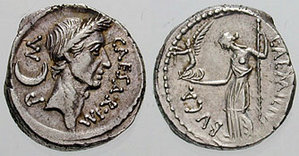 Another
statue of Caesar was placed in the temple of
Quirinus with the inscription "To the Invincible
God". Since Quirinus was the deified likeness of the
city and its founder and first king, Romulus, this
act identified Caesar on equal terms with not only
the gods, but also the ancient kings. A third statue
was erected on the capitol alongside those of the
seven Roman Kings and of Lucius Junius Brutus, the
man who originally led the revolt to expel the
Kings. In yet more scandalous behaviour, Caesar had
coins minted bearing his likeness. This was the
first time in Roman history that a living Roman was
featured on a coin and would set a precedent for
emperors to come. It is likely that Caesar's
relationship with Cleopatra persuaded this decision
as minting coins bearing one's likeness was common
practice for Egyptian pharaohs. Another
statue of Caesar was placed in the temple of
Quirinus with the inscription "To the Invincible
God". Since Quirinus was the deified likeness of the
city and its founder and first king, Romulus, this
act identified Caesar on equal terms with not only
the gods, but also the ancient kings. A third statue
was erected on the capitol alongside those of the
seven Roman Kings and of Lucius Junius Brutus, the
man who originally led the revolt to expel the
Kings. In yet more scandalous behaviour, Caesar had
coins minted bearing his likeness. This was the
first time in Roman history that a living Roman was
featured on a coin and would set a precedent for
emperors to come. It is likely that Caesar's
relationship with Cleopatra persuaded this decision
as minting coins bearing one's likeness was common
practice for Egyptian pharaohs.
When Caesar returned to Rome in October of 45 BC, he
gave up his fourth Consulship (which he held without
colleague) and placed Quintus Fabius Maximus and
Gaius Trebonius as suffect consuls in his stead.
This irritated the Senate, because he completely
disregarded the Republican system of election, and
performed these actions at his own whim. He
celebrated a fifth triumph, this time to honour his
victory in Hispania. The Senate continued to
encourage more honours. A temple to Libertas was to
be built in his honour, and he was granted the title
Liberator. They elected him Consul for life, and
allowed to hold any office he wanted, including
those generally reserved for plebeians. Rome also
seemed willing to grant Caesar the unprecedented
right to be the only Roman to own imperium. In this,
Caesar alone would be immune from legal prosecution
and would technically have the supreme command of
the legions. More honours
continued, including the right to appoint half of
all magistrates, which were supposed to be elected
positions. He also appointed magistrates to all
provincial duties, a process previously done by lot
or through approval of the Senate. The month of his
birth, Quintilis, was renamed Julius (hence the
English July) in his honour, and his birthday, July
12, was recognized as a national holiday. Even a
tribe of the people’s assembly was to be named for
him. A temple and priesthood, the Flamen maior, was
established and dedicated in honour of his family.
Caesar, however, did have a reform agenda, and took
on various social ills. He passed a law that
prohibited citizens between the ages of 20 and 40
from leaving Italy for more than three years, unless
on military assignment. Theoretically, this would
help preserve the continued operation of local farms
and businesses, and prevent corruption abroad. If a
member of the social elite did harm, or killed a
member of the lower class, then all the wealth of
the perpetrator was to be confiscated. Caesar
demonstrated that he still had the best interest of
the state at heart, even if he believed that he was
the only person capable of running it. A general
cancellation of one-fourth of all debt also greatly
relieved the public, and helped endear him even
further to the common population. Caesar tightly
regulated the purchase of state-subsidized grain,
and forbade those who could afford privately
supplied grain from purchasing from the grain dole.
He made plans for the distribution of land to his
veterans, and for the establishment of veteran
colonies throughout the Roman world.
In 63 BC Caesar had been elected Pontifex Maximus,
and one of his roles as such was settling the
calendar. A complete overhaul of the old Roman
calendar proved to be one of his most long lasting
and influential reforms. In 46 BC, Caesar
established a 365-day year with a leap year every
fourth year (this Julian Calendar was subsequently
modified by Pope Gregory XIII in 1582 into the
modern Gregorian calendar). As a result of this
reform, a certain Roman year (mostly equivalent to
46 BC in the modern Calendar) was made 445 days
long, to bring the calendar into line with the
seasons. Additionally,
great public works were undertaken. Rome was a city
of great urban sprawl and unimpressive brick
architecture, and desperately needed a renewal. A
new Rostra of marble was built, along with
courthouses and marketplaces. A public library under
the great scholar Marcus Terentius Varro was also
under construction. The Senate house, the Curia
Hostilia, which had been recently repaired, was
abandoned for a new marble project to be called the
Curia Julia. The Forum of Caesar, with its Temple of
Venus Genetrix, was built. The city Pomerium (sacred
boundary) was extended, allowing for additional
growth. All of the pomp,
circumstance, and public taxpayers' money being
spent incensed certain members of the Roman Senate.
One of these was Caesar's closest friend, Marcus
Junius Brutus.
Assassination plot
Ancient biographers describe the tension between
Caesar and the Senate, and his possible claims to
the title of king. These events would be the
principal motive for Caesar's assassination by his
political opponents in the Senate.
Plutarch records that at one point, Caesar informed
the Senate that his honours were more in need of
reduction than augmentation, but withdrew this
position so as not to appear ungrateful. He was
given the title Pater Patriae ("Father of the
Fatherland"). He was appointed dictator a third
time, and then nominated for nine consecutive
one-year terms as dictator, effectually making him
dictator for ten years. He was also given censorial
authority as praefectus morum (prefect of morals)
for three years. The
Senate named Caesar Dictator Perpetuus, "dictator
for life" or "perpetual dictator". Roman mints
printed a denarius coin with this title and his
profile on one side, and with an image of the
goddess Ceres and Caesar's title of Augur Pontifex
Maximus on the reverse. While printing the title of
dictator was significant, Caesar's image was not for
it was customary to print consuls and other public
officials on coins during the Republic.
According to Cassius Dio, a senatorial delegation
went to inform Caesar of new honors they had
bestowed upon him in 44 BC. Caesar received them
while sitting in the Temple of Venus Genetrix,
rather than rising to meet them. According to Dio,
this was a chief excuse for the offended senators to
plot his assassination. He wrote that a few of
Caesar's supporters blamed his failure to rise on a
sudden attack of diarrhoea, but his enemies
discounted this in observing that he had walked home
unaided. Suetonius wrote
that Caesar failed to rise in the temple either
because he was restrained by Cornelius Balbus or
that he balked at the suggestion he should rise.
Suetonius also gave the account of a crowd assembled
to greet Caesar upon his return to Rome. A member of
the crowd placed a laurel wreath on the statue of
Caesar on the Rostra. The tribunes, Gaius Epidius
Marcellus and Lucius Caesetius Flavius ordered that
the wreath be removed as it was a symbol of Jupiter
and royalty. Caesar had the tribunes censored from
office through his official powers. According to
Suetonius, he was unable to disassociate himself
with the title of monarch from this point forward.
His biographer also gives the story that a crowd
shouted to him "rex", the Latin word for king.
Caesar replied, "I am Caesar, not Rex", a pun on the
Roman name coming from the title. Also, at the
festival of the Lupercalia, while he gave a speech
from the Rostra, Mark Antony, who had been elected
co-consul with Caesar, attempted to place a crown on
his head several times. Caesar put it aside to be
used as a sacrifice to Jupiter Opitimus Maximus.
Plutarch and Suetonius are similar in their
depiction of these events, but Dio combines the
stories writing that the tribunes arrested the
citizens who placed diadems or wreaths on statues of
Caesar. He then places the crowd shouting "rex" on
the Alban Hill with the tribunes arresting a member
of this crowd as well. The plebeian protested that
he was unable to speak his mind freely. Caesar then
brought the tribunes before the senate and put the
matter to a vote, thereafter removing them from
office and erasing their names from the records.
Suetonius adds that Lucius Cotta proposed to the
Senate that Caesar should be granted the title of
"king" for it was prophesied that only a king would
conquer Parthia. Caesar intended to invade Parthia,
a task which would later give considerable trouble
to Mark Anthony during the second triumvirate.
Brutus began to conspire against Caesar with his
friend and brother-in-law Cassius and other men,
calling themselves the Liberatores ("Liberators").
Many plans were discussed by the group, as
documented by Nicolaus of Damascus:
“ The conspirators never met openly, but they
assembled a few at a time in each other's homes.
There were many discussions and proposals, as might
be expected, while they investigated how and where
to execute their design. Some suggested that they
should make the attempt as he was going along the
Sacred Way, which was one of his favorite walks.
Another idea was for it to be done at the elections
during which he had to cross a bridge to appoint the
magistrates in the Campus Martius; they should draw
lots for some to push him from the bridge and for
others to run up and kill him. A third plan was to
wait for a coming gladiatorial show. The advantage
of that would be that, because of the show, no
suspicion would be aroused if arms were seen
prepared for the attempt. But the majority opinion
favoured killing him while he sat in the Senate,
where he would be by himself since only Senators
would be admitted, and where the many conspirators
could hide their daggers beneath their togas. This
plan won the day. ” Two
days before the assassination of Caesar, Cassius met
with the conspirators and told them that, if anyone
found out about the plan, they were going to turn
their knives on themselves.
On the Ides of March (March 15; see Roman calendar)
of 44 BC, a group of senators called Caesar to the
forum for the purpose of reading a petition, written
by the senators, asking him to hand power back to
the Senate. However, the petition was a fake. Mark
Antony, having vaguely learned of the plot the night
before from a terrified Liberator named Servilius
Casca, and fearing the worst, went to head Caesar
off at the steps of the forum. However, the group of
senators intercepted Caesar just as he was passing
the Theatre of Pompey, and directed him to a room
adjoining the east portico.
As Caesar began to read the false petition, the
aforementioned Casca pulled down Caesar's tunic and
made a glancing thrust at the dictator's neck.
Caesar turned around quickly and caught Casca by the
arm, crying in Latin "Villain Casca, what do you
do?" Casca, frightened, called to his fellow
senators in Greek: "Help, brothers!" ("αδελφοι
βοήθει!" in Greek, "adelphoi boethei!"). Within
moments, the entire group, including Brutus, was
striking out at the dictator. Caesar attempted to
get away, but, blinded by blood, he tripped and
fell; the men eventually murdering him as he lay,
defenseless, on the lower steps of the portico.
According to Eutropius, around sixty or more men
participated in the assassination. He was stabbed 23
times.[44] The
dictator's last words are, unfortunately, not known
with certainty, and are a contested subject among
scholars and historians alike. In Shakespeare's
Julius Caesar, Caesar's last words are given as "Et
tu, Brute? Then fall, Caesar." ("And you, Brutus?
Then fell, Caesar."). However, this is Shakespeare's
invention. Suetonius reports his last words, spoken
in Greek, as "καί σύ τέκνον"[45] (transliterated as
"Kai su, teknon?"; "You too, my child?" in
English).[46] Plutarch reports that Caesar said
nothing, pulling his toga over his head when he saw
Brutus among the conspirators.[47]
Regardless, shortly after the assassination the
senators left the building talking excitedly amongst
themselves, and Brutus cried out to his beloved
city: "People of Rome, we are once again free!" A
wax statue of Caesar was erected in the forum
displaying the 23 stab wounds. A crowd who had
amassed there started a fire, which badly damaged
the forum and neighboring buildings. In the ensuing
chaos Mark Antony, Octavian (later Augustus Caesar),
and others fought a series of five civil wars, which
would end in the formation of the Roman Empire.
Aftermath of assassination
The result unforeseen by the assassins was that
Caesar's death precipitated the end of the Roman
Republic. The Roman middle and lower classes, with
whom Caesar was immensely popular, and had been
since Gaul and before, were enraged that a small
group of high-browed aristocrats had killed their
champion. Antony did not give the speech that
Shakespeare penned for him more than 1600 years
later ("Friends, Romans, countrymen, lend me your
ears..."), but he did give a dramatic eulogy that
appealed to the common people, a reflection of
public opinion following Caesar's murder. Antony,
who had been drifting apart from Caesar, capitalized
on the grief of the Roman mob and threatened to
unleash them on the Optimates, perhaps with the
intent of taking control of Rome himself. But Caesar
had named his grand nephew Gaius Octavian his sole
heir, giving him the immensely powerful Caesar name
as well as making him one of the wealthiest citizens
in the Republic. Gaius Octavian was also, for all
intents and purposes, the son of the great Caesar,
and consequently also inherited the loyalty of much
of the Roman populace. Octavian, only aged 19 at the
time of Caesar's death, proved to be dangerous, and
while Antony dealt with Decimus Brutus in the first
round of the new civil wars, Octavian consolidated
his position. Later Mark Antony would marry Caesar's
lover Cleopatra. In order
to combat Brutus and Cassius, who were massing an
army in Greece, Antony needed both the cash from
Caesar's war chests and the legitimacy that Caesar's
name would provide any action he took against the
two. A new Triumvirate was formed (the second and
final one) with Octavian, Antony, and Caesar's loyal
cavalry commander Lepidus as the third member. This
Second Triumvirate deified Caesar as Divus Iulius
and—seeing that Caesar's clemency had resulted in
his murder—brought back the horror of proscription,
abandoned since Sulla, and proscribed its enemies in
large numbers in order to seize even more funds for
the second civil war against Brutus and Cassius,
whom Antony and Octavius defeated at Philippi. A
third civil war then broke out between Octavian on
one hand and Antony and Cleopatra on the other. This
final civil war, culminating in Antony and
Cleopatra's defeat at Actium, resulted in the
ascendancy of Octavius, who became the first Roman
emperor, under the name Caesar Augustus. In 42 BC,
Caesar was formally deified as "the Divine Julius"
(Divus Iulius), and Caesar Augustus henceforth
became Divi filius ("Son of a God").
The Health of Julius Caesar
Caesar suffered from epilepsy. He had four
documented episodes of what where probably complex
partial seizures. He may additionally have had
absence seizures in his youth. There is family
history of epilepsy amongst his ancestors and
descendants. The earliest accounts of these seizures
were made by the biographer Suetonius who was born
after Caesar's death. |[48][49][50]
Caesar's literary works
Caesar was considered during his lifetime to be one
of the best orators and authors of prose in
Rome—even Cicero spoke highly of Caesar's rhetoric
and style.[51] Among his most famous works were his
funeral oration for his paternal aunt Julia and his
Anticato, a document written to blacken Cato's
reputation and respond to Cicero's Cato memorial.
Unfortunately, the majority of his works and
speeches have been lost to history.
Memoirs
- The Commentarii de Bello Gallico
(Commentaries on the Gallic War), campaigns in
Gallia and Britannia during his term as
proconsul; and
- The Commentarii de Bello Civili
(Commentaries on the Civil War), events of the
Civil War until immediately after Pompey's death
in Egypt.
- Other works historically attributed to
Caesar, but whose authorship is doubted, are:
- De Bello Alexandrino (On the Alexandrine
War), campaign in Alexandria;
- De Bello Africo (On the African War),
campaigns in North Africa; and
- De Bello Hispaniensis (On the Hispanic War),
campaigns in the Iberian peninsula.
These narratives, apparently simple and direct in
style— to the point that Caesar's Commentarii are
commonly studied by first and second year Latin
students— are highly sophisticated advertisements
for his political agenda, most particularly for the
middle-brow readership of minor aristocrats in Rome,
Italy, and the provinces.
Military career
Historians place the generalship of Caesar as one of
the greatest military strategists and tacticians who
ever lived along with Alexander the Great, Sun Tzu,
Hannibal, Genghis Khan and Napoleon Bonaparte.
Although he suffered occasional tactical defeats,
such as Battle of Gergovia during the Gallic War and
The Battle of Dyrrhachium during the Civil War,
Caesar's tactical brilliance was highlighted by such
feats as his circumvallation of Alesia during the
Gallic War, the rout of Pompey's numerically
superior forces at Pharsalus during the Civil War,
and the complete destruction of Pharnaces' army at
Battle of Zela. Caesar's
successful campaigning in any terrain and under all
weather conditions owes much to the strict but fair
discipline of his legionaries, whose admiration and
devotion to him were proverbial due to his promotion
of those of skill over those of nobility. Caesar's
infantry and cavalry were first rate, and he made
heavy use of formidable Roman artillery; additional
factors that made him so effective in the field were
his army's superlative engineering abilities and the
legendary speed with which he manoeuvred his troops
(Caesar's army sometimes marched as many as 40 miles
a day). His army was made of 40,000 infantry and
many cavaliers, with some specialized units, such as
engineers. He records in his Commentaries on the
Gallic Wars that during the siege of one Gallic city
built on a very steep and high plateau, his
engineers were able to tunnel through solid rock and
find the source of the spring that the town was
drawing its water supply from, and divert it to the
use of the army. The town, cut off from their water
supply, capitulated at once.
Caesar's name
Using the Latin alphabet as it existed in the day of
Caesar (i.e., without lower case letters, "J", or
"U"), Caesar's name is properly rendered "GAIVS
IVLIVS CAESAR" (the form "CAIVS" is also attested
using the old Roman pronunciation of letter C as G;
it is an antique form of the more common "GAIVS").
It is often seen abbreviated to "C. IVLIVS CAESAR".
(The letterform "Æ" is a ligature, which is often
encountered in Latin inscriptions where it was used
to save space, and is nothing more than the letters
"ae".) In Classical Latin, it was pronounced IPA
[ˈgaːius ˈjuːlius ˈkaisar].[52] In the days of the
late Roman Republic, many historical writings were
done in Greek, a language most educated Romans
studied. Young wealthy Roman boys were often taught
by Greek slaves and sometimes sent to Athens for
advanced training, as was Caesar's principal
assassin, Brutus. In Greek, during Caesar's time,
his family name was written Καίσαρ, reflecting its
contemporary pronunciation. Thus his name is
pronounced in a similar way to the pronunciation of
the German Kaiser. Clearly, this German name was not
derived from the Middle Ages Ecclesiastical Latin,
in which the familiar part "Caesar" is [ˈtʃeːsar],
from which the modern English pronunciation (a
much-softened "SEE-zer") is derived.
His name is also remembered in Norse mythology,
where he is manifested as the legendary king
Kjárr.[53]
Caesar's family
Parents
Father Gaius Julius Caesar the Elder
Mother Aurelia (related to the Aurelia
Cottae)
Sisters
Julia Caesaris "Maior" (the elder)
Julia Caesaris "Minor" (the younger)
Wives
First marriage to Cornelia Cinnilla, from
83 BC until her death in childbirth in 69 or
68 BC
Second marriage to Pompeia Sulla, from 68
BC until he divorced her around 62 BC
Third marriage to Calpurnia Pisonis, from
59 BC until Caesar's death
Children
Julia with Cornelia Cinnilla, born in 83
or 82 BC
Caesarion, with Cleopatra VII, born 47
BC. He would become Pharaoh with the name
Ptolemy Caesar and was killed at age 17 by
Caesar's adopted son Octavian
Adopted: son, Gaius Julius Caesar
Octavianus (his great-nephew by blood), who
later became Emperor Augustus.
Grandchildren
Grandson from Julia and Pompey, dead at
several days, unnamed
Lovers
Cleopatra VII
Servilia Caepionis, mother of Brutus
Eunoë, queen of Mauretania and wife of
Bogudes
Julius Sabinus, a Gaul of the Lingones at
the time of the Batavian rebellion of AD 69,
claimed to be the great-grandson of Caesar
on the grounds that his great-grandmother
had been Caesar's lover during the Gallic
war. [54]
Political rivals and rumours of homosexual
activity
Roman society viewed the passive role during sex,
regardless of gender, to be a sign of submission or
inferiority. Indeed, Suetonius says that in Caesar's
Gallic triumph, his soldiers sang that, "Caesar may
have conquered the Gauls, but Nicomedes conquered
Caesar."[55] According to Cicero, Bibulus, Gaius
Memmius (whose account may be from firsthand
knowledge), and others (mainly Caesar's enemies), he
had an affair with Nicomedes IV of Bithynia early in
his career. The tales were repeated by some Roman
politicians as a way to humiliate and degrade him.
It is possible that the rumors were spread only as a
form of character assassination. Caesar himself,
according to Cassius Dio, denied the accusations
under oath.[56] Catullus
wrote two poems suggesting that Caesar and his
engineer Mamurra were lovers,[57] but later
apologised.[58] Mark
Antony charged that Octavian had earned his adoption
by Caesar through sexual favors. Suetonius described
Antony's accusation of an affair with Octavian as
political slander. The boy Octavian was to become
the first Roman emperor following Caesar's
death.[59]
Chronology
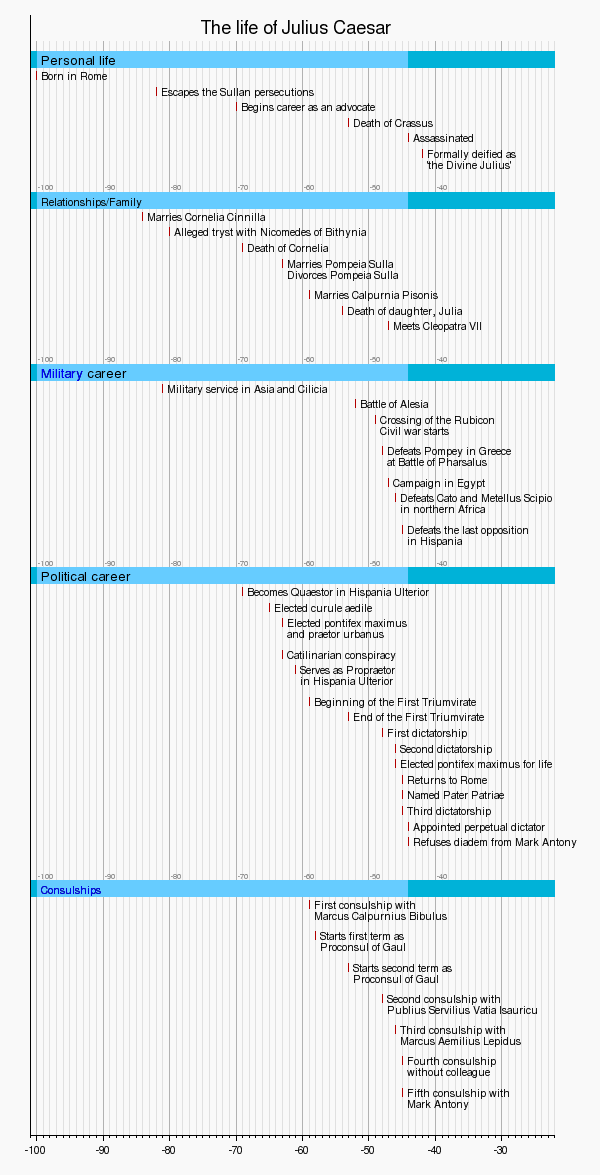
Honours
Was voted the title Divus, or "god," after his
death. During his life,
he received many honours, including titles such as
Pater Patriae (Father of the Fatherland), Pontifex
Maximus (Highest Priest), and Dictator. The many
titles bestowed on him by the Senate are sometimes
cited as a cause of his assassination, as it seemed
inappropriate to many contemporaries for a mortal
man to be awarded so many honours.
As a young man he was awarded the Corona Civica
(civic crown) for valor while fighting in Asia
minor. Perhaps the most
significant title he carried was his name from
birth: Caesar. This name would be awarded to every
Roman emperor, and it became a signal of great power
and authority far beyond the bounds of the empire.
The title became the German Kaiser and Slavic
Tsar/Czar. As the last tsar in nominal power was
Simeon II of Bulgaria whose reign ended in 1946; for
two thousand years after Julius Caesar's
assassination, there was at least one head of state
bearing his name.
Note, however, that Caesar was an ordinary name of
no more importance than other cognomen like Cicero
and Brutus. It did not become an Imperial title
until well after Julius Caesar's death.
Notes
- Official name after 42 BC, Imperator
Gaius Iulius Caesar Divus (Latin script:
GAIVS IVLIVS CAESAR) (in inscriptions
IMP•C•IVLIVS•CAESAR•DIVVS), in English,
"Imperator Gaius Julius Caesar, the deified
one". Also in inscriptions, Gaius Iulius
Gaii Filius Gaii Nepos Caesar, in English,
"Gaius Julius Caesar, son of Gaius, grandson
of Gaius".
- Suetonius, Lives of the Twelve Caesars:
Julius 6; Velleius Paterculus, Roman History
2.41; Virgil, Aeneid
- Pliny the Elder, Natural History 7.7.
The misconception that Julius Caesar himself
was born by Caesarian section dates back at
least to the 10th century (Suda kappa 1199).
However, he wasn't the first to bear the
name, and in his time the procedure was only
performed on dead women, while Caesar's
mother, Aurelia, lived long after he was
born.
- Historia Augusta: Aelius 2.
- Suetonius, Julius 1; Plutarch, Caesar 1,
Marius 6; Pliny the Elder, Natural History
7.54; Inscriptiones Italiae, 13.3.51-52
- a b Suetonius, Julius 46
- Suetonius, Lives of Eminent Grammarians
7
- a b Plutarch, Caesar 1; Suetonius,
Julius 1
- Appian, Civil Wars 1.34-75; Plutarch,
Marius 32-46, Sulla 6-10; Velleius
Paterculus, Roman History 2.15-20; Eutropius
5; Florus, Epitome of Roman History 2.6, 2.9
- Suetonius, Julius 1; Pliny the Elder,
Natural History 7.54
- Velleius Paterculus, Roman History 2.22;
Florus, Epitome of Roman History 2.9
- Suetonius, Julius 1; Plutarch, Caesar 1;
Velleius Paterculus, Roman History 2.41
- Appian, Civil Wars 1.76-102; Plutarch,
Sulla 24-33; Velleius Paterculus, Roman
History 2.23-28; Eutropius, Abridgement of
Roman History 5; Florus, Epitome of Roman
History 2.9
- William Smith, A Dictionary of Greek and
Roman Antiquities: Flamen
- Suetonius, Julius 2-3; Plutarch, Caesar
2-3; Cassius Dio, Roman History 43.20
- Appian. Civil Wars 1.103
- Suetonius, Julius 77.
- Plutarch, Sulla 36-38
- Suetonius, Julius 3; Appian, Civil Wars
1.107
- Suetonius, Julius 55
- Suetonius, Julius 4. Plutarch (Caesar
3-4) reports the same events but follows a
different chonology.
- Again, according to Suetonius's
chronology (Julius 4). Plutarch (Caesar
1.8-2) says this happened earlier, on his
return from Nicomedes's court. Velleius
Paterculus (Roman History 2:41.3-42 says
merely that it happened when he was a young
man.
- Plutarch, Caesar 1-2
- Suetonius, Julius 5-8; Plutarch, Caesar
5; Velleius Paterculus, Roman History 2.43
- Suetonius, Julius 9-11; Plutarch, Caesar
5.6-6; Cassius Dio, Roman History 37.8, 10
- Cicero, For Gaius Rabirius; Cassius Dio,
Roman History 26-28
- Velleius Paterculus, Roman History 2.43;
Plutarch, Caesar 7; Suetonius, Julius 13
- Sallust, Catiline War 49
- Cicero, Against Catiline 4.7-9; Sallust,
Catiline War 50-55; Plutarch, Caesar
7.5-8.3, Cicero 20-21, Cato the Younger
22-24; Suetonius, Julius 14
- Suetonius, Julius 16
- Suetonius, Julius 17
- Cicero, Letters to Atticus 1.12, 1.13,
1.14; Plutarch, Caesar 9-10; Cassius Dio,
Roman History 37.45
- Plutarch, Caesar 11-12; Suetonius,
Julius 18.1
- Plutarch, Julius 13; Suetonius, Julius
18.2
- Plutarch, Caesar 13-14; Suetonius 19
- Cicero, Letters to Atticus 2.1, 2.3,
2.17; Velleius Paterculus, Roman History
2.44; Plutarch, Caesar 13-14, Pompey 47,
Crassus 14; Suetonius, Julius 19.2; Cassius
Dio, Roman History 37.54-58
- Suetonius, Julius 21
- Cicero, Letters to Atticus 2.15, 2.16,
2.17, 2.18, 2.19, 2.20, 2.21; Velleius
Paterculus, Roman History 44.4; Plutarch,
Caesar 14, Pompey 47-48, Cato the Younger
32-33; Cassius Dio, Roman History 38.1-8
- Suetonius, Julius 19.2
- Velleius Paterculus, Roman History
2:44.4; Plutarch, Caesar 14.10, Crassus
14.3, Pompey 48, Cato the Younger 33.3;
Suetonius, Julius 22; Cassius Dio, Roman
History 38:8.5
- Suetonius, Julius 23
- See Cicero's speeches against Verres for
an example of a former provincial governor
successfully prosecuted for illegally
enriching himself at his province's expense.
- Cicero, Letters to Atticus 1.19; Julius
Caesar, Commentaries on the Gallic War Book
1; Appian, Gallic Wars Epit. 3; Cassius Dio,
Roman History 38.31-50
- Woolf Greg (2006), Et Tu Brute? - The
Murder of Caesar and Political
Assassination, 199 pages - ISBN
1-8619-7741-7
- Suetonius, Julius 82.2
- Suetonius, Life of the Caesars, Julius
trans. J C Rolfe [1]
- Plutarch, Caesar 66.9
- Hughes J (2004). "Dictator Perpetuus:
Julius Caesar--did he have seizures? If so,
what was the etiology?". Epilepsy Behav 5
(5): 756-64. PMID 15380131.
- Gomez J, Kotler J, Long J (1995). "Was
Julius Caesar's epilepsy due to a brain
tumor?". The Journal of the Florida Medical
Association 82 (3): 199-201. PMID 7738524.
- H. Schneble (2003-01-01). Gaius Julius
Caesar. German Epilepsy Museum. Retrieved on
2006-08-10.
- Cicero, Brutus, 252.
- Note that the first name, like the
second, is properly pronounced in three
syllables, not two. See Latin spelling and
pronunciation.
- Anderson, Carl Edlund. (1999). Formation
and Resolution of Ideological Contrast in
the Early History of Scandinavia. Ph.D.
thesis, University of Cambridge, Department
of Anglo-Saxon, Norse & Celtic (Faculty of
English). p. 44.PDF (308 KiB)
- Tacitus, Histories 4.55
- Suetonius, Julius 49
- Suetonius, Julius 49; Cassius Dio, Roman
History 43.20
- Catullus, Carmina 29, 57
- Suetonius, Julius 73
- Suetonius, Augustus 68, 71
References
Primary sources
- Caesar's own writings
- Forum Romanum Index to Caesar's
works online in Latin and translation
- Collected works of Caesar in Latin,
Italian and English
- Caesar and contemporaries on the
civil wars
- omnia munda mundis Hypertext of
Caesar's De Bello Gallico
- Works by Julius Caesar at Project
Gutenberg
- Ancient historians' writings
- Suetonius: The Life of Julius
Caesar. (Latin and English,
cross-linked: the English translation by
J. C. Rolfe.)
- Suetonius: The Life of Julius Caesar
(J. C. Rolfe English translation,
modified)
- Plutarch: The Life of Julius Caesar
(English translation)
- Plutarch: The Life of Mark Antony
(English translation)
- Plutarch on Antony (English
translation, Dryden edition).
- Cassius Dio, Books 37–44 (English
translation)
- Appian, Book 13 (English
translation)
Secondary
sources
- Canfora, Luciano. Julius Caesar:
The People's Dictator. Edinburgh:
Edinburgh University Press, 2006
(hardcover, ISBN 0748619364;
paperback, ISBN 0748619372).
Berkeley: University of California
Press, 2007 (hardcover, ISBN
0520235029).
- Goldsworthy, Adrian. Caesar:
Life of a Colossus. New Heaven, CT;
London: Yale University Press, 2006
(hardcover, ISBN 0-300-12048-6).
- Jiménez, Ramon L. Caesar Against
Rome: The Great Roman Civil War.
Westpoint, CT: Praeger Publishers,
2000 (hardcover, ISBN
0-275-96620-8).
- Kleiner, Diana E. E. Cleopatra
and Rome. Cambridge, Massachusetts
and London, England: The Belknap
Press of Harvard University Press,
2005 (hardcover, ISBN
0-674-01905-9).
- Meier, Christian. Caesar: A
Biography. New York: Basic Books,
1996 (hardcover, ISBN
0-465-00894-1); 1997 (paperback,
ISBN 0-465-00895-X).
- Niel, Thomas (2005). Rome and
Its Legends. New York, NY: Simon and
Shuster.
|