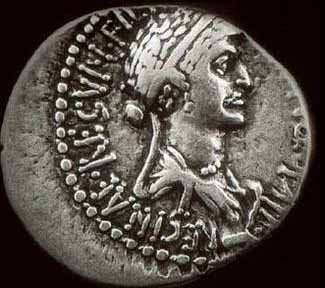
 Cleopatra
VII Thea Philopator (in Greek, Κλεοπάτρα Φιλοπάτωρ;
January 69 BC–November 30, 30 BC) was a Hellenistic
co-ruler of Egypt with her father (Ptolemy XII
Auletes) and later with her brothers/husbands
Ptolemy XIII and Ptolemy XIV. She later became the
supreme ruler of Egypt, consummated a liaison with
Gaius Julius Caesar, that solidified her grip on the
throne, and, after Caesar's assassination, aligned
with Mark Antony, with whom she produced twins. In
all, Cleopatra had four children, one by Caesar
(Caesarion) and three by Antony (Cleopatra Selene
II, Alexander Helios, Ptolemy Philadelphus). Her
unions with her brothers produced no children: it is
possible that they were never consummated; in any
case, they were not close. Her reign marks the final
end of the Hellenistic Era and the beginning of the
Roman Era in the eastern Mediterranean. She was the
last Pharaoh of Ancient Egypt (her son by Julius
Caesar, Caesarion, ruled in name only before
Augustus had him executed). Cleopatra
VII Thea Philopator (in Greek, Κλεοπάτρα Φιλοπάτωρ;
January 69 BC–November 30, 30 BC) was a Hellenistic
co-ruler of Egypt with her father (Ptolemy XII
Auletes) and later with her brothers/husbands
Ptolemy XIII and Ptolemy XIV. She later became the
supreme ruler of Egypt, consummated a liaison with
Gaius Julius Caesar, that solidified her grip on the
throne, and, after Caesar's assassination, aligned
with Mark Antony, with whom she produced twins. In
all, Cleopatra had four children, one by Caesar
(Caesarion) and three by Antony (Cleopatra Selene
II, Alexander Helios, Ptolemy Philadelphus). Her
unions with her brothers produced no children: it is
possible that they were never consummated; in any
case, they were not close. Her reign marks the final
end of the Hellenistic Era and the beginning of the
Roman Era in the eastern Mediterranean. She was the
last Pharaoh of Ancient Egypt (her son by Julius
Caesar, Caesarion, ruled in name only before
Augustus had him executed).
After Antony's rival and Caesar's legal heir, Gaius
Julius Caesar Octavian (who later became the first
Roman Emperor, Augustus), brought the might of Rome
against Egypt, it is said that Cleopatra took her
own life on November 30, 30 BC, allegedly by means
of an asp. Her legacy survives in the form of
numerous dramatizations of her story, including
William Shakespeare's Antony and Cleopatra, several
modern films and the HBO series Rome.
Cleopatra was a direct descendant of Alexander's
general, Ptolemy I Soter, son of Arsinoe and Lacus,
both of Macedon. A Greek by language and culture,
Cleopatra is reputed to have been the first member
of her family in their 300-year reign in Egypt to
have learned the Egyptian language.
Early years
Childhood
Cleopatra is an Ancient Macedonian name, frequently
used in Macedonia in the time of Philip II of
Macedon, and was born by several members of the
Hellenistic dynasties; hence the number, a modern
device to distinguish her from other Ptolemaic
Cleopatras. She was the third daughter of the king
Ptolemy XII Auletes, probably also of her father's
sister. Her nickname means "Loving her Father."
Little is known about Cleopatra's childhood, but she
would have observed the disordered events and loss
of public affection for the Ptolemaic dynasty under
the reign of her father. It is said that her father
survived two assassination attempts when a servant
found a deadly puff adder in his bed, and a servant
who tasted his wine died afterward. Her eldest
sister Tryphaena also tried to poison her, so she
began using food-tasting servants. This disloyalty
occurred for many reasons, including the physical
and moral degeneration of the sovereigns,
centralization of power and corruption. This led to
uprising in and loss of Cyprus and of Cyrenaica,
making Ptolemy's reign one of the most calamitous of
the dynasty. When Ptolemy made a journey to Rome
with Cleopatra, Tryphaena seized the Crown of Egypt.
Shortly after arrangements for a Roman assistance in
Egypt, Ptolemy's followers assassinated Tryphaena
and killed her guard. Berenice's guards in turn
killed those followers.
In 58 BC Cleopatra's older sister, Berenice IV
seized power from her father. With the assistance of
the Roman governor of Syria, Aulus Gabinius, Ptolemy
XII overturned his eldest daughter in 55 BC and had
her executed. Cleopatra's other older sister
Tryphaena took over shortly after that. She was
killed as well, which left Cleopatra with her
husband and younger brother, Ptolemy XIII, joint
heirs to the throne.
Accession to the throne
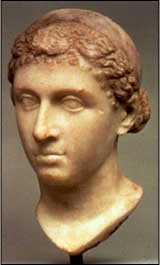 Ptolemy
XII died in March 51 BC,making the 18-year-old
Cleopatra and the 12-year-old Ptolemy XIII joint
monarchs. The first three years of their reign were
difficult, due to economic difficulties, famine,
deficient floods of the Nile, and political
conflicts. Although Cleopatra was married to her
young brother, she quickly showed indications that
she had no intentions of sharing power with him. Ptolemy
XII died in March 51 BC,making the 18-year-old
Cleopatra and the 12-year-old Ptolemy XIII joint
monarchs. The first three years of their reign were
difficult, due to economic difficulties, famine,
deficient floods of the Nile, and political
conflicts. Although Cleopatra was married to her
young brother, she quickly showed indications that
she had no intentions of sharing power with him.
In August 51 BC, relations between the sovereigns
completely broke down. Cleopatra dropped Ptolemy's
name from official documents and her face appeared
alone on coins, which went against Ptolemaic
tradition of female rulers being subordinate to male
co-rulers. This resulted in a cabal of courtiers,
led by the eunuch Pothinus, removing Cleopatra from
power and making Ptolemy sole ruler in circa 48 BC
(or possibly earlier, as a decree exists from 51 BC
with Ptolemy's name alone). She tried to raise a
rebellion around Pelusium, but she was soon forced
to flee Egypt with her only surviving sister,
Arsinoë.[1]
Cleopatra and Julius Caesar
Assassination of Pompey
While Cleopatra was in exile, Ptolemy became
embroiled in the Roman civil war. In the autumn of
48 BC, Pompey fled from the forces of Julius Caesar
to Alexandria, seeking sanctuary. Ptolemy, only
fifteen years old at that time, had set up a throne
for himself on the harbour from where he watched as
on July 28, 48 BC Pompey was murdered by one of his
former officers, now in Ptolemaic service. He was
beheaded in front of his wife and children, who were
on the ship he had just disembarked from. Ptolemy is
thought to have ordered the death as a way of
pleasing Julius Caesar and thus become an ally of
Rome, to which Egypt was in debt. This was a
catastrophic miscalculation on Ptolemy's part. When
Caesar arrived in Egypt two days later, Ptolemy
presented him with Pompey's severed, pickled head.
Caesar was enraged. This was probably due to the
fact that, although he was Caesar's political enemy,
Pompey was a Consul of Rome and the widower of
Caesar's only legitimate daughter, Julia (who died
in childbirth with their son). Caesar seized the
Egyptian capital and imposed himself as arbiter
between the rival claims of Ptolemy and Cleopatra.
Caesar and
Caesarion Eager to
take advantage of Julius Caesar's anger with
Ptolemy, Queen Cleopatra returned to the palace
rolled into a Persian carpet and had it presented to
Caesar by her servants: when it was unrolled,
Cleopatra tumbled out. It is believed that Caesar
was charmed by the gesture, and she became his
mistress. Nine months after their first meeting,
Cleopatra gave birth to their baby. It was at this
point Caesar abandoned his plans to annex Egypt,
instead backing Cleopatra's claim to the throne.
After a short civil war, Ptolemy XIII was drowned in
the Nile and Caesar restored Cleopatra to her
throne, with another younger brother Ptolemy XIV as
new co-ruler. Despite
the thirty year age difference, Cleopatra and Caesar
became lovers during his stay in Egypt between 48 BC
and 47 BC.They met when they were 21(Cleopatra) and
50 (Caesar) On 23 June 47 BC Cleopatra gave birth to
a child, Ptolemy Caesar (nicknamed "Caesarion" which
means "little Caesar"). Cleopatra claimed Caesar was
the father and wished him to name the boy his heir,
but Caesar refused, choosing his grand-nephew
Octavian instead. Caesarion was the intended
inheritor of Egypt and Rome, uniting the East and
the West. Cleopatra
and Caesarion visited Rome between 47 BC and 44 BC
and were probably present when Caesar was
assassinated on 15 March 44 BC. Before or just after
the assassination she returned to Egypt. When
Ptolemy XIV died due to deteriorating health,
Cleopatra made Caesarion her co-regent and
successor. To safeguard herself and Caesarion she
also had her sister Arsinoe killed, a common and
necessary practice of the times.
Cleopatra and Mark
Antony In 42 BC,
Mark Antony, one of the triumvirs who ruled Rome in
the power vacuum following Caesar's death, summoned
Cleopatra to meet him in Tarsus to answer questions
about her loyalty. Cleopatra arrived in great state,
and so charmed Antony that he chose to spend the
winter of 41 BC–40 BC with her in Alexandria. On 25
December 40 BC she gave birth to twins, who were
named Alexander Helios and Cleopatra Selene II.
Four years later, in 37 BC, Antony visited
Alexandria again en route to make war with the
Parthians. He renewed his relationship with
Cleopatra, and from this point on Alexandria would
be his home. He married Cleopatra according to the
Egyptian rite (a letter quoted in Suetonius suggests
this), although he was at the time married to
Octavia Minor, sister of his fellow triumvir
Octavian. He and Cleopatra had another child,
Ptolemy Philadelphus.
At the Donations of Alexandria in late 34 BC,
following Antony's conquest of Armenia, Cleopatra
and Caesarion were crowned co-rulers of Egypt and
Cyprus; Alexander Helios was crowned ruler of
Armenia, Media, and Parthia; Cleopatra Selene II was
crowned ruler of Cyrenaica and Libya; and Ptolemy
Philadelphus was crowned ruler of Phoenicia, Syria,
and Cilicia. Cleopatra also took the title of Queen
of Kings. Antony's
behavior was considered outrageous by the Romans,
and Octavian convinced the Senate to levy war
against Egypt. In 31 BC Antony's forces faced the
Romans in a naval action off the coast of Actium.
Cleopatra was present with a fleet of her own.
Popular legend tells us that when she saw that
Antony's poorly equipped and manned ships were
losing to the Romans' superior vessels, she took
flight and that Antony abandoned the battle to
follow her, but no contemporary evidence states this
was the case.
Following the Battle of Actium, Octavian invaded
Egypt. As he approached Alexandria, Antony's armies
deserted to Octavian on August 12, 30 BC
There are a number of unverifiable but famous
stories about Cleopatra, of which one of the best
known is that, at one of the lavish dinners she
shared with Antony, she playfully bet him that she
could spend ten million sesterces on a dinner. He
accepted the bet. The next night, she had a
conventional, unspectacular meal served; he was
ridiculing this, when she ordered the second course
— only a cup of strong vinegar. She then removed one
of her priceless pearl earrings, dropped it into the
vinegar, allowed it to dissolve, and drank the
mixture. The earliest report of this story comes
from Pliny the Elder and dates to about 100 years
after the banquet described would have happened. The
calcium carbonate in pearls does dissolve in
vinegar, but slowly unless the pearl is first
crushed.[2]
Suicide The
Death of Cleopatra by Reginald ArthurAntony
committed suicide, having been told Cleopatra was
dead. According to the doctor Olympus (an
eye-witness), he was brought to Cleopatra's tomb and
died in her arms. A few days later, on November 30,
Cleopatra also died by snakebite. The ancient
sources generally agree that she had two asps hidden
in a fig basket so as she was eating she would never
know when she would die. Her two handmaidens died
with her. Octavian, waiting in a building nearby,
was informed of her death, and went to see for
himself.[3] Cleopatra's
son by Caesar, Caesarion, was proclaimed pharaoh by
Egyptians, but Octavian had already won. Caesarion
was captured and executed, his fate reportedly
sealed by Octavian's famous phrase: "Two Caesars are
one too many." This ended not just the Hellenistic
line of Egyptian pharaohs, but the line of all
Egyptian pharaohs. The three children of Cleopatra
and Antony were spared and taken back to Rome where
they were taken care of by Antony's wife, Octavia
Minor, who was also Octavian's sister. |