Cyrus (Old Persian Kuruš; Hebrew Kores): founder of
the Achaemenid empire. He was born about 600 BCE as
the son of Cambyses I, the king of the Persian
kingdom called Anšan. During Cambyses' reign, the
Persians were vassals of the Median leader Astyages.
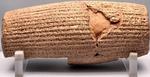 Cyrus' cylinder
(British
Museum, London)
Cyrus' cylinder
(British
Museum, London)
Expressions like 'king of the Persian kingdom' and
'the Median kingdom' are a bit misleading. The Medes
and the Persians were coalitions of Iranian nomad
tribes; in the fifth century, this was still
remembered and the Greek researcher Herodotus of
Halicarnassus wrote:
The achievement of Deioces
[...] was to unite under his rules the peoples
of Media - Busae, Parataceni, Struchates,
Arizanti, Budii, Magi.
The Persian nation contains a
number of tribes [...]: the Pasargadae,
Maraphii, and Maspii, upon which all the other
tribes are dependent. Of these, the Pasargadae
are the most distinguished; they contain the
clan of the Achaemenids from which spring the
Perseid kings. Other tribes are the Panthialaei,
Derusiaei, Germanii, all of which are attached
to the soil, the remainder -the Dai, Mardi,
Dropici, Sagarti, being nomadic.
[Herodotus, Histories 1.101 &
125;
tr. Aubrey de Selincourt]
These 'kingdoms' were in fact losely organized
tribal coalitions. In the first half of the sixth
cenctury, the Median federation was the most
powerful and was able to demand tribute from the
Persians, but also from the Armenians, Parthians,
Drangians and Arians.
Cyrus became king of Anšan in 559, and formed a new
coalition of his own tribe, the Pasargadae, together
with the Maraphii, Maspii, Panthialaei, Derusiaei,
Germanii, Dahae, Mardi, Dropici and Sagarti. They
revolted in 550 (or 554/553 according to another
chronology). The
Median king Astyages sent an army to Anšan. It was
commanded by Harpagus, but he defected to the
Persians. Astyages was captured and Cyrus became the
new ruler of the empire of Persians and Medes.
According to the Greek topographer Strabo of Amasia,
who lived more than five centuries later, Cyrus'
victory took place among the Pasargadae, where Cyrus
built his residence. From now on, this tribal name
became the name of a city.
According to Herodotus, Cyrus' father Cambyses had
been married to Astyages' daughter Mandane. This
would explain why the Medes accepted Cyrus' rule; he
was one of them. Intertribal marriages were common,
but it is also possible that the story of Cambyses'
Median marriage was invented to justify Cyrus' rule.
The Greek historian Ctesias of Cnidus writes that
Cyrus also married a daughter of Astyages. If both
authors are right, this woman must have been Cyrus'
aunt. Cyrus seems to
have united Persia and Media in a personal union; it
was, therefore, a dual monarchy. Taking over the
loosely organized Median empire also implied taking
over several subject countries: Armenia, Cappadocia,
Parthia, Drangiana, Aria. They were probably ruled
by vassal kings called satraps. It is plausible that
Elam was an early addition. In 547 (or a bit later),
Cyrus added Lydia to his possessions, a state that
had among its vassals the Greek and Carian towns in
the west and southwest of what is now Turkey. A part
of the population appears to have been deported to
Nippur in Babylonia, where a community of Lydians is
recorded in the Murašu Archive.
According to Herodotus, Cyrus left Lydia and 'his
mind was on Babylon and the Bactrians and the Sacae
and the Egyptians' (Histories 1.154). It is certain
that Cyrus never invaded Egypt, which was left to
his son and successor Cambyses. However, it is
possible that he added Cilicia to his dominions,
making the local ruler (the Syennesis) a vassal
king. Babylonian sources do not mention imported
Cilician iron after 545 - which may be signicant.
It is very plausible
that Cyrus did indeed, ad Herodotus suggests,
conquer Bactria, although there is no independent
confirmation of this. What we do know for certain is
that eight years after the conquest of Lydia, the
Persian king took Babylon and captured its king
Nabonidus (October 539). The Babylonian Empire had
been large, and Cyrus now became ruler of Syria and
Palestine as well. He allowed the Jews, who were
exiled to Babylon, to return home. This may have
been an attempt to fortify the empire's western
border against possible Egyptian attacks.
The second century Greek-Roman author Arrian of
Nicomedia tells us in his book about Alexander the
Great (the Anabasis) that Cyrus founded a frontier
town in Sogdia; there is no reason to doubt this
statement. The Greeks called this town Cyropolis
('town of Cyrus') or Cyreschata (a pun on the name
of the king and the word 'far away'); both names
seem renderings of Kurushkatha, 'town of Cyrus'. The
Sacae (or Scythians) lived between Bactria and
Cyreschata, and there is nothing implausible in
Herodotus' words that Cyrus subdued these tribes.
Another story by Arrian deals with Cyrus' expedition
to India (text); probably, this story is also
accurate, but we cannot be completely certain. If he
did invade India, he had to control Gandara first,
and it is certain that Cyrus managed to seize this
country: in the Behistun inscription, it is
mentioned in the list of countries that king Darius
the Great inherited from earlier Persian kings.
However, it seems equally certain that Cyrus did not
conquer the Indus valley itself, because India is
not mentioned in the Behistun inscription. Maybe his
navy conquered Maka during this campaign.
Cyrus' latest expedition took him to modern
Khazakhstan, where he fought against a nomadic tribe
called Massagetes. The news of his death in battle
reached Babylon in December 530, where letters were
dated 'first year of the reign of king Cambyses',
because Cyrus had appointed his son Cambyses as his
successor. (The mother of Cambyses was Cassadane, a
sister of Otanes, who was to play an important role
after the death of Cambyses.)
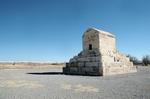
The tomb of Cyrus
Cyrus was buried near
Pasargadae, in a small building containing a gold
sarcophagus, his arms, his jewellery and a cloak.
This cloak played an important role in the Persian
inauguration rituals (see Plutarch of Chaeronea,
Life of Artaxerxes 3.1; the custom itself is
Babylonian). When Persia was subjected by the
Macedonian king Alexander the Great, many sacred
objects were taken away to prevent the coronation of
of an anarya, a foreigner; Cyrus' body was
desacrated by throwing it on the ground. Alexander
ordered restorations in January 324 BCE.
Cyrus' capital was Pasargadae, where inscriptions in
his palace state Cyrus the Great King, an
Achaemenid. They were probably written during the
reign of Darius I the Great, and it is uncertain
whether the two kings really belonged to the same
family.
Literature
The most important sources documenting the reign of
Cyrus are the contemporary Chronicle of Nabonidus
and the Cyrus cylinder. The first book of the
Histories by the Greek researcher Herodotus is also
very important, but legends and fairy tales
sometimes obscure the historical facts. The book
known as Education of Cyrus by the Athenian author
Xenophon (c.430-c.355) is a vie romancée that
contains no historical information.
- E. Badian, 'Alexander the Great between two
thrones and Heaven: variations on an old theme'
in: Alastair Small (ed.), Subject and Ruler: the
Cult of the Ruling Power in Classical Antiquity
(1996 Ann Arbor)
- Andrew R. Burn, Persia and the Greeks. The
Defence of the West, c.546-478 B.C. (1962
London) pages 36-62
- Amélie Kuhrt 'The Cyrus Cylinder and
Achaemenid Imperial Policy' in: Journal for the
Study of the Old Testament 25 (1983) 83-97.
- Max Mallowan, 'Cyrus the Great' in: Ilya
Gershevitch (ed.): The Cambridge History of
Iran, vol. II: The Median and Achaemenian
Periods, 1985 Cambridge, pages 392-419
- R.J. van der Spek, 'Did Cyrus the Great
introduce a new policy towards subdued nations?'
in: Persica 10 (1982), pages 278-283
|