(hik' ssohss) Racial name from the
Greek form of an Egyptian word meaning “rulers of foreign lands”
given to kings of the Fifteenth and Sixteenth Dynasties of Egypt.
The word, which does not appear in the Bible, was later
misinterpreted by Josephus as meaning “shepherd kings.”
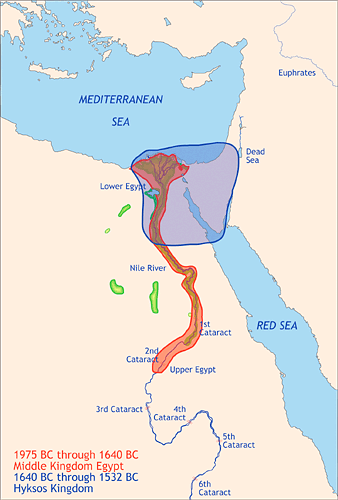
With the decline of the Middle Kingdom of Egypt (about 2000-1786 B.C.)
large numbers of Asiatics, mostly Semites like the Hebrew
patriarchs, migrated into the Nile Delta of northern Egypt from
Canaan. These probably came initially for reasons of economic
distress, such as famine, as did Abraham (Genesis 12:10). Unlike
Abraham, many groups stayed in Egypt as permanent settlers. Under
the weak Thirteenth Dynasty, some Asiatics established local
independent chiefdoms in the eastern Delta region. Eventually, one
of these local rulers managed to consolidate the rule of northern
Egypt as pharaoh, thus beginning the Fifteenth Dynasty. The
Sixteenth Dynasty, perhaps contemporary with the Fifteenth,
consisted of minor Asiatic kings. As these dynasties of pharaohs
were not ethnic Egyptians, they were remembered by the native
population as “Hyksos.”
While the Hyksos pharaohs ruled northern Egypt from Avaris in the
eastern Delta, the native Egyptian Seventeenth Dynasty ruled
southern Egypt from Thebes. This period is known as the Second
Intermediate or Hyksos Period (about 1786-1540 B.C.). The status quo
was maintained until war erupted between the Hyksos and the last two
pharaohs of the Seventeenth Dynasty. About 1540 B.C., Ahmose I
sacked Avaris and expelled the Hyksos. As the first pharaoh of a
reunited Egypt, Ahmose I established the Eighteenth Dynasty and
inaugurated the Egyptian New Kingdom or Empire.
Joseph's rise to power (Genesis 41:39-45) as pharaoh's
second-in-command would have been far more likely under a Hyksos
king. Joseph was related ethnically to the Semitic Hyksos rulers,
while the native Egyptians regarded Semites with contempt. Ahmose I
is very likely the pharaoh “who did not know Joseph” (Exodus 1:8
NRSV). If Joseph served a Hyksos pharaoh, an Egyptian king would not
have “known” of him in a political or historical sense, nor would he
have regarded him as significant in an ethnic sense.
Daniel C. Browning, Jr
 . . |
Copyright Statement
These dictionary topics are from the Holman Bible Dictionary,
published by Broadman & Holman, 1991. All rights reserved. Used by
permission of Broadman & Holman.
Bibliography Information
Butler, Trent C. Editor.. "Entry for 'HYKSOS'". "Holman Bible
Dictionary".
<http://www.studylight.org/dic/hbd/view.cgi?number=T2935>. 1991. |